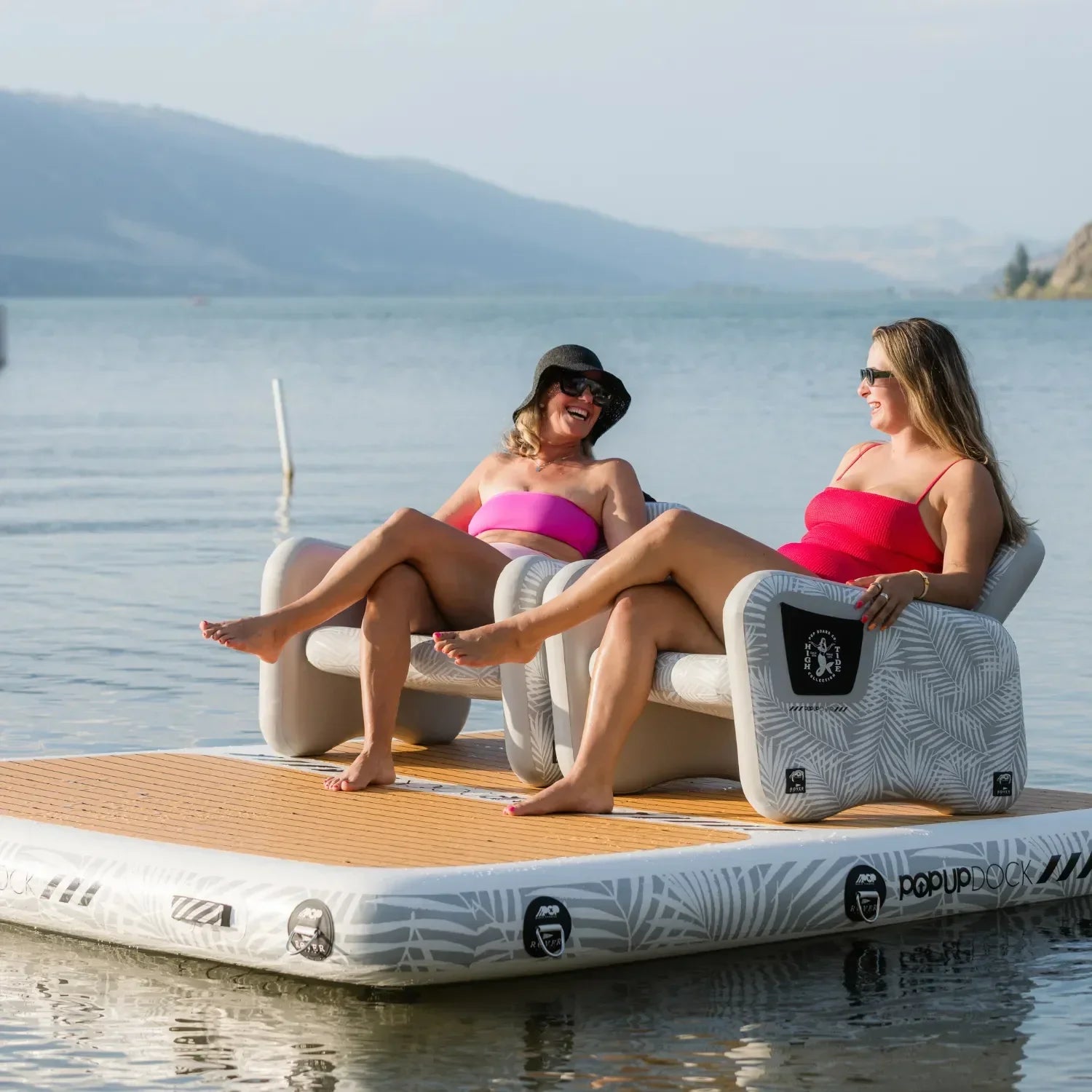
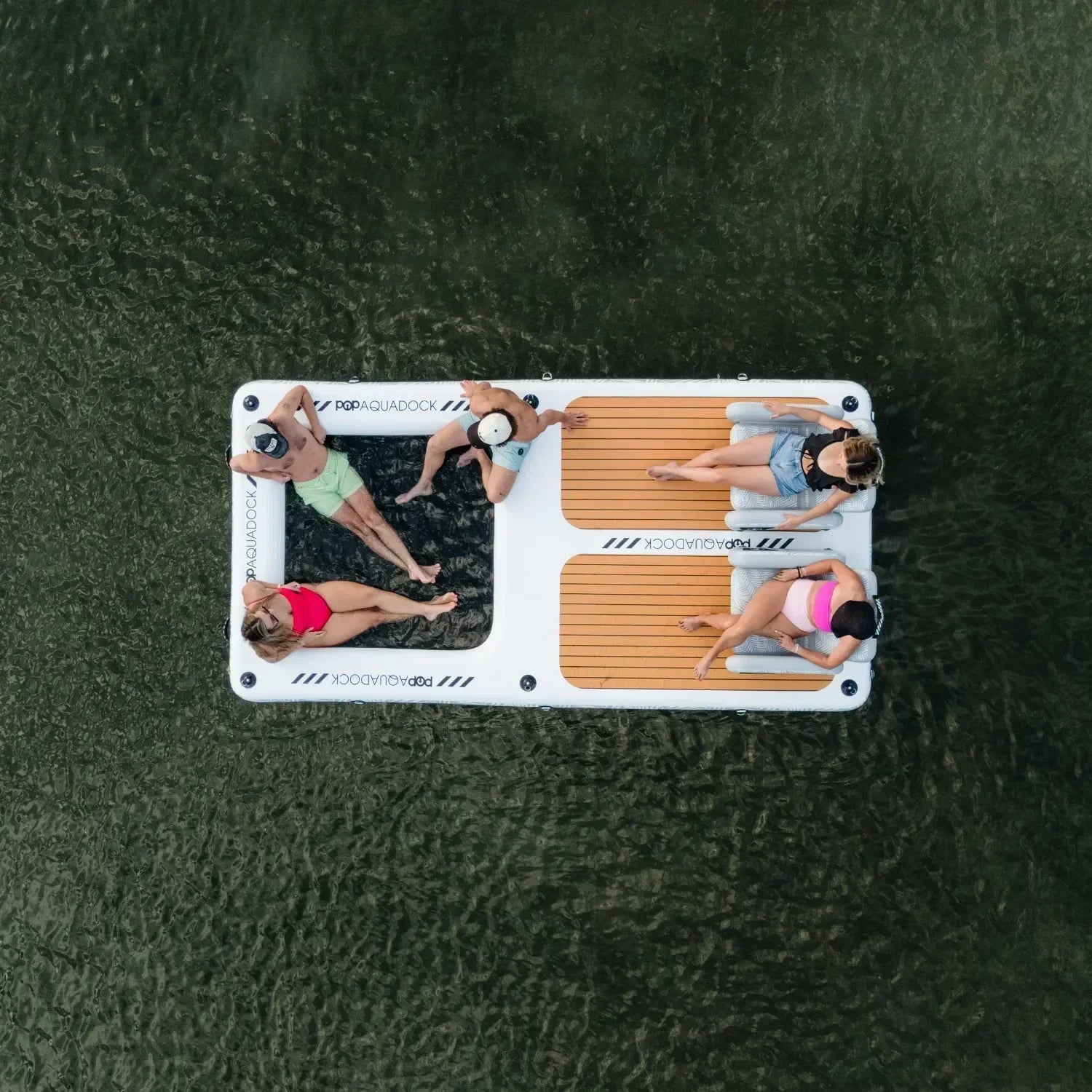
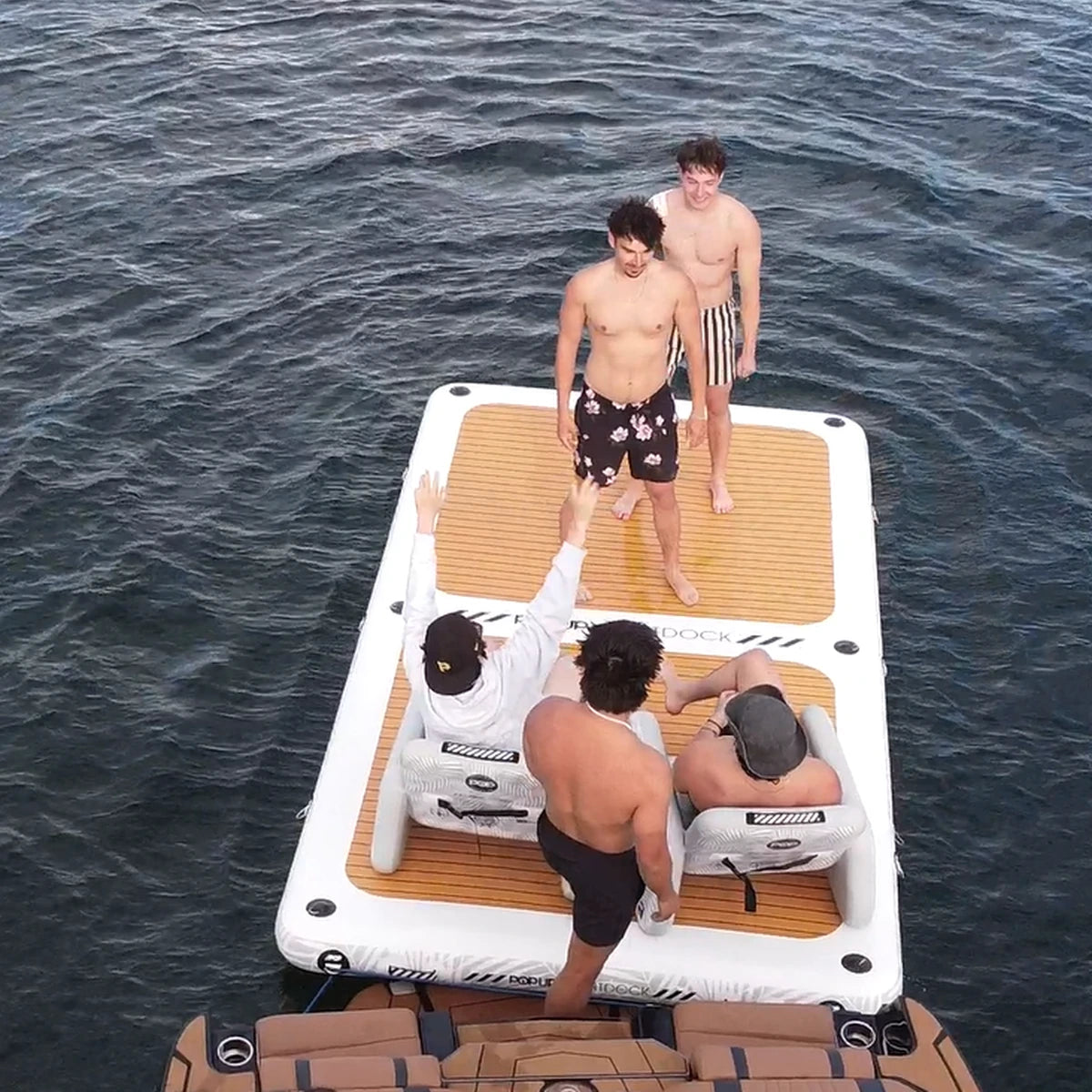
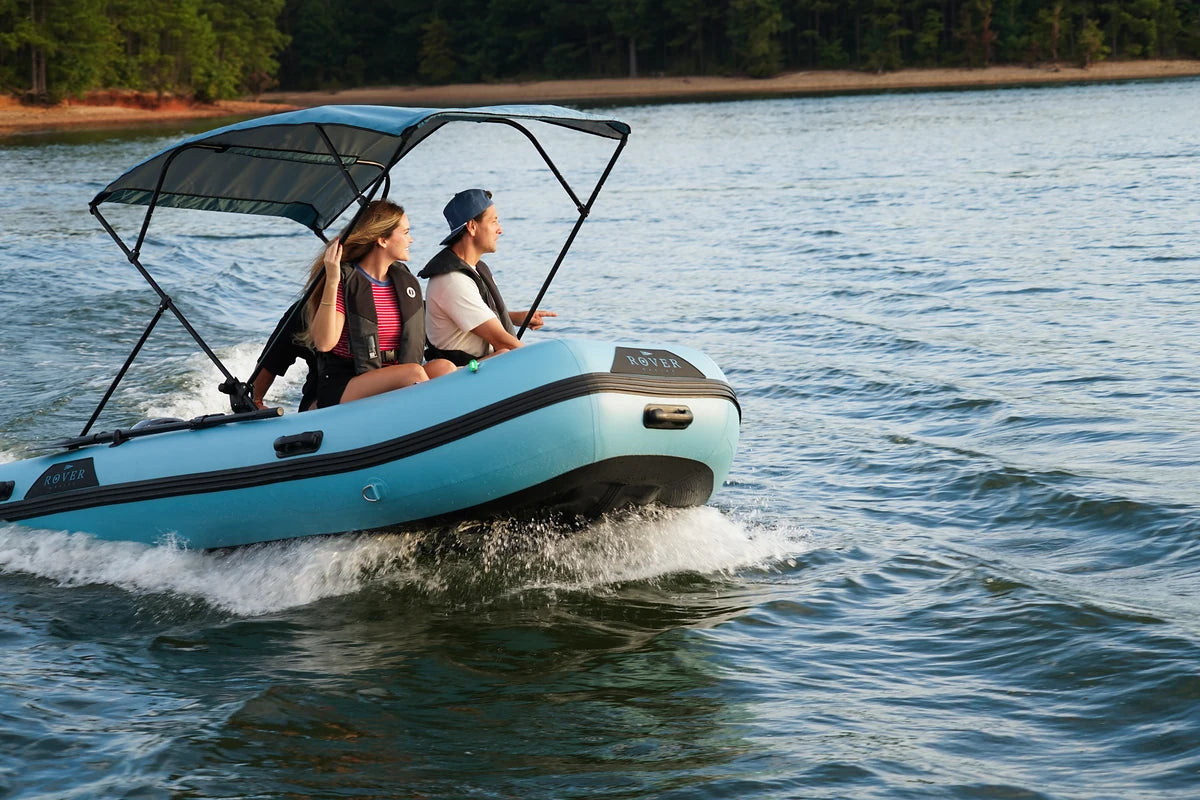
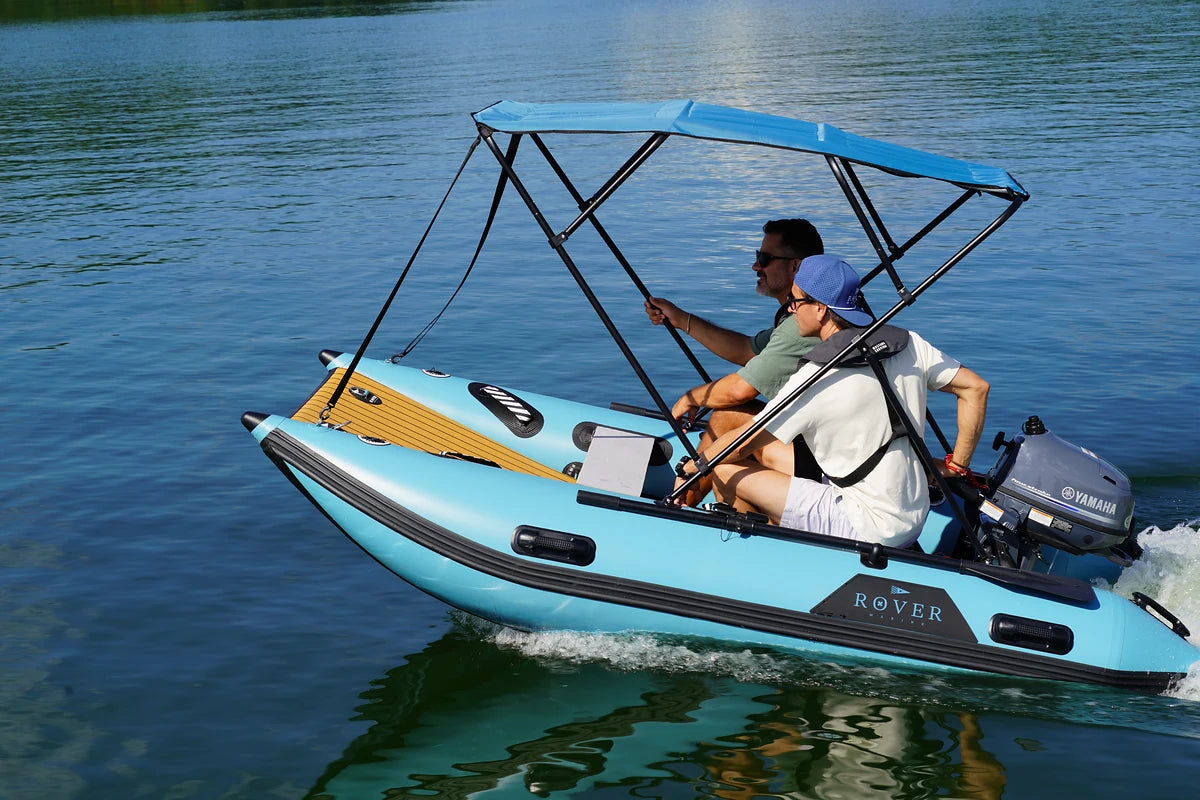
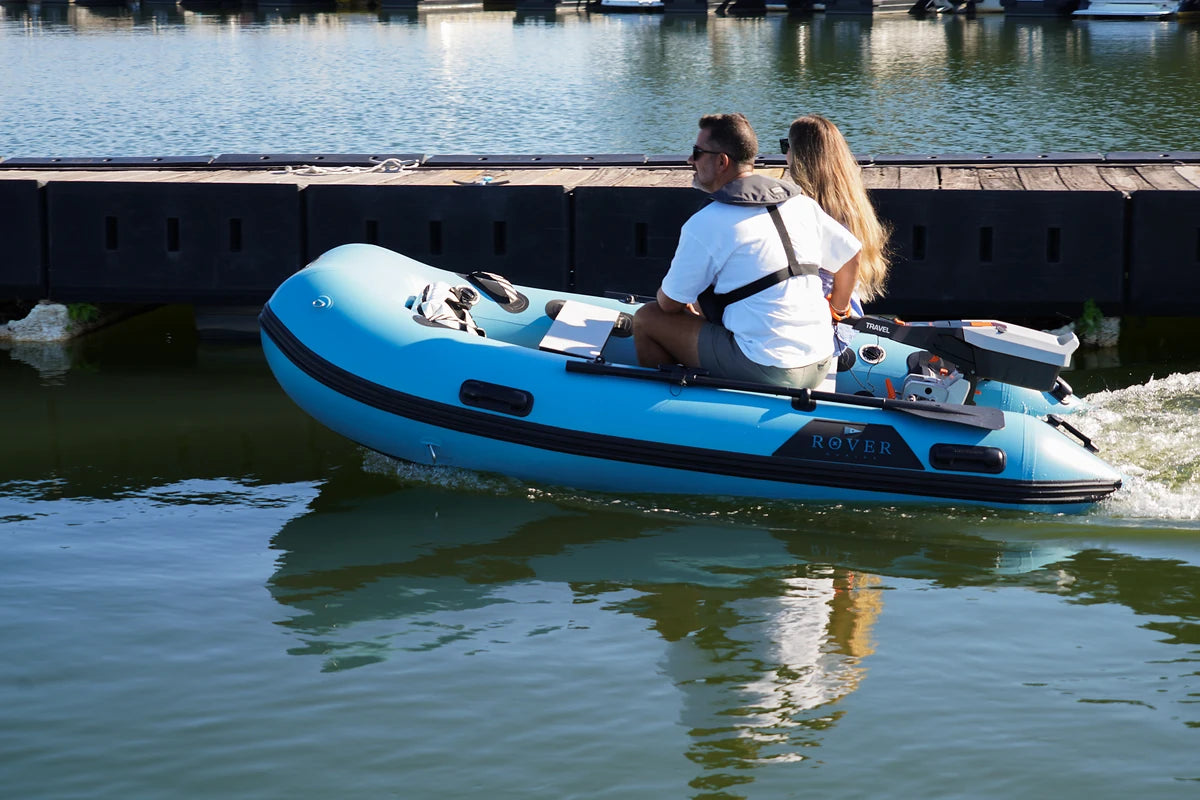
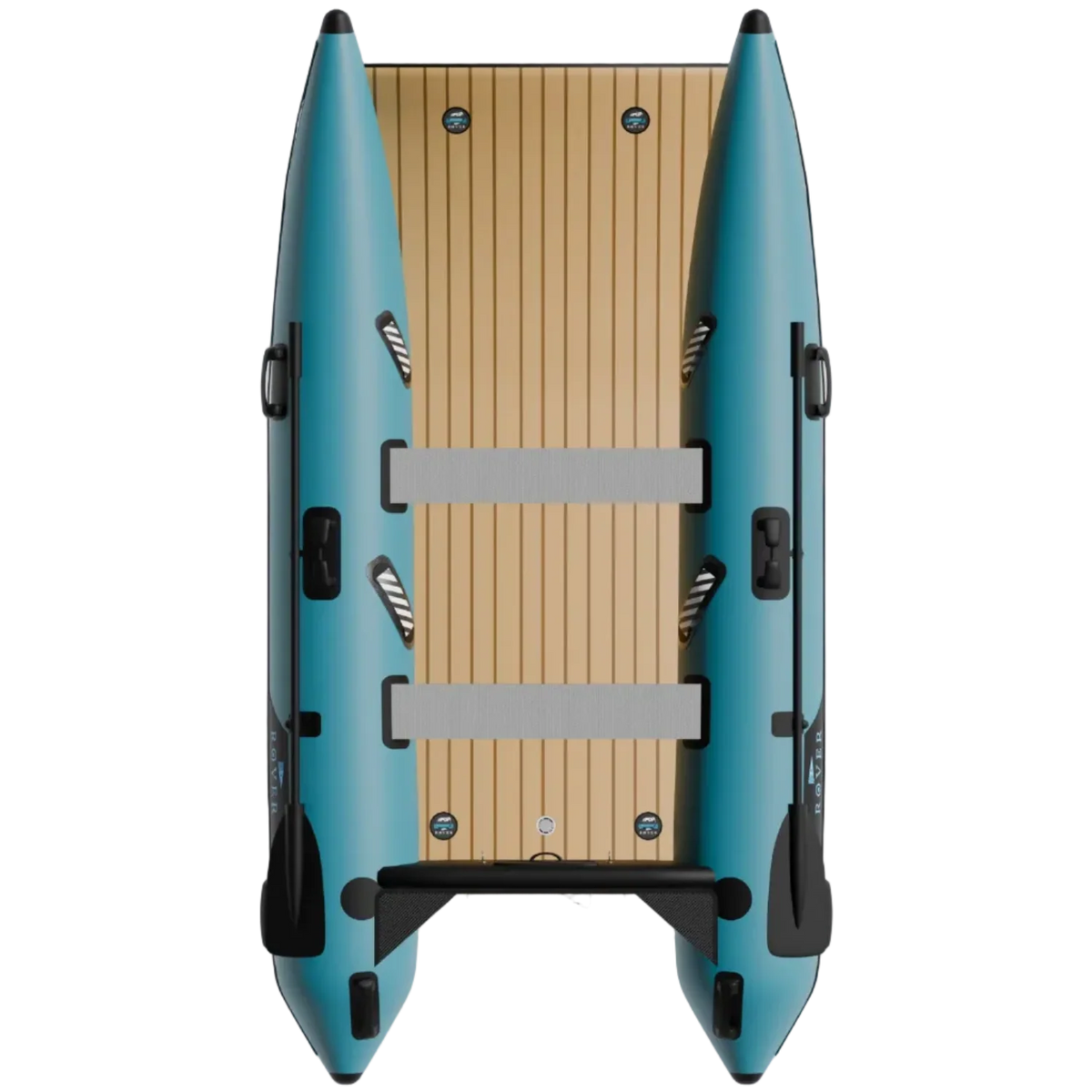
An inflatable catamaran is a boat with two air-filled pontoons joined by a rigid floor, so it sits flatter and steadier than a single-tube inflatable and packs down with no trailer. The Rover Marine Battle Cat comes in 8 ft (600 lb), 10 ft (1000 lb) and 12 ft (1200 lb). For most Canadian cottage and lake buyers, the 10 ft is the one to start with.
We sell, rig and answer the phone about these boats from our shop in Kelowna, and the same questions come up every week. What is it, how is it different from a regular inflatable, which size, which motor, and do I need a licence. This page answers all of them in one place, with links to a deeper guide for each.

What is an inflatable catamaran?
A catamaran has two hulls joined by a deck. On an inflatable catamaran those hulls are air-filled pontoons, and the deck between them is a rigid inflatable floor you can stand on.
The Rover Marine Battle Cat is built exactly like that: a twin-pontoon catamaran hull with a high-pressure drop-stitch floor topped with a teak-look pad. It comes in 8, 10 and 12 ft, and it runs a short-shaft gas or electric outboard (sold separately). In the box you get a manual pump, two aluminum paddles, bench seating and a repair kit.

Catamaran or regular inflatable boat?
A regular inflatable dinghy wraps one tube around a floor, with a pointed bow. A catamaran puts the buoyancy at the two outside edges instead. That changes how the boat feels the moment you step aboard.
| Inflatable catamaran (Battle Cat) | Single-hull inflatable dinghy | |
|---|---|---|
| Feel at rest | Flatter and steadier side to side, which you notice when someone stands up to cast or a dog shifts its weight | Steady, but the tube shape means more movement when weight moves to one side |
| Deck | Open rectangular floor between the pontoons | Floor tapers toward the bow |
| Getting in and out | Easier from a dock or swim platform with kids, pets or bags | Fine, but you step over the tube |
| Best for | Fishing, families, dogs, lounging and swimming off | Classic tender duty and the most compact stow |
Rover Marine makes both. If you are torn, our Battle Boat vs Battle Cat comparison lines them up model by model.
Who should buy one, and who should not

It is a good fit if you are:
- A cottager who wants a dock boat without a trailer, a boathouse or a marina bill.
- An angler who wants a steady, quiet platform for small lakes and calm bays. See our inflatable catamaran fishing guide.
- A boat owner who needs a tender that deflates into a locker. See using an inflatable catamaran as a cottage boat or tender.
- A family that wants room for two kids, a 70 lb dog and a cooler.
- Someone in a condo or townhouse who has to store the boat inside.
It is the wrong boat if you plan to cross big open water in the afternoon chop. On Okanagan Lake the wind often builds after lunch, and a light inflatable with a small outboard is a morning-and-evening boat on big water, not a cross-lake commuter. It is also the wrong boat if nobody in the house can help carry it: even the 8 ft weighs 84 lb, and the 12 ft weighs 130 lb.
Choosing a size: 8, 10 or 12 ft
Pick the size by who is aboard and how you will carry it, not by the biggest number. These figures come straight from the live product pages.
| Battle Cat 8 ft | Battle Cat 10 ft | Battle Cat 12 ft | |
|---|---|---|---|
| Capacity (product page) | 2 persons / 600 lb | 4 people / 1000 lb | 4 people / 1200 lb |
| Boat weight | 84 lb | 98 lb | 130 lb |
| Recommended motor (Rover Marine) | Up to 6 hp | Up to 10 hp | Up to 20 hp |
| Pleasure Craft Licence needed? | Not at the recommended power | Yes at 10 hp; no with a 9.9 hp or an electric | Yes with anything 10 hp or more |
| Who it suits | Solo or a couple, tender duty, tight storage | Two adults plus kids, a dog or a cooler | Bigger crews and heavier loads |
The 10 ft is where most cottage and lake buyers land. The 8 ft makes sense when storage or carrying is the main problem. The 12 ft is for crews and loads that genuinely need it. Our inflatable catamaran size guide walks through the decision with real loads added up.
Choosing a motor

Rover Marine recommends up to 6 hp on the 8 ft, up to 10 hp on the 10 ft and up to 20 hp on the 12 ft. Those are ceilings, not targets. Plenty of owners run far less.
Electric is the other route. We carry the ePropulsion Spirit 1.0 Plus (1 kW, listed as 3 HP equivalent) and the Torqeedo Travel S (1100 W input, also listed as 3 HP equivalent). They are quiet, there is no fuel to store at the cottage, and each one weighs about 20 kg with its battery. They will not push a loaded 12 ft like a 20 hp gas motor will, and we would rather tell you that now. Our electric outboard guide compares the two with their published range figures.
Licences and operator cards
Two different documents, and people mix them up constantly.
Pleasure Craft Licence (the boat). Transport Canada says a recreational boat needs a Pleasure Craft Licence when it has one or more engines totalling at least 10 horsepower (7.5 kW) and is mainly kept and used in Canada. So a 9.9 hp sits under the line, and a 10 hp or a 20 hp does not. There is a fee, and a new licence is valid for 5 years. Details are on Transport Canada's Pleasure Craft Licence page.
Proof of competency (the driver). Transport Canada says that if you operate a boat with a motor and use it for recreation, you need proof of competency, and that includes electric trolling motors. For most people that is a Pleasure Craft Operator Card. An electric outboard does not get you out of it.
Local lake restrictions on motors are a separate thing again, so check the rules for your lake. We go deeper in our guide to boating laws for inflatable boats in Canada.
Setting it up
Lay it out on a tarp or grass, inflate the pontoons and floor to the pressures in your Rover Marine manual, fit the seats, then mount the motor. An electric pump such as the Cachalot 2 (20 PSI maximum) saves your arms. Do your first setup in the yard, not on the beach with the family waiting. Our step-by-step setup guide covers each stage and the mistakes we see most.
Accessories worth adding
| Accessory | Why you would want it | What the product page says |
|---|---|---|
| Bimini | Shade on long July days | Available in 8, 10 and 12 ft; match it to your boat size. Folds down when not in use. |
| RH40 rod holder | Keeps rods off the pontoons | Clamp, plug-in or screw mount; fits 7/8 or 1 inch OD rails; full 360 degree rotation. |
| 3-step rope ladder | Getting back aboard after a swim | Three anti-slip steps, 34 inch length, 400+ lb capacity, snap hooks for rails, cleats or D-rings. |
| Clamp-on cup holders | Coffee at dawn, drinks at dusk | Two-pack, tool-free clamp, 360 degree adjustment. |

Everything else lives in the boating accessories collection.
Looking after it
Rinse it, dry it completely, and never roll it up wet. Store it somewhere rodents cannot get at it, which in a cottage shed is harder than it sounds. Our inflatable catamaran winter storage guide covers the off-season, and if you run electric, read how to winterize an electric outboard before the battery goes in the garage.

What backs it up
Per the Battle Cat product pages: 5 years on the hull, 3 years on the tubes and seams, and 2 years on boat accessories, with claims repaired or replaced. There is a 60-day Rider's Guarantee from delivery (unused returns get a full refund), and if another site sells the same Rover Marine boat for less, we match it. Coverage differs on other products, so check each product page or our warranty page.
What owners say
“10' Battle Cat Catamaran is well paired with ePropulsion's Spirit 1 Plus electric motor.”Nancy M., verified buyer, Battle Cat 10 ft
“What a beast of a boat! Huge tubes, and quality components.”Michael S., verified buyer, Battle Cat 12 ft
matthew duke met our crew at the Vancouver boat show, then bought a Battle Cat.
Google reviewWe are rated 4.9 stars from 178 Google reviews and Excellent (4.6) on Trustpilot.
The full inflatable catamaran series
Frequently Asked Questions
What is an inflatable catamaran?
It is a boat with two air-filled pontoons joined by a rigid inflatable floor. Putting the buoyancy at the outside edges gives a flatter, steadier feel and an open deck compared with a single-tube inflatable of the same length.
Do I need a trailer for an inflatable catamaran?
No. It deflates for transport and storage, so most owners launch from a dock or beach. Plan on carrying it: the Battle Cat weighs 84 lb (8 ft), 98 lb (10 ft) or 130 lb (12 ft).
Do I need a licence to run an inflatable catamaran in Canada?
Transport Canada requires a Pleasure Craft Licence for a recreational boat with engines totalling at least 10 horsepower (7.5 kW). Separately, anyone operating a motorized recreational boat, electric included, needs proof of competency such as a Pleasure Craft Operator Card.
What size motor does a Battle Cat need?
Rover Marine recommends up to 6 hp on the 8 ft, up to 10 hp on the 10 ft and up to 20 hp on the 12 ft. Many owners run less, including 1 kW class electric outboards.
How many people does a Battle Cat carry?
The product pages list 2 persons / 600 lb for the 8 ft, 4 people / 1000 lb for the 10 ft and 4 people / 1200 lb for the 12 ft. Count passengers, gear, motor and battery against the pound rating.
What warranty comes with the Battle Cat?
Rover Marine covers the Battle Cat for 5 years on the hull, 3 years on the tubes and seams and 2 years on boat accessories, plus a 60-day Rider's Guarantee on unused returns and a price match.
Can I use a Battle Cat in salt water?
At the time of writing, the product pages say saltwater care is still being confirmed with Rover Marine. Call us at 1-800-399-5260 before using one in salt water.
Related Canadian Board Co. guides and gear
Find the Battle Cat that fits your crew
Compare the 8, 10 and 12 ft side by side, or call 1-800-399-5260 and tell us who is going aboard and where you launch.
Shop inflatable catamarans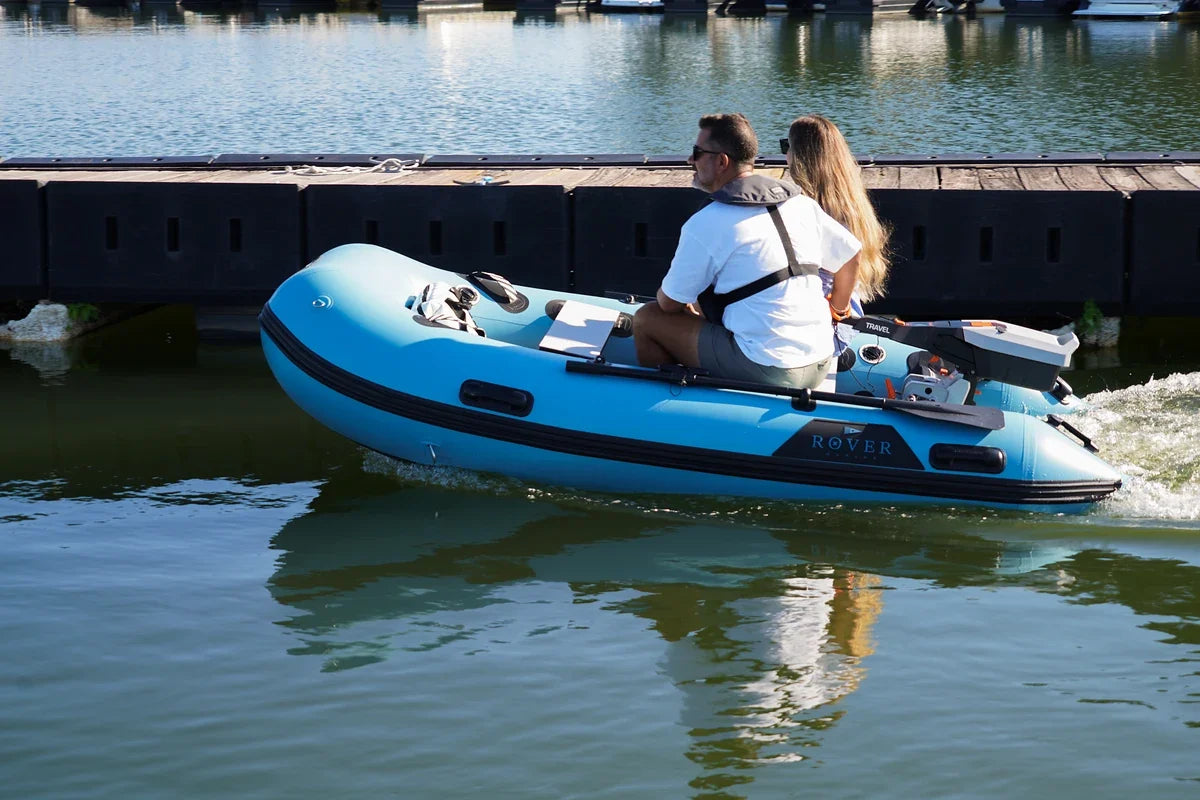

Leave a comment
All comments are moderated before being published.
This site is protected by hCaptcha and the hCaptcha Privacy Policy and Terms of Service apply.