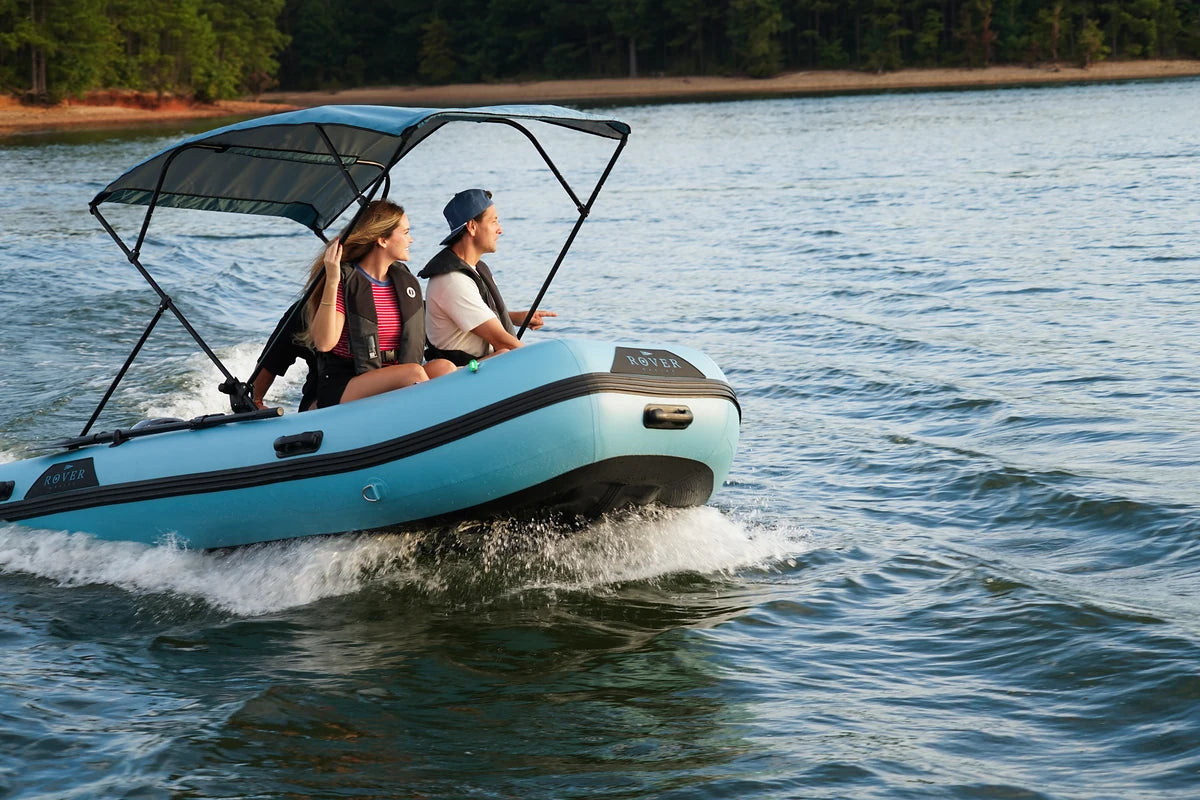
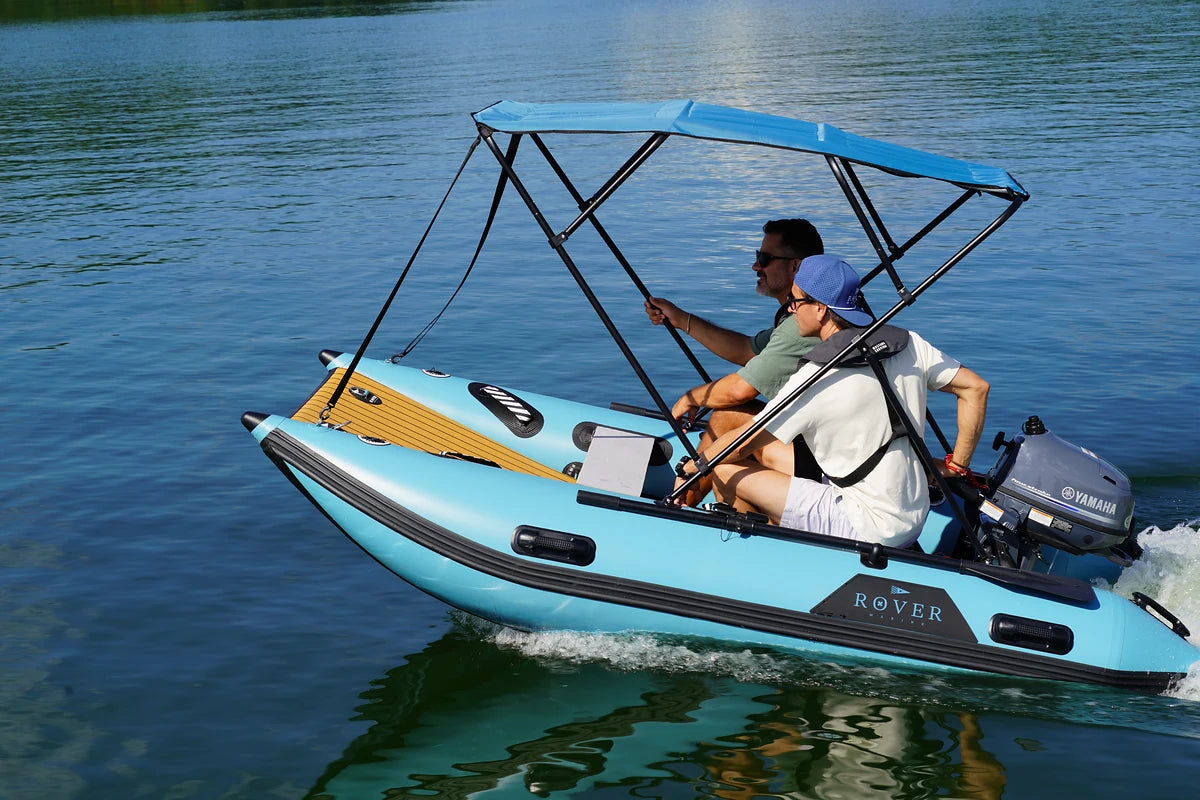
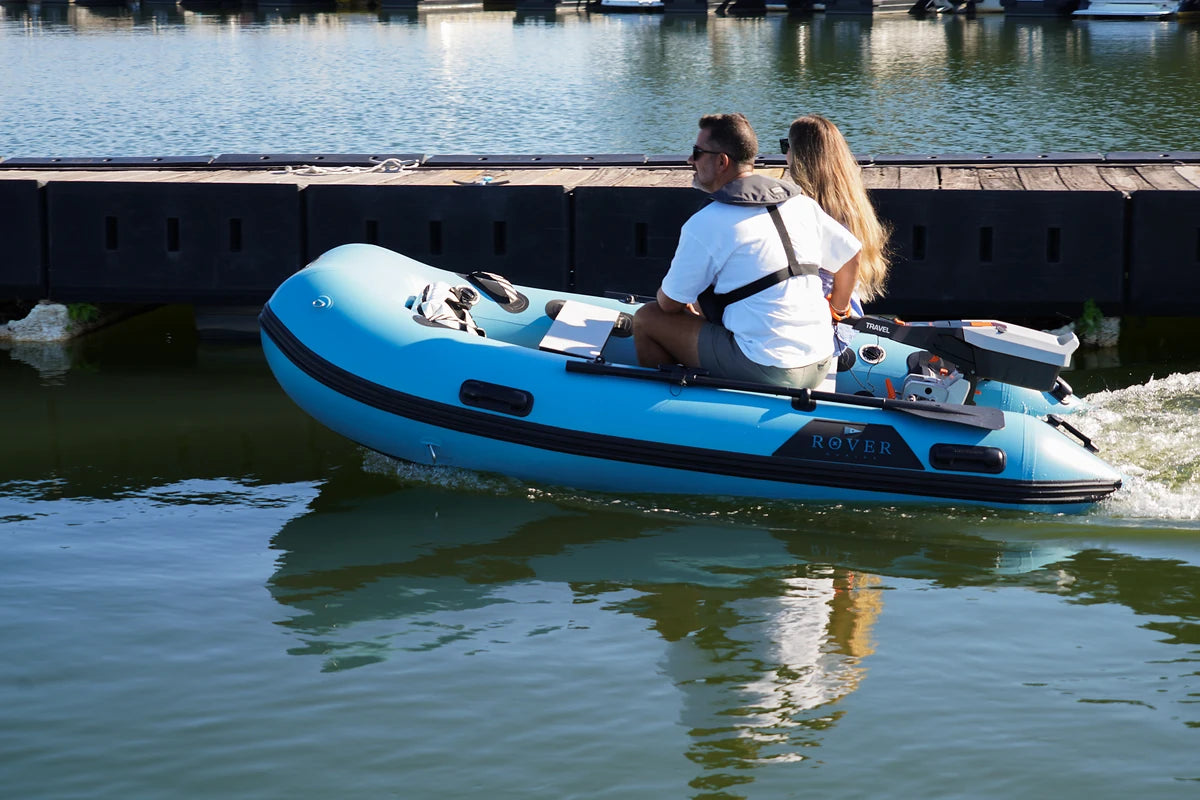
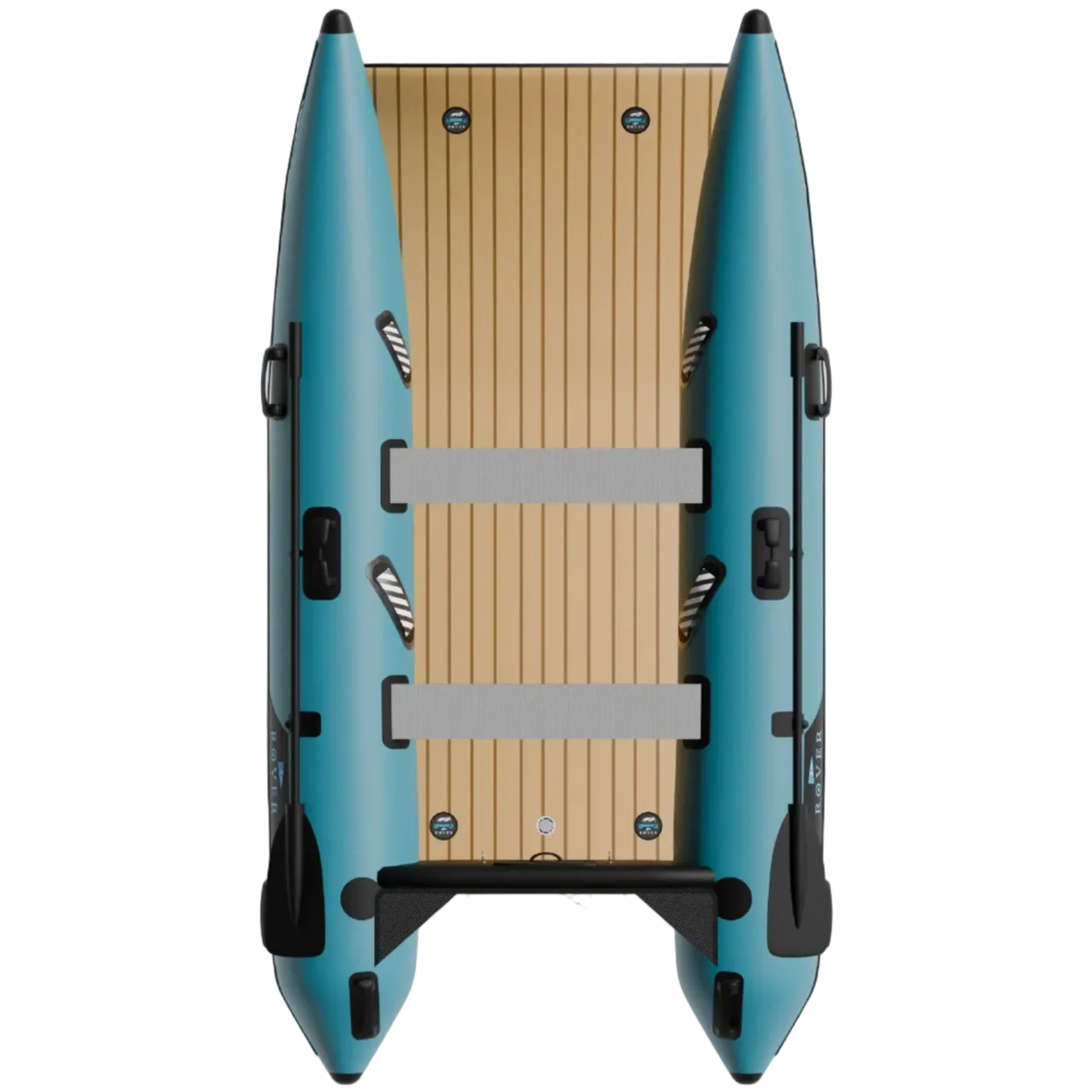
Add up everyone and everything aboard, then pick the size that keeps you comfortably under its rating and that you can actually carry. The Battle Cat 8 ft (2 persons / 600 lb, 84 lb) suits solo anglers, couples and tender duty. The 10 ft (4 people / 1000 lb, 98 lb) suits most families. The 12 ft (4 people / 1200 lb, 130 lb) is for heavier loads and more power.
Size is the decision people agonize over most, and the one that is easiest to get right if you do the arithmetic. Too small and you outgrow it by August. Too big and it lives in the garage because getting it to the water is a chore. New to these boats? Start with our inflatable catamaran buyer's guide.
The three sizes at a glance
These figures are copied from the live 8 ft, 10 ft and 12 ft product pages. All three share the same build: twin pontoons and a high-pressure drop-stitch floor with a teak-look pad.
| Battle Cat 8 ft | Battle Cat 10 ft | Battle Cat 12 ft | |
|---|---|---|---|
| Capacity | 2 persons / 600 lb | 4 people / 1000 lb | 4 people / 1200 lb |
| Boat weight | 84 lb | 98 lb | 130 lb |
| Recommended motor (Rover Marine) | Up to 6 hp | Up to 10 hp | Up to 20 hp |
| Carry | Two people, short carries are easy | Two people | Two people, plan the route |
| Best for | Solo anglers, couples, tender duty, tight storage | Most cottage families, two anglers, dog owners | Heavier loads, gear-heavy crews, more power |
One thing jumps out of that table. The 12 ft and the 10 ft carry the same number of people. Moving up to the 12 ft buys you 200 lb more capacity, more room per person and a higher recommended motor ceiling, not an extra seat.
Step 1: add up who and what is aboard
Count everything: every passenger, the dog, the cooler, tackle, towels, the motor and the battery. The electric outboards we carry weigh about 20 kg (about 44 lb) with the battery. A gas outboard's weight is on its own spec sheet, so look it up rather than guess. Then stay comfortably under the rating. A boat loaded to its limit sits lower, feels slower and gives you no margin when a wake rolls through.
Here are some real loads we size for in the shop:
| Crew and gear | Total (approx.) | Fits | Our pick |
|---|---|---|---|
| Two adults (180 lb + 150 lb), a 70 lb dog, a small cooler (30 lb), electric outboard with battery (about 44 lb) | About 474 lb | 8 ft (600 lb) or 10 ft | 10 ft if the dog moves around a lot; 8 ft if storage is tight |
| Solo angler (200 lb), tackle and rods (40 lb), electric outboard with battery (about 44 lb) | About 284 lb | Any size | 8 ft |
| Two adults, two kids (80 lb + 60 lb), cooler and towels (50 lb), electric outboard with battery (about 44 lb) | About 564 lb | 10 ft or 12 ft (the 8 ft is rated for 2 persons) | 10 ft |
| Four adults (avg 190 lb), day gear (60 lb), electric outboard with battery (about 44 lb) | About 864 lb | 10 ft, but close to its 1000 lb rating | 12 ft for the margin |
| Five people | n/a | None. Every Battle Cat size is rated for 4 people or fewer. | Two boats, or a different boat |

Step 2: think about where it lives and how it gets to the water
This is the step people skip, and it is the one that decides whether you actually use the boat.
- Who carries it? 84 lb, 98 lb and 130 lb are the boat weights alone. On a rocky Shuswap beach or down cottage stairs, every one of these is a two-person job, and the 12 ft needs a plan.
- Where is it stored? Condo lockers and boat lockers favour the 8 ft. A cottage shed can take any of them.
- How far is the walk? Thirty steps from the car to the dock is fine with anything. A long trail to the water favours the smaller boat.

Step 3: think about what you will do with it
| Main use | Size |
|---|---|
| Solo fishing on small lakes and bays (see the fishing guide) | 8 ft |
| Two anglers casting from the same boat | 10 ft |
| Yacht tender where locker space is tight (see the tender guide) | 8 ft |
| Cottage family boat, swimming, island runs | 10 ft |
| Heavier loads, more gear, a bigger gas motor | 12 ft |
Step 4: match the motor
Rover Marine recommends up to 6 hp on the 8 ft, 10 hp on the 10 ft and 20 hp on the 12 ft. A 1 kW class electric outboard (listed as 3 HP equivalent) suits the 8 ft and 10 ft at relaxed speeds. See the electric outboard guide for the range numbers.
Licensing can tip the decision. Transport Canada requires a Pleasure Craft Licence when engines total at least 10 horsepower (7.5 kW). If you want to avoid the licence, a 9.9 hp or an electric on the 10 ft keeps you under the line. A 12 ft running the full 20 hp needs one. Either way, the driver of any motorized recreational boat needs proof of competency, electric included.

Why the 10 ft is the usual answer
For most Canadian cottage and lake buyers, the 10 ft is the balance point. It is rated for 4 people and 1000 lb, it weighs 98 lb, which is only 14 lb more than the 8 ft, and it takes up to 10 hp. That small weight gap is why we rarely talk a family into the 8 ft.
If you are torn between two sizes, size up for comfort, unless carrying or storage is the real constraint. In that case, size down and do not look back.
“What a beast of a boat! Huge tubes, and quality components.”Michael S., verified buyer, Battle Cat 12 ft
“10' Battle Cat Catamaran is well paired with ePropulsion's Spirit 1 Plus electric motor.”Nancy M., verified buyer, Battle Cat 10 ft
Still not sure?
Call us at 1-800-399-5260 and tell us who is going aboard, how far you carry it and where you launch. That is usually a two-minute conversation. If you are also weighing a single-hull dinghy, read how to choose the right inflatable dinghy.

Frequently Asked Questions
What size inflatable catamaran do I need?
Add up passengers, gear, motor and battery and stay comfortably under the rating. The Battle Cat 8 ft is rated 2 persons / 600 lb, the 10 ft 4 people / 1000 lb and the 12 ft 4 people / 1200 lb. Most cottage families end up with the 10 ft.
Which Battle Cat is best for two adults?
The 8 ft or the 10 ft. The 8 ft is rated for 2 persons and is easier to store; the 10 ft gives you room to move, fish side by side or bring a dog, and weighs only 14 lb more.
How heavy is the Battle Cat?
The product pages list the boat weight as 84 lb for the 8 ft, 98 lb for the 10 ft and 130 lb for the 12 ft. Plan on two people to carry any of them over rough ground.
Does the 12 ft Battle Cat carry more people than the 10 ft?
No. Both are rated for 4 people. The 12 ft is rated for 1200 lb versus 1000 lb and takes up to 20 hp instead of 10 hp, so it suits heavier loads and more power rather than more seats.
Can a family of four fit in a Battle Cat 10 ft?
Usually, yes. Two adults, two kids, a cooler and an electric outboard typically come in well under the 1000 lb rating. Four adults with gear get close to it, which is when we suggest the 12 ft.
What motor size goes with each Battle Cat?
Rover Marine recommends up to 6 hp on the 8 ft, up to 10 hp on the 10 ft and up to 20 hp on the 12 ft. A Pleasure Craft Licence is required once engines total at least 10 horsepower (7.5 kW).
Related Canadian Board Co. guides and gear
Compare the three Battle Cat sizes
See the 8, 10 and 12 ft in the boats collection, or call 1-800-399-5260 and we will size it with you.
Shop inflatable catamarans

Leave a comment
All comments are moderated before being published.
This site is protected by hCaptcha and the hCaptcha Privacy Policy and Terms of Service apply.