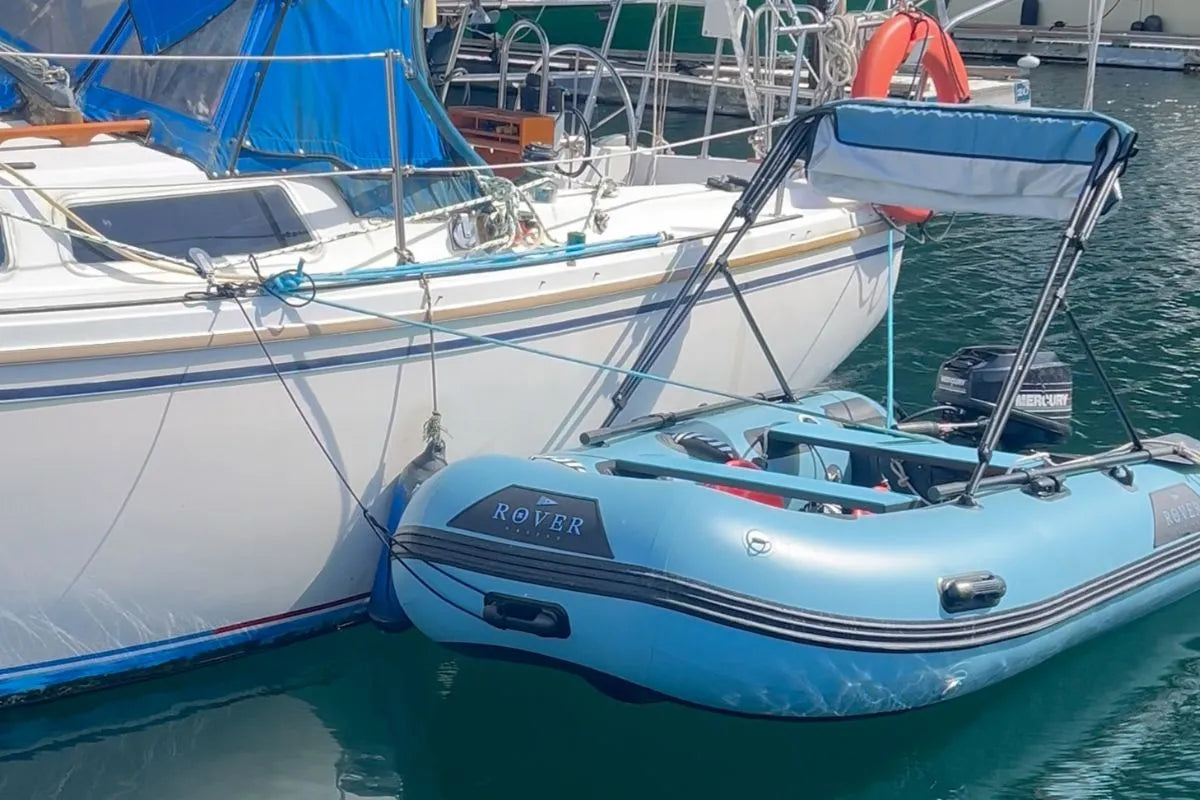
The Rover Marine lineup gives Canadian boaters two distinct platforms: the Battle Boat, a single-hull inflatable dinghy, and the Battle Cat, an inflatable catamaran. They share the same construction philosophy, similar pricing, and the same "no trailer required" use case, but they handle very differently and suit different buyers. This guide is the direct comparison.
We're a Canadian-owned, family-run team based in Kelowna, BC, and we sell both lines to Canadians from Newfoundland to BC. The 1-800-399-5260 line gets the Battle Boat vs Battle Cat question often enough that this guide is now the standard pre-call reading. Here's the framework.

The two boats at a glance
Battle Boat, single-hull dinghy
- Sizes: 8 ft, 10 ft, 12 ft
- Pricing: from $2,999 CAD
- Hull: traditional single-hull dinghy with a drop-stitch inflatable floor
- Inflated dimensions: 8 ft x 4.5 ft x 15 in / 10 ft x 5 ft x 18 in / 12 ft x 5.5 ft x 20 in
- Deflated size: 38 x 24 x 15 in / 45 x 28 x 18 in / 48 x 32 x 20 in
- Weight: 86 lb / 100 lb / 135 lb
- Capacity: 2 people and 600 lb / 4 people and 1000 lb / 4 people and 1200 lb
- Recommended power shown in current spec table: up to 6 HP / up to 10 HP / up to 20 HP
- Optimal motor pairing shown in current FAQ: 5 HP / 10 HP / 15 HP
- Inflation time: approximately 5 to 8 minutes with a quality electric pump
- Best for: tenders, cottage families, anglers, solo missions, and anyone with storage limits
Battle Cat, catamaran
- Sizes: 8 ft, 10 ft, 12 ft
- Pricing: from $2,999 CAD
- Hull: dual pontoons with reinforced high-pressure floor between
- Inflated dimensions: 8 ft x 4.5 ft / 10 ft x 5 ft / 12 ft x 5.5 ft
- Deflated size: 38 x 24 x 15 in / 45 x 28 x 18 in / 48 x 32 x 20 in
- Weight: 84 lb / 98 lb / 130 lb
- Capacity: 2 people and 600 lb / 4 people and 1000 lb / 4 people and 1200 lb
- Recommended power shown in current spec table: up to 6 HP / up to 10 HP / up to 20 HP
- Current product copy also notes: Battle Cat is engineered for electric or gas outboards up to 10 HP, so always confirm the product page, printed specification, and compliance plate before mounting a motor.
- Inflation time: approximately 5 to 8 minutes with a quality electric pump
- Best for: families wanting maximum stability, anglers needing a casting platform, paddlers crossing chop, and lakes with frequent wind

The hull difference: what it actually feels like
The single biggest functional difference between the two is the hull. The Battle Boat is a traditional inflatable dinghy: one main air chamber forming a U-shaped hull, with a drop-stitch floor providing the rigid platform. It rides like a small boat. It lifts, turns, and handles like every aluminum dinghy you've ever been in, just lighter and easier to launch.
The Battle Cat is a catamaran. Two parallel pontoons with a high-pressure deck stretched between them. The dual-hull design slices through chop rather than riding over it, which means a fundamentally calmer ride in any conditions where wind or wake is present. The trade-off: the catamaran turns differently, takes a wider arc, takes more deck space than the equivalent-length Battle Boat, and feels less "boaty", more like a floating platform with a motor.
In flat-water conditions, calm lake, light wind, no boat wake, the two boats feel similar. The Battle Boat is slightly faster off the line; the Battle Cat is slightly more stable at rest. The differences amplify as conditions get worse. On a 1-foot chop with 20 km/h wind, the Battle Cat is markedly more comfortable. In flat water with no traffic, the Battle Boat's traditional hull is more intuitive.
Decision rule by use case
If you're buying a tender for a yacht or sailboat: Battle Boat
The Battle Boat is the right tender. It nests in a yacht locker more easily than a catamaran, the U-shape compresses better than two parallel pontoons, and the 8 ft size is purpose-built for tender duty. Inflate at the dock, deflate after a shore run, store on board.
If you're buying for a cottage with one boat and varied use: Battle Boat
For most Canadian cottages, varied use, mixed conditions, sometimes fishing, sometimes shuttling, sometimes just running to the back of the lake, the Battle Boat is the more traditional and versatile option. The 10 ft handles two adults plus gear comfortably, the 12 ft handles a family, and the motor compatibility gives real on-water capability.
If you're a serious angler or fish from a standing position: Battle Cat
The catamaran's deck is bigger, flatter, and more stable than the equivalent-length single hull. Standing to cast is easier. Reaching across to land a fish is easier. The dual-pontoon stability means you don't have to worry as much about a sudden weight shift dumping the boat. For anglers, the Battle Cat is the right hull.
If your home lake gets wind and chop: Battle Cat
Some lakes are reliably calm; others have a daily wind cycle that builds chop by mid-afternoon. If the second sounds like your lake, Lake Simcoe, Lake of the Woods, the Great Lakes interior, BC's Okanagan in summer, the Battle Cat will be the more comfortable boat most of the time. The catamaran hull cuts through chop where the Battle Boat rides over it.
If you want the smallest, most portable traditional option: Battle Boat 8 ft
The 8 ft Battle Boat is the compact entry point in the traditional single-hull lineup. It is the right pick for tender duty, solo missions, small cottages, and anyone with serious storage constraints. It still has real inflatable-boat weight, currently listed at 86 lb, so plan storage and lifting accordingly.
If you want compact stability: Battle Cat 8 ft
The 8 ft Battle Cat is the compact stability-first option. It gives buyers the catamaran stance in the smallest current Battle Cat size. For fishing or family use, most buyers will still prefer the 10 ft or 12 ft, but the 8 ft matters for buyers who want catamaran stability and tighter storage.
If you want the most cottage-capable option: Battle Boat 12 ft or Battle Cat 12 ft
The 12 ft sizes both handle a family with gear and larger motor setups. The Battle Boat 12 ft is more traditional and agile. The Battle Cat 12 ft is more stable and has more deck space. For most family cottages, the choice between them comes down to "do we want traditional handling" or "do we want stability and a bigger deck?"

Motor compatibility: gas vs electric
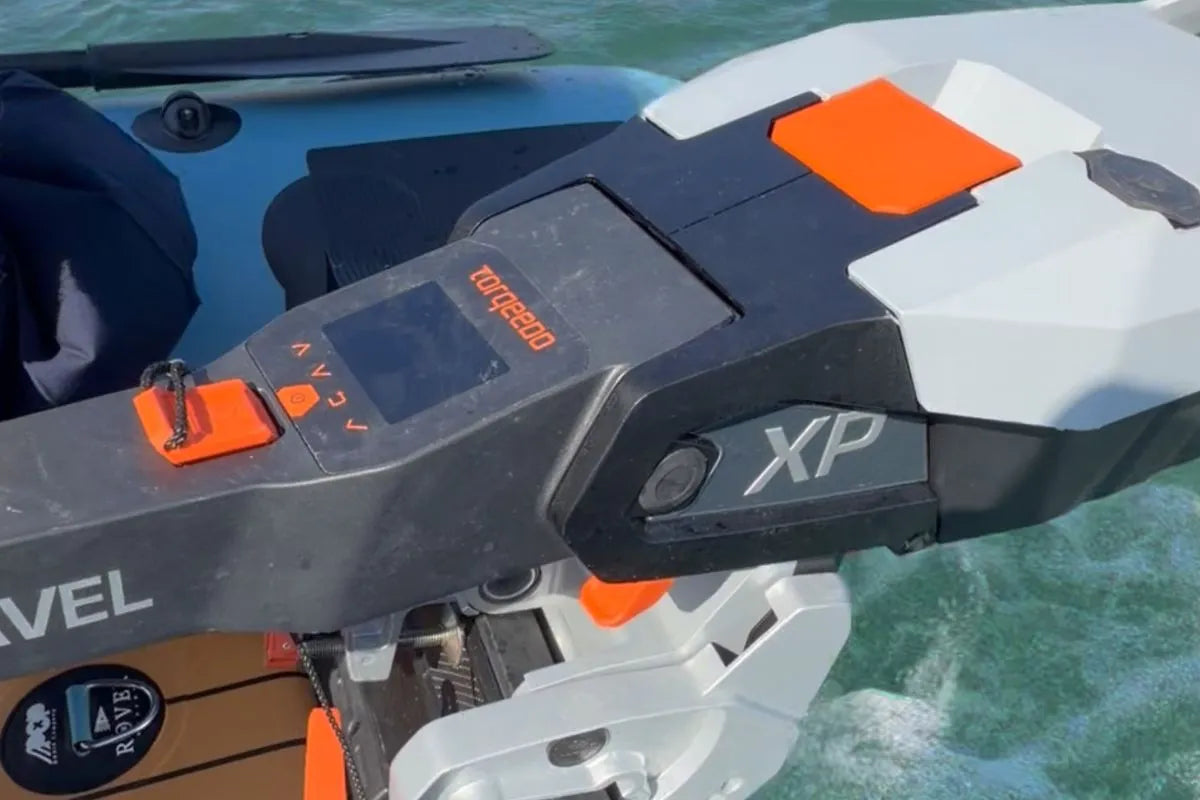
Both boats are compatible with gas and electric outboards. The choice between them is its own decision. For the long version, see the electric outboard lineup here: https://www.canadianboardco.com/collections/electric-outboard-motors, which includes both Torqeedo and ePropulsion options for the inflatable-boat segment.
For the Battle Boat, current CBC product information lists 8 ft, 10 ft, and 12 ft models with increasing motor capability. The product FAQ gives optimal pairings of 5 HP, 10 HP, and 15 HP, while the product spec table and boats collection show max power ratings of up to 6 HP, 10 HP, and 20 HP by size. For safety and compliance, use the current product page, printed specification, and boat compliance plate as the final source before mounting a motor.
- 8 ft: compact gas or electric outboard setup
- 10 ft: small-to-medium gas or electric outboard setup
- 12 ft: larger gas or electric outboard setup within the current rating
For the Battle Cat, the current CBC product selector and package details list 8 ft, 10 ft, and 12 ft sizes. The current spec table shows the same recommended power progression by size: up to 6 HP, up to 10 HP, and up to 20 HP. Other product copy on the page references up to 10 HP, so confirm the printed specification and compliance plate before mounting a motor.
For Canadian boaters, the practical motor decision is gas versus electric. Gas gives more range and less battery planning, but requires fuel handling and more maintenance. Electric is cleaner, quieter, and easier around a cottage with shore power, but range depends on battery capacity, load, wind, and how hard you run it. Most Canadian cottage families with shore power are increasingly looking at electric. Browse the motor lineup here: https://www.canadianboardco.com/collections/electric-outboard-motors.
Pleasure Craft Operator Card and licensing
Both boats are subject to standard Transport Canada regulations.
In Canada, if you operate a recreational boat fitted with a motor, including an electric motor, you need proof of competency. The most common proof is a Pleasure Craft Operator Card, or PCOC. This is different from a Pleasure Craft Licence.
If your pleasure craft has one or more engines totalling at least 10 HP, or 7.5 kW, and is principally operated and maintained in Canadian waters, it needs a Pleasure Craft Licence through Transport Canada.
Standard safety equipment requirements apply: PFD per person, sound signalling device, bailer or manual pump, buoyant heaving line, navigation lights if used after dark, and proper anchoring equipment for the conditions.
The water safety collection has Transport Canada-approved PFDs, whistles, and required equipment. For official Transport Canada information, use Transport Canada’s Pleasure Craft Operator Card page and Transport Canada’s Pleasure Craft Licence page.
Storage and transport: the practical reality
Both boats deflate to a carry bag. Here's the realistic comparison for storage and transport based on the current product specifications:
Battle Boat
- 8 ft: 38 x 24 x 15 in deflated size, approximately 86 lb
- 10 ft: 45 x 28 x 18 in deflated size, approximately 100 lb
- 12 ft: 48 x 32 x 20 in deflated size, approximately 135 lb
Battle Cat
- 8 ft: 38 x 24 x 15 in deflated size, approximately 84 lb
- 10 ft: 45 x 28 x 18 in deflated size, approximately 98 lb
- 12 ft: 48 x 32 x 20 in deflated size, approximately 130 lb
- Storage note: the Battle Cat can feel bulkier because the catamaran has more total surface area than the single-hull boat.

For a yacht owner storing the tender on board, the Battle Boat's smaller compressed footprint is still the better choice. For a cottage owner storing in a boathouse with normal-size boat lockers, both models are realistic, but the listed weights mean most buyers should plan for two-person handling on the larger sizes.
What both boats share
- Marine-grade PVC construction with drop-stitch floor, giving rigid, stable footing without aluminum-floor weight
- UV-resistant outer layer
- Compatibility with electric and gas outboards
- Inflation in minutes with a quality electric pump
- Deflation to a carry bag for vehicle or cottage storage
- Saltwater compatibility, with fresh-water rinse recommended after every saltwater outing
- Free shipping Canada-wide on orders over $100
Warranty note
Rover Marine Battle Boat and Battle Cat warranty coverage is listed as 5 years from date of purchase on boat seams and manufacturer defects, plus 3 years from date of purchase on bags and paddles. Warranty details are available here: https://www.canadianboardco.com/pages/3-year-warranty.
Eligible boards are also backed by the 60-Day Rider's Guarantee.
The decision framework, simplified
Here's the one-question version:
- Will you be fishing, carrying family on the water, or boating on a windy lake? Battle Cat.
- Will you be tendering, running solo missions, or dealing with storage constraints? Battle Boat.
- Do you want one boat to do almost everything? Battle Boat 12 ft is the most versatile traditional answer.
- Do you want the most capable family platform? Battle Cat 12 ft.
- Do you want compact catamaran stability? Battle Cat 8 ft.
If you're between two specific models, call our 1-800-399-5260 line. The team will walk you through your home lake, your storage situation, your motor preference, and your typical use, and recommend a specific size and model. We'd rather spend ten minutes on the phone than have you buy the wrong boat.
What we'd buy ourselves
Small cottage, single-vehicle family, 10 to 15 uses per season
Battle Boat 10 ft with an electric outboard. Compact, versatile, and still manageable for a family cottage setup.
Family cottage, boat as the summer centrepiece
Battle Boat 12 ft with an appropriately rated gas outboard. Most traditional, most versatile, and built for running the back of the lake without battery-range anxiety.
Yacht owner who needs a tender
Battle Boat 8 ft with a compact motor. Fits tender duty, runs to shore, gets the job done.
Compact stability-first setup
Battle Cat 8 ft. This is the smaller catamaran option for buyers who want the dual-pontoon stance but still need to stay compact.
Serious angler or family wanting maximum stability
Battle Cat 10 ft. The catamaran is the right hull for fishing from standing and for a stable family platform.
Multi-cottage family that paddles, fishes, and crosses bigger water
Battle Cat 12 ft. Maximum deck, maximum stability, and the boat that handles more Canadian lake conditions without compromise.
Browse the full lineup at https://www.canadianboardco.com/collections/boats. Both boats ship from Kelowna, BC with free Canada-wide shipping over $100. Call 1-800-399-5260 if anything in this guide is unclear. The people who answer are paddlers and boaters, not a call centre.
Frequently asked questions
What's the main difference between Battle Boat and Battle Cat?
The hull. Battle Boat is a single-hull dinghy that handles like a traditional small boat. Battle Cat is a catamaran with two parallel pontoons that cuts through chop and provides a wider, more stable deck. Same construction philosophy, very different ride.
Which is faster, Battle Boat or Battle Cat?
With the same motor and the same load, the Battle Boat is generally slightly faster off the line and more agile in tight maneuvers. The Battle Cat is more stable at higher speeds in chop, where the catamaran hull doesn't slow as much. For most casual use, the speed difference is small.
Which boat is better for fishing?
Battle Cat. The dual-pontoon hull provides a more stable casting platform, and the deck is bigger and flatter than an equivalent-length Battle Boat. Standing to cast and landing a fish are both easier on the catamaran. For an angler, this is the right hull.
Which boat is the better tender for a yacht or sailboat?
Battle Boat, especially the 8 ft. The U-shaped single hull compresses smaller for stowage in a yacht locker, and the smaller motor setups match typical tender use. The Battle Cat's parallel pontoons are bulkier when deflated.
Can I use either boat in saltwater?
Yes. Both are built with marine-grade PVC for saltwater compatibility. Always rinse thoroughly with fresh water after every saltwater outing and dry before storage to protect seams and valves.
Do I need a Pleasure Craft Operator Card for these boats?
If the boat is fitted with a motor and used recreationally in Canada, you need proof of competency. The most common proof is a Pleasure Craft Operator Card. If the motor or motors total at least 10 HP, or 7.5 kW, and the boat is principally operated and maintained in Canadian waters, the boat also needs a Pleasure Craft Licence. For official rules, see Transport Canada at https://tc.canada.ca/en/marine-transportation/preparing-operate-your-vessel/pleasure-craft-operator-card-pcoc.
How much does each boat weigh in its carry bag?
Current CBC product information lists Battle Boat weights at approximately 86 lb, 100 lb, and 135 lb across the 8 ft, 10 ft, and 12 ft sizes. Battle Cat is listed at approximately 84 lb, 98 lb, and 130 lb across the same sizes. The Battle Cat can feel bulkier in the bag because of the dual-pontoon construction.
What motors do you recommend for the Battle Boat or Battle Cat?
It depends on size and use. Compact boats pair best with smaller gas or electric outboards, while larger 10 ft and 12 ft setups can handle more power within the current rating. CBC carries electric options including Torqeedo and ePropulsion here: https://www.canadianboardco.com/collections/electric-outboard-motors. Always confirm the current product page, printed specification, and compliance plate before mounting a motor.


Leave a comment
All comments are moderated before being published.
This site is protected by hCaptcha and the hCaptcha Privacy Policy and Terms of Service apply.