
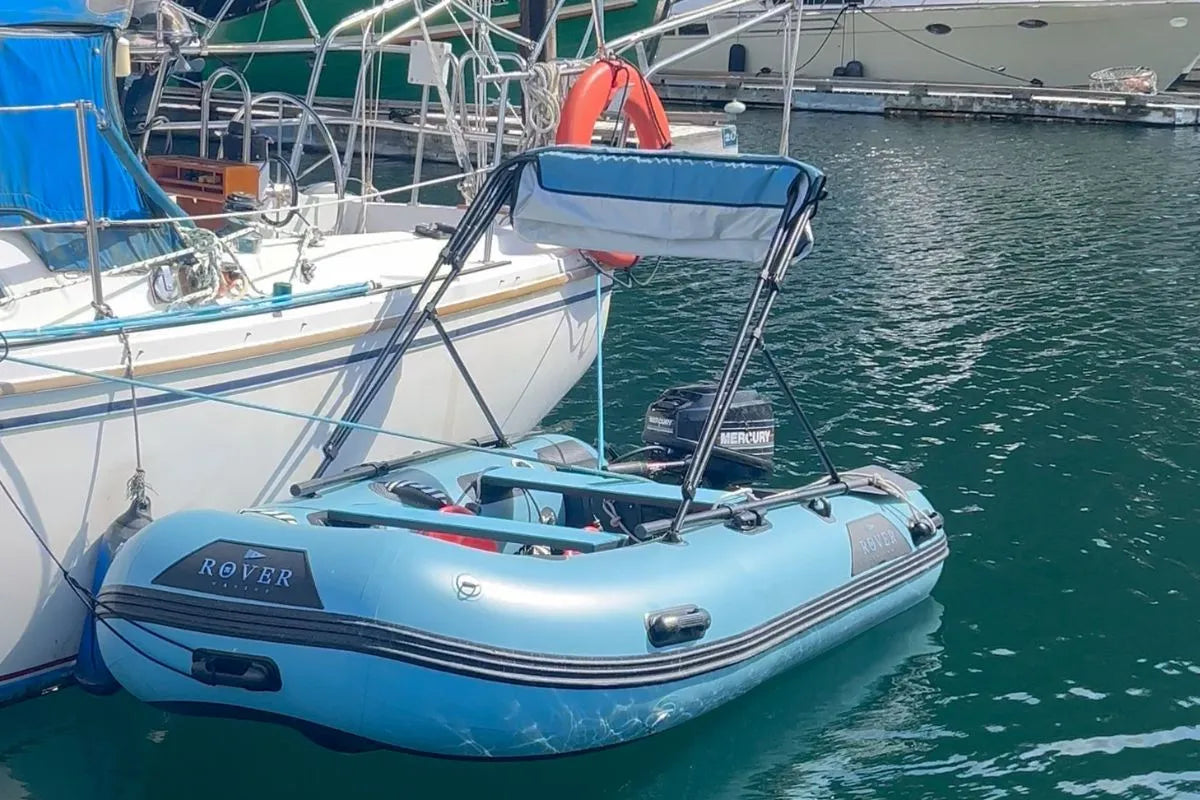
A yacht tender is the small boat that does the work between the yacht and the shore: running provisions, ferrying guests, exploring shallow inlets, and handling the dozens of practical jobs that come with anchored cruising. For Canadian yacht and sailboat owners, the inflatable tender has become the standard answer to the question of "how do we get to shore from the anchor." This guide is the buying framework specifically for that use case.
We're a Canadian-owned, family-run team based in Kelowna, BC, and we ship Rover Marine inflatables to yacht owners on every Canadian coast: Pacific cruising, Great Lakes club sailing, East Coast ocean cruising, and inland lake cottage yachting. The 1-800-399-5260 line gets the tender-sizing question regularly. Here's the framework.

The case for an inflatable tender
A yacht tender has three jobs: store on the yacht, get to shore, and not break. Inflatable tenders win on all three for most cruising boats.
Stowage
A deflated inflatable can fit in a yacht locker, on deck under a cover, or lashed to the foredeck if the dimensions work for your boat. A rigid dinghy needs davits, lifting tackle, or deck space, all of which compete with other rigging.
Weight and handling
A portable inflatable is easier to deal with than a rigid dinghy, but it is not weightless. The current 8 ft Battle Boat spec lists the boat at 86 lb, so plan for two-person handling if you are lifting it from dock to deck or moving it in and out of a locker.
Towing
Towing any dinghy at speed in chop is a known way to create problems. Towing an inflatable can work for short, low-speed moves in protected water, but the cleaner cruising practice is to deflate and stow for longer passages.
Repair
Inflatable tenders are field-repairable for most small damage. A PVC patch kit, spare valve cores, and basic cleaning supplies can solve many minor issues during a cruise. Rigid dinghies are usually less forgiving when damaged away from home.
The case for rigid still exists: better hard-water performance at higher speeds, more durability against rocky landings, and longer expected service life under aggressive use. For most cruising yachts running tender duty, though, the inflatable is the practical answer.
Sizing the tender to the yacht
The constraint that sets tender size is stowage. Before you buy, measure the real space you have, not the space you think you have. Measure cockpit lockers, aft lazarettes, sail lockers, foredeck tie-down areas, and davit lift capacity if you plan to store the tender inflated.
The current Rover Marine Battle Boat specs are much larger and heavier than the older numbers in the original draft, so this matters.
8 ft Battle Boat
- Deflated size: 38 x 24 x 15 in
- Weight: 86 lb
- Capacity: 2 people / 600 lb
- Recommended power: up to 6 HP
- Best for: yacht tender duty, short shore runs, small crews, and storage-constrained boats where the locker or deck space can actually take the packed dimensions.
10 ft Battle Boat
- Deflated size: 45 x 28 x 18 in
- Weight: 100 lb
- Capacity: 4 people / 1000 lb
- Recommended power: up to 10 HP
- Best for: owners with more stowage room, more frequent guest runs, and regular provisioning trips where the extra capacity matters.
12 ft Battle Boat
- Deflated size: 48 x 32 x 20 in
- Weight: 135 lb
- Capacity: 4 people / 1200 lb
- Recommended power: up to 20 HP
- Best for: larger yachts, davit storage, family cottages, and owners who want maximum capability from one inflatable boat.

The decision rule for most cruising sailboats:
- Yacht 28-35 feet: 8 ft Battle Boat if your locker, lazarette, or deck stowage can handle the 38 x 24 x 15 in packed size and the 86 lb listed weight. If not, measure again before buying.
- Yacht 35-45 feet: 8 ft or 10 ft Battle Boat. The 10 ft adds capacity for more adults and gear, but it needs more locker space and more handling effort.
- Yacht 45+ feet: 10 ft or 12 ft Battle Boat. Davits or aft-deck storage make the larger sizes practical, and the bigger yacht usually means more guests, more provisions runs, and more reasons to want capacity.
For yacht owners specifically, the 8 ft is still the standard starting point, but the old "25-30 lb locker tender" idea does not match the current Battle Boat spec. Treat it as a real inflatable boat, not a backpack dinghy.
The Battle Boat lineup for tender duty
The Rover Marine Battle Boat is the most-used inflatable tender in our lineup, and the 8 ft size is the standard yacht-use starting point. The current lineup is:
8 ft Battle Boat
- Deflated size: 38 x 24 x 15 in
- Weight: 86 lb
- Capacity: 2 people / 600 lb
- Recommended power: up to 6 HP
- Inflated dimensions: 8 ft x 4.5 ft x 15 in
- Best for: yacht tender duty, cottage solo missions, storage-constrained users, and short shore runs.
10 ft Battle Boat
- Deflated size: 45 x 28 x 18 in
- Weight: 100 lb
- Capacity: 4 people / 1000 lb
- Recommended power: up to 10 HP
- Inflated dimensions: 10 ft x 5 ft x 18 in
- Best for: cruising yachts with locker space, family cottage use, and mid-range tender duty.
12 ft Battle Boat
- Deflated size: 48 x 32 x 20 in
- Weight: 135 lb
- Capacity: 4 people / 1200 lb
- Recommended power: up to 20 HP
- Inflated dimensions: 12 ft x 5.5 ft x 20 in
- Best for: larger yachts with davits, family cottages, and owners wanting maximum capability in a single tender.
For yacht owners, the 8 ft is usually the first model to evaluate. Owners who do a lot of guest entertaining, longer shore runs, or regular provisioning trips may benefit from the 10 ft. The 12 ft is a larger-yacht or davit-storage choice, not the normal locker tender.
Catamaran tenders: when they make sense
The Battle Cat is a catamaran inflatable. It is not the standard yacht-tender choice for most sailboats, but there are specific cases where it makes sense: yachts with davit storage, owners who fish from the tender, and boaters who want maximum stability more than compact stowage.
The current Battle Cat page shows 8 ft, 10 ft, and 12 ft size options, with listed weights of 84 lb, 98 lb, and 130 lb, and capacities of 2 people / 600 lb, 4 people / 1000 lb, and 4 people / 1200 lb. The package details are similar to the Battle Boat, but the dual-pontoon design can feel bulkier because of the catamaran footprint.

Battle Cat advantages
- More deck space for fishing or carrying gear
- Better stability in chop or wake
- A flatter platform for casting
- A more planted feel for guests stepping in and out
Battle Cat disadvantages for tender use
- Bulkier feel when packed because of the dual-pontoon design
- Less ideal for tight yacht lockers
- Better suited to davits, aft-deck storage, or cottage use than deep locker stowage
- Less traditional handling than the Battle Boat
For yachts using davits or aft-deck storage with a fishing-focused use case, the Battle Cat is worth considering. For most cruising tender duty, the Battle Boat is still the right pick.
Motor selection for tender duty
The right outboard for a yacht tender is small, light enough to handle, reliable, and matched to the boat's rating. Do not buy the motor first and force it onto the tender. Match the motor to the boat size, transom rating, load, and how far you actually run.
Gas outboards
Small 4-stroke gas outboards remain practical for tender duty. They are familiar, quick to refuel, and useful if you do not have reliable charging on board or at the marina.
- 2.5 HP to 6 HP is the normal small-tender range.
- Gas is still the simplest answer for longer shore runs or owners who already carry fuel safely.
- The trade-off is fuel smell, fuel storage, oil changes, winterization, noise, and more small-engine maintenance.
Electric outboards
For yacht tenders, electric is increasingly the choice. Canadian Board Co.'s current electric outboard collection includes current Torqeedo and ePropulsion options such as the Torqeedo Travel XS S, Torqeedo Travel S, Torqeedo Travel XP, ePropulsion Spirit 1.0 Evo, ePropulsion Spirit 2, and the compact ePropulsion eLite.
For yacht tenders, electric makes sense for four reasons:
- No fuel handling on the yacht: no jerry cans, no spillage, no gas smell.
- Quiet operation, which matters for early-morning shore runs and quiet anchorages.
- Charging from yacht or marina power when available.
- Range is usually sufficient for tender duty, because most tender trips are short shore runs, not full-lake expeditions.
Browse the current electric outboard lineup here: https://www.canadianboardco.com/collections/electric-outboard-motors.
Practical motor pairings
Every pairing below still needs to be checked against the current product page, printed specification, and boat compliance plate before mounting a motor.
8 ft Battle Boat
Best paired with a compact gas outboard or a 1kW class electric outboard. For light tender duty, look at Torqeedo Travel XS S, Torqeedo Travel S, or ePropulsion Spirit 1.0 Evo depending on load, charging access, and budget.
10 ft Battle Boat
Best paired with a small-to-mid gas outboard or a 1kW to 2kW electric outboard. If you regularly carry three adults, provisions, or gear, step up from the smallest electric options.
12 ft Battle Boat
Best for larger outboard setups within the current rating. For electric, consider higher-thrust portable options like Torqeedo Travel XP or ePropulsion Spirit 2, and talk to the team before building a heavier system.

The tender accessories that matter
A yacht tender setup isn't just the boat and motor. The accessories turn the package into a working tender.
Pump
A compact electric pump, DC or rechargeable, gets the boat inflated quickly. The manual pump that ships with the boat is the backup. Browse pumps here: https://www.canadianboardco.com/collections/pumps.
Oars
The Battle Boat package includes aluminum row paddles. Check that the oarlocks are seated properly before every shore run. They are also an important backup if the motor quits or the battery dies.
Anchor
A small boat anchor matched to your local bottom is useful for swimming stops, shore visits, and holding position. Canadian Board Co. does not sell anchor systems, so source this from a marine supply shop or marina that understands your cruising area.
PFDs
Transport Canada-approved PFDs, one per person. Whistles should be attached. Browse water safety gear here: https://www.canadianboardco.com/collections/water-safety.
Bailer or manual pump
Required safety gear depends on vessel type, length, and setup. A bailer or manual pump is one of the items small-boat owners should plan for. Keep it accessible, not buried in a storage bag.
Fenders
When the tender sits alongside the yacht, a small fender or two helps prevent PVC abrasion against the hull.
Tow line
For short dinghy-towing scenarios at low speed, use a proper tow line attached to the correct bow attachment point. For longer or rougher passages, deflate and stow.
Repair kit
Spare valve cores, PVC patch kit, and isopropyl alcohol belong in the tender bag. Small issues are much easier to fix before they become trip-ending problems.
Stowage and on-yacht logistics
Two questions yacht owners always ask:
How do I stow it underway?
For 28-40 foot cruising boats, the cleanest setup is usually to deflate, fold, and store the tender in a cockpit locker, aft lazarette, sail locker, or secured deck bag, if the packed dimensions fit. The 8 ft Battle Boat's current deflated size is 38 x 24 x 15 in, so measure before assuming it fits.
On longer passages, many owners lash the bag securely to the foredeck or store it in a sail locker. For trips with regular tender use and short moves between anchorages, some owners leave the boat partially inflated and lash it to the foredeck. That speeds deployment but takes deck space and increases UV exposure.
For 40+ foot yachts with davits, the tender can remain inflated and ready for use if the davit system is rated for the tender, motor, fuel or battery, and any gear left on board. Lift the tender clear of the water for any passage exceeding a few hours of motoring or sailing.
How long does the boat last with this kind of use?
A well-cared-for inflatable yacht tender can last for many seasons, but the life of the boat depends heavily on how it is stored and used.
The variables that shorten that:
- UV exposure when stored on deck. Use a cover for any stowage that exposes the boat to direct sunlight. Continuous UV exposure can shorten inflatable lifespan significantly.
- Saltwater without rinsing. Always rinse with fresh water after saltwater outings. The PVC is built for marine use, but metal hardware, valve threads, and motor mounts benefit from rinsing.
- Dragging across rocks. This is one of the most common causes of pinhole damage. Carry or float the tender instead of dragging it over rough shoreline.
- Rodent damage in offseason storage. Mice can chew valve gaskets, seams, and corners. Store in a sealed or rodent-resistant location.
- Improper inflation pressure. Over-inflation stresses seams. Under-inflation lets the boat flex too much, which also stresses seams. Follow the printed spec on the boat.
For maintenance specifics, see our guide here: https://www.canadianboardco.com/blogs/water-sports-guide/keep-your-inflatable-dock-shipshape-the-ultimate-guide-to-longevity-and-performance. Most of the inflatable dock maintenance principles also apply to inflatable boats.
Transport Canada basics for yacht tenders
A yacht tender may feel like a small accessory to the main boat, but it is still a vessel. Canadian rules matter.
- Proof of competency: In Canada, operators of power-driven pleasure craft generally need proof of competency. The most common proof is the Pleasure Craft Operator Card.
- Pleasure Craft Licence: A recreational pleasure craft needs a Pleasure Craft Licence if it has one or more engines totalling at least 10 HP, or 7.5 kW, and is principally operated and maintained in Canadian waters.
- Safety gear: Required safety equipment depends on vessel size and setup. Plan for PFDs, sound signalling, bailer or manual pump, heaving line or anchor equipment where applicable, and navigation lights if operating after dark.
For official guidance, check Transport Canada’s Pleasure Craft Operator Card page at https://tc.canada.ca/en/marine-transportation/preparing-operate-your-vessel/pleasure-craft-operator-card-pcoc and Pleasure Craft Licence page at https://tc.canada.ca/en/marine-transportation/vessel-licensing-registration/licensing-pleasure-craft/apply-manage-pleasure-craft-licence-pcl/apply-manage-pleasure-craft-licence-pcl.
The honest recommendation
For most cruising yacht owners in Canada, the recommendation is:
First-time inflatable tender owner with a 30-40 foot yacht
Start by measuring for the 8 ft Battle Boat. If the 38 x 24 x 15 in packed size and 86 lb listed weight work for your locker or deck plan, it is the simplest tender choice. Pair it with a compact gas outboard or 1kW class electric outboard.
Yacht owner with regular guest entertaining or shore runs
The 10 ft Battle Boat gives more capacity and comfort. It is better for three-adult use, provisions, and longer shore runs, but it needs more storage room and handling effort.
Yacht owner who fishes from the tender
Consider the Battle Cat if you have the storage setup for it. The catamaran platform is more stable for standing, casting, and carrying gear.
Larger yacht with davits
The 10 ft or 12 ft Battle Boat becomes practical when you have davits or proper aft-deck storage. The larger size gives more capacity, but you need to account for the tender, motor, battery or fuel, and gear weight.
Browse the full lineup at https://www.canadianboardco.com/collections/boats. Electric outboards live at https://www.canadianboardco.com/collections/electric-outboard-motors.
Warranty, shipping, and support
Free shipping Canada-wide on orders over $100.
Rover Marine Battle Boat and Battle Cat warranty coverage is listed as 5 years from date of purchase on boat seams and manufacturer defects, plus 3 years from date of purchase on bags and paddles. General warranty details are available here: https://www.canadianboardco.com/pages/3-year-warranty.
Eligible boards are also backed by the 60-Day Rider's Guarantee.
Call 1-800-399-5260 if you want a tender-specific consultation. We'll walk through your yacht, your typical anchorages, your guest count, and your stowage situation, and recommend a specific model and motor. Most yacht owners get a clearer answer in a 10-minute call than in three weeks of research.
Frequently asked questions
What's the best inflatable tender for a 35-foot sailboat?
The 8 ft Battle Boat is the standard starting point for many 28-40 foot cruising boats, but measure first. The current deflated size is 38 x 24 x 15 in and the listed weight is 86 lb. If that works for your locker, deck bag, or lazarette, it is the cleanest tender choice. If you need more capacity and have more stowage room, step up to the 10 ft.
Can I tow an inflatable tender behind my sailboat?
For short distances at low speed in protected water, yes. For longer passages, higher speeds, or chop, deflate and stow. A towed inflatable in rough water can swamp, flip, damage hardware, or be lost. The standard practice for cruising is to stow the tender for any serious passage.
How long does an inflatable yacht tender last?
With good care, an inflatable yacht tender can last for many seasons. The variables that shorten lifespan are UV exposure without a cover, saltwater without fresh-water rinsing, dragging across rocks, rodent damage in storage, and improper inflation pressure.
Do I need a Pleasure Craft Operator Card to operate the tender?
If the tender is a motorized pleasure craft in Canada, the operator generally needs proof of competency. The most common proof is a Pleasure Craft Operator Card. This is different from a Pleasure Craft Licence, which applies to the vessel when the motor or motors total at least 10 HP, or 7.5 kW, and the craft is principally operated and maintained in Canadian waters.
What size electric outboard is right for a yacht tender?
For an 8 ft Battle Boat, a compact 1kW class electric is usually the first place to look. Current CBC options include models such as the Torqeedo Travel S and ePropulsion Spirit 1.0 Evo. For a 10 ft tender carrying more adults or gear, look at 1kW to 2kW options depending on load and range needs. Browse current electric outboards here: https://www.canadianboardco.com/collections/electric-outboard-motors.
Does the tender need to be licensed with Transport Canada?
A recreational pleasure craft needs a Pleasure Craft Licence if it has one or more engines totalling at least 10 HP, or 7.5 kW, and is principally operated and maintained in Canadian waters. Smaller-motor configurations may not need a Pleasure Craft Licence, but the operator still generally needs proof of competency if the tender is motorized.
Can I store the inflated tender on deck for an entire cruising season?
Yes, if you protect it properly. UV exposure is the biggest issue for inflatables left inflated and exposed. Use a purpose-built cover, rinse after saltwater use, and check pressure regularly. If the tender is on davits, make sure the davits are rated for the full load, including motor, battery or fuel, and gear.
What if I damage the tender during a cruise?
Most small damage is field-repairable. A repair kit with PVC patch material, valve cores, and surface-prep supplies can handle pinholes and slow valve leaks. For seam damage, valve housing damage, or drop-stitch floor issues, call 1-800-399-5260 before attempting a major repair. We can help triage the issue and coordinate parts or warranty support.


Leave a comment
All comments are moderated before being published.
This site is protected by hCaptcha and the hCaptcha Privacy Policy and Terms of Service apply.