
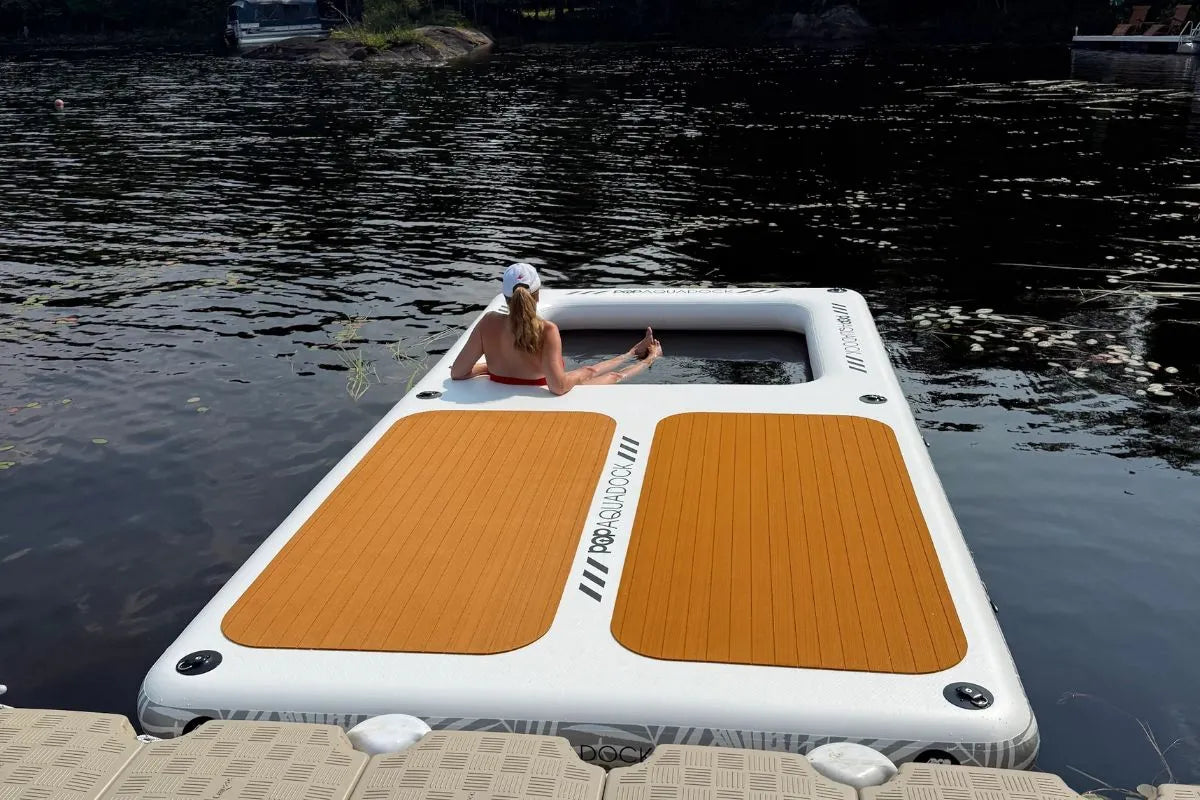
There's a specific scene every Canadian cottage owner with an inflatable dock has experienced at least once: you deploy the dock, anchor it, walk back to the cottage to grab a coffee, and twenty minutes later look out the window to see the dock has rotated 90 degrees and is now drifting toward your neighbour's swim line. This guide is about preventing that.
We're a Canadian-owned, family-run team based in Kelowna, BC, and the anchoring question is one of the most common 1-800-399-5260 calls we get from owners of new inflatable docks. The fix is straightforward, but the wrong setup is one of the most common dock-related problems in cottage country.
Why a single anchor doesn't work
The instinct for most first-time inflatable dock owners is to use one anchor at the centre of the dock. It seems logical: the anchor holds the dock in place, the wind blows, the dock points into the wind. Problem solved.
The actual physics is different. A 14-foot inflatable dock has a large, flat, shallow-draft surface. Every breath of wind catches that surface. Connected to a single anchor, the dock can pivot, sometimes slowly, sometimes fast, and over the course of a day it can swing around the anchor point as the wind shifts.
Worse, a single anchor concentrates load on one attachment point. In sustained wind, that one point takes a continuous lateral pull. Over time, that can stress the surrounding PVC and hardware. The dock may survive, but the setup is harder on the product than it needs to be.
The fix is a two-point system. Bow and stern, fixed positions, with enough line to allow movement without letting the dock rotate freely. This is the basic setup most portable inflatable dock owners should start with.

The two-point anchor system, explained
The principle is straightforward. Two anchors, set in fixed positions, with anchor lines of appropriate length, holding the dock in a stable orientation instead of letting it spin around a single point.
Basic setup
- Position the dock where you want it deployed. Ten to fifteen metres off the shore is typical for many cottage swim lines, but your lake depth, shoreline, and swimming area matter more than a fixed number.
- Set the first anchor at the end of the dock that usually points into the prevailing wind.
- Run the first anchor line to the nearest D-ring or approved attachment point. Tension it enough to hold position, but do not make it guitar-string tight.
- Set the second anchor at the opposite end of the dock.
- Run the second anchor line to the opposite end and tension it so the dock sits straight without rotating freely.
Both lines should be firm but not over-tightened. The dock needs some give for wave action. A line with no slack can stress the attachment points. A sloppy line lets the dock drift too far.
In higher-wind locations, consider a third stabilizing line to shore or a four-point anchor setup. The goal is not to make the dock immovable. The goal is to stop rotation, spread load across multiple attachment points, and make the dock easy to pull in if the weather turns.

Anchor types: matching anchor to lake bottom
The right anchor depends on the lake bottom. Get this wrong and the anchor drags, no matter how heavy it is.
Sandy bottom
Mushroom anchors or other soft-bottom anchors can work well in sand. The anchor settles into the bottom and develops holding power as it beds in. This is the kind of bottom where a simple two-point setup is most likely to work for a temporary inflatable dock.
Muddy or silty bottom
Mushroom anchors can also work in mud and silt because they settle into the soft bottom. Holding power depends on how deep the anchor beds in, how much wind the dock sees, and whether the dock is staying out for a few hours, a weekend, or most of the season.
Rocky bottom
Mushroom anchors do not work well on rock or hard-packed gravel. They sit on the surface and can slide. For rocky bottoms, owners usually look at deadweight-style anchors, weighted bags, grapnel-style options, or a marina-recommended setup that matches the shoreline.
Mixed bottom
Rock plus sand plus weeds is common on Canadian lakes. In mixed bottoms, there is no universal answer. Deadweight-style anchoring or weighted bags often make more sense than a mushroom anchor, but the right setup depends on depth, wind exposure, and whether the dock is temporary or semi-permanent.
Anchor weight: do not treat this as one-size-fits-all
The original mistake most people make is asking, "How heavy should the anchor be?" before asking the better questions: how exposed is the shoreline, what is the lake bottom, how deep is the water, how long is the dock staying out, and how fast can you pull it in when weather changes?
A protected cottage cove may only need a lighter two-point setup. An exposed shoreline may need heavier deadweight anchors, a four-point layout, a shore line, or a completely different setup recommended by a local marina. Permanent floating docks are a different category altogether. Rigid dock systems often use several hundred pounds of concrete anchoring at the corners. That does not mean every portable inflatable dock needs that kind of anchor weight.
For a portable inflatable dock, the safer framework is:
8' POPUP Dock
The 8' POPUP Dock is the compact option with less wind-catching surface area. In calm, protected water, many owners can use a lighter two-point setup matched to the lake bottom. In exposed water, add a second stabilizing point or pull the dock when wind builds.
14' POPUP AquaDock
The 14' POPUP AquaDock has more surface area and catches more wind. Do not rely on one centre anchor. Start with a two-point setup, and consider four-point or shore-assisted anchoring if the dock stays out for longer periods or sits in wind-exposed water.
14' POPUP YachtDock
The 14' POPUP YachtDock is built for bigger loads and more serious use, so anchoring matters even more. Treat the anchoring plan as part of the setup, not an afterthought. For exposed shorelines, talk to a local marina or dock installer before leaving it out for extended periods.

When in doubt, do not simply keep adding weight and hope for the best. A heavier anchor can help, but layout, bottom type, line length, and the ability to pull the dock in bad weather matter just as much.
Anchor line length: the 3-to-1 starting point
Anchor line length is the second variable most cottage owners get wrong. Too short and the line pulls upward on the anchor instead of letting it hold horizontally. Too long and the dock moves farther than expected.
As a starting point, many boaters use scope ratios like this:
- Calm conditions: line length around 3 times the water depth
- Windy or wave conditions: line length around 5 times the water depth
- Storm or extreme conditions: do not leave a portable inflatable dock out if you can safely pull it
For a typical cottage swim area with the dock in 6 feet, or 1.8 metres, of water:
- Calm: about 18 feet, or 5.5 m, of line per anchor
- Wind: about 30 feet, or 9 m, of line
These are starting points, not guarantees. Wind direction, lake bottom, current, waves, and nearby hazards all matter. If extra line creates a tangle hazard in a busy swim area, adjust the setup and ask a marina for help.
For line material, use UV-stable marine rope appropriate for outdoor water use. Nylon is commonly used because it has some stretch and shock absorption. Inspect lines every season and replace anything faded, stiff, fuzzy, frayed, or damaged.
The shore line: when and how
For exposed shorelines, high-wind cottages, or cases where rotation absolutely can't happen, a shore line can help. This is usually a line running from the dock back to shore or to a fixed point, used along with anchor points rather than instead of them.
The shore line:
- Helps reduce rotation by adding a third control point
- Allows for easier retrieval if wind comes up
- Acts as a backup if an anchor drags
Do not tie directly around a tree with bare rope if it will damage the bark. Use a proper tree-safe strap or a fixed shore tie point. If you are unsure what is allowed on your shoreline, check local rules or ask a marina before installing anything permanent.
Specific scenarios
Scenario 1: calm cove, sandy bottom, 5 feet of water
A cottage on a calm cove with a sandy bottom and no regular wind issues is the easiest setup.
Setup: A two-point anchor system using soft-bottom anchors such as mushroom-style anchors may be enough. Use appropriate rope length, check the dock after wind shifts, and pull it if weather changes.
Scenario 2: open shoreline, rocky bottom, 8 feet of water
A cottage on an open shoreline with a rocky bottom and regular afternoon wind needs more planning.
Setup: Do not rely on mushroom anchors. Look at deadweight-style anchoring, weighted bags, a shore line, or a local marina-recommended setup. Plan to pull the dock for high wind or storms.
Scenario 3: exposed shoreline, mixed bottom, 10 feet of water
An exposed shoreline with mixed bottom and frequent storms is not a set-and-forget inflatable dock situation.
Setup: Use a multi-point system, consider a shore line, ask a marina or dock installer about local anchor choice, and pull the dock for forecast storms, hail, or heavy chop.
Scenario 4: yacht owner running the dock alongside an anchored boat
When an inflatable dock is used beside an anchored boat, do not load one D-ring or one tie point.
Setup: Use multiple attachment points to spread load. Use the boat's anchoring as the primary system only if the boat itself is properly anchored. The dock's own lines should keep it positioned without putting all stress on one point.
What to do in changing conditions
Wind shifts. Storms come up. Inflatable docks can handle normal lake use, but extreme conditions are different.
Conditions to watch:
- Sustained wind over 25 km/h: be cautious. Check the dock, watch the lines, and inspect the setup after the wind settles.
- Sustained wind over 40 km/h or storm forecast: pull the dock if you can do it safely. Most portable inflatable docks should not be treated like permanent floating dock structures.
- Hail forecast: pull the dock. Hail damage is one of the weather events that can puncture an inflatable surface.
- Heavy chop with rocks nearby: pull the dock or move it. An inflatable dock hitting rocks in chop can be damaged even if the anchor system technically holds.
The pull-and-redeploy routine:
- Reduce tension on the shore line first if you are using one.
- Disconnect the stern or downwind line carefully.
- Walk, paddle, or tow the dock toward shore using a safe control line.
- Disconnect the remaining anchor line once the dock is under control.
- Pull the dock onto land, deflate if needed, and store it somewhere protected.
For most cottage owners, the dock comes out of the water at the end of the season anyway. Mid-season pulls for storms are a manageable inconvenience and often the right choice.
Dock anchoring is not the same as boat anchoring
It is worth separating inflatable dock anchoring from inflatable boat anchoring.
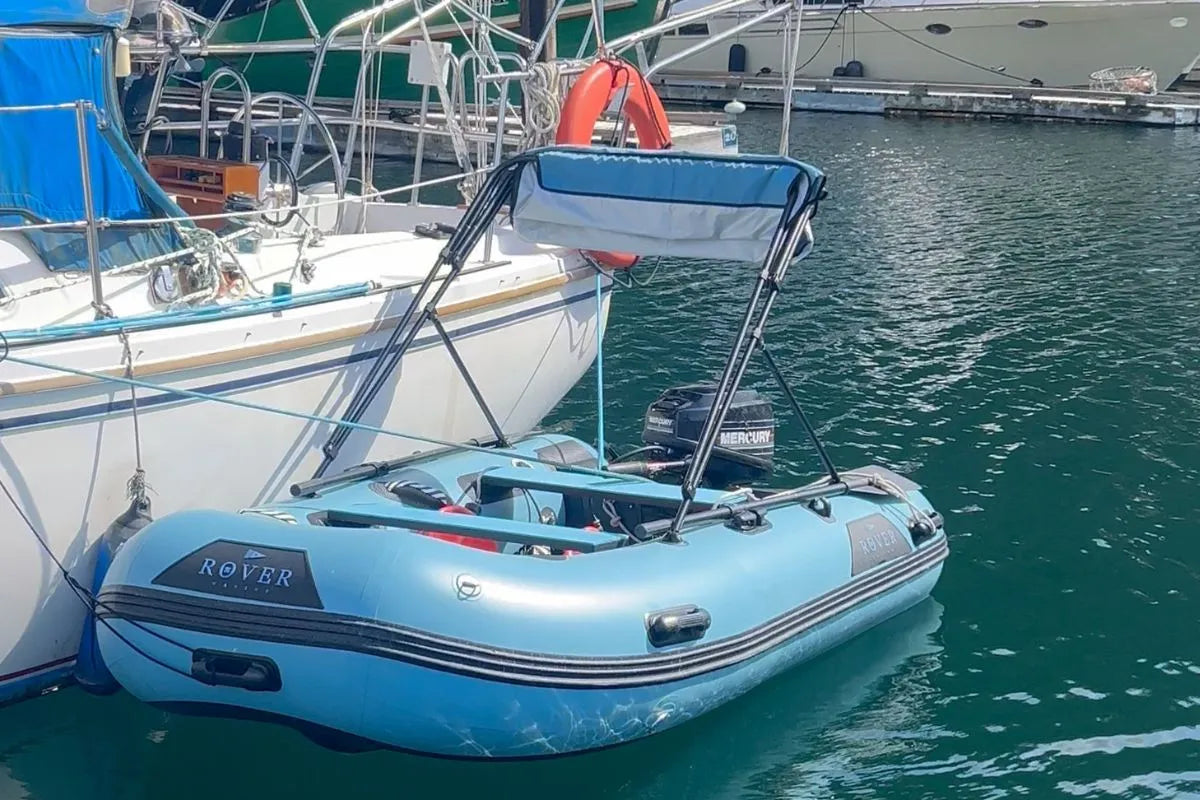
An inflatable dock is a large, flat platform that catches wind and sits in one place. A small inflatable boat, like a Battle Boat or Battle Cat, uses a different anchor setup when stopping for fishing, lunch, or holding position. You are not using the same deadweight system you would use for a floating dock.
For small inflatable boats, choose an anchor based on the size and weight of the boat, lake bottom, wind, current, and intended use. Compact fluke, grapnel, mushroom, river, or folding anchors may all make sense in different conditions. The anchor system for a boat should come from a marine supply shop or local marina that understands your lake bottom.
For Canadian pleasure craft, Transport Canada’s Small Vessel Regulations require pleasure craft not more than 9 m to carry either a manual propelling device or an anchor with at least 15 m of cable, rope, chain, or a combination. You can read the regulation here: https://laws-lois.justice.gc.ca/eng/regulations/SOR-2010-91/section-206.html.
The bottom line
Proper anchoring is the difference between an inflatable dock that stays useful and one that creates problems. The system does not need to be complicated, but it does need to match your water.
The key rules are simple:
- Do not rely on one centre anchor.
- Use at least two control points for most dock setups.
- Match anchor type to bottom type.
- Use enough line for depth and conditions.
- Inspect ropes and attachment points regularly.
- Pull the dock for storms, hail, heavy chop, or exposed wind.
- Ask a local marina or dock installer if your shoreline is exposed, rocky, deep, or unusual.
Canadian Board Co. does not sell dock anchor systems, anchor blocks, shackles, anchor lines, tree wraps, or sandbag anchors. Source those from a marine supply shop, marina, or local dock installer that can match the setup to your lake bottom and shoreline.
14' POPUP AquaDock
14' POPUP YachtDock
8' POPUP Dock
Inflatable docks
Warranty and support note
Free shipping Canada-wide on orders over $100.
Eligible boards are backed by the 60-Day Rider's Guarantee. Inflatable docks are listed with 3-year warranty coverage. General warranty details are available here: https://www.canadianboardco.com/pages/3-year-warranty.
If anything in this guide is unclear for your specific cottage situation, call 1-800-399-5260. We can help you think through the dock setup, but exact anchor hardware should be sourced from a local marina or marine supplier that understands your shoreline.
Frequently asked questions
Can I use a single anchor on a 14-foot inflatable dock?
No. A single-anchor setup can allow an inflatable dock to pivot as the wind changes, which can twist lines and load one attachment point. Use at least a two-point setup, usually bow and stern. In exposed locations, consider a shore line or four-point layout.
What weight anchor do I need for a 14' POPUP AquaDock?
There is no universal anchor weight that works for every 14' POPUP AquaDock setup. Anchor choice depends on bottom type, depth, wind exposure, whether the dock is temporary or left out for the season, and local conditions. In protected water, a lighter two-point setup may be enough. In exposed or rocky water, ask a local marina or dock installer about deadweight-style anchors, weighted bags, or a shore-assisted system.
How long should my anchor line be?
As a starting point, use about three times the water depth in calm conditions and about five times the water depth in windier conditions. For a dock in 6 feet of water, that means roughly 18 feet of line in calm water and roughly 30 feet in wind. Adjust for shoreline, swim area, hazards, bottom type, and local conditions.
What anchor type works on rocky bottoms?
Mushroom anchors do not work well on rock or hard-packed gravel because they do not set. For rocky bottoms, look at deadweight-style anchors, weighted bags, grapnel-style options, or a local marina-recommended system. The right answer depends on the specific lake bottom.
How often should I replace anchor lines?
Inspect anchor lines every season. Replace them immediately if you see UV damage, fading, stiffness, fuzzy texture, fraying, or abrasion. Many cottage owners replace outdoor anchor lines every few seasons, but exposure and use matter more than the calendar.
Do I need to pull the dock for every thunderstorm?
You do not necessarily need to pull the dock for every light rain or brief weather change, but you should pull it for severe weather, hail, sustained high wind, or heavy chop near rocks. Portable inflatable docks are easier to pull than repair, and weather damage is easier to prevent than fix.
Can I use a chain instead of nylon line for anchor connection?
A short section of chain near the anchor can help with chafe protection in some setups, but a full chain line is usually heavy and has little shock absorption. Many setups use marine rope for the main line because it is easier to handle and has some give. Ask a marina for the right rope and chain combination for your lake bottom.
Where do I get heavy-duty anchor hardware in Canada?
Canadian Board Co. does not sell dock anchor systems, anchor blocks, anchor lines, shackles, tree wraps, or sandbag anchors. Buy those from a local marina, marine supply shop, or dock installer that can match the anchor system to your lake bottom, depth, and wind exposure. Call 1-800-399-5260 if you need help understanding how the dock should be positioned, but source the actual anchoring hardware locally.

Leave a comment
All comments are moderated before being published.
This site is protected by hCaptcha and the hCaptcha Privacy Policy and Terms of Service apply.