
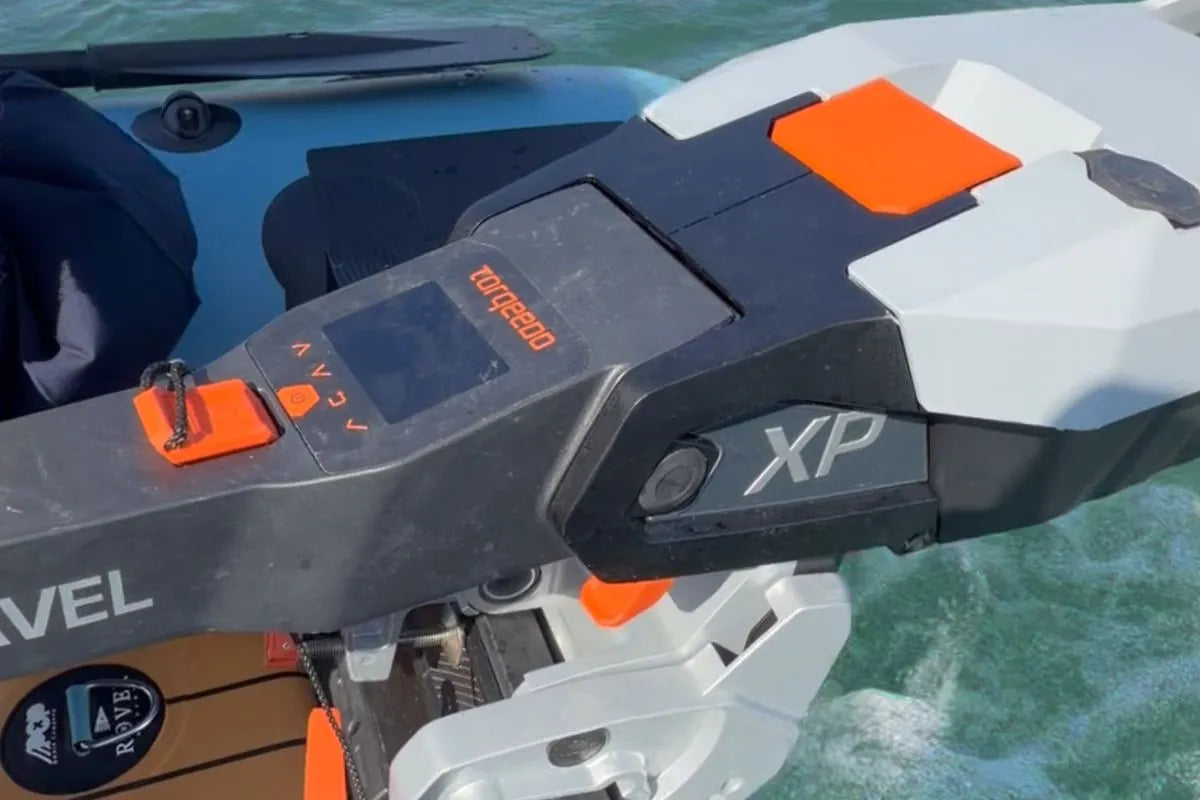
Electric outboards have moved from "future tech" to "real cottage option" over the last five years. For Canadian boaters using an inflatable boat, Battle Boat, Battle Cat, or any other inflatable in the same size range, the electric vs gas decision is now a real choice with real trade-offs. This guide walks the decision specifically for the inflatable-boat segment.
We're a Canadian-owned, family-run team based in Kelowna, BC, and we ship Torqeedo and ePropulsion electric outboards to Canadians from Newfoundland to BC. The 1-800-399-5260 line gets variations of "should I go gas or electric, and which brand" weekly. Here's the framework.
Why electric, why now
The case for an electric outboard on an inflatable boat is specific. It's not the case for electric on a 22-foot fishing boat, where range matters more than anything else. On an inflatable, the use case favours electric in ways that are genuinely competitive with gas:
- Inflatable boats run shorter sessions on average. Cottage shuttles, fishing trips, family runs to the back of the lake. Two to four hours of real on-water time, not full-day expeditions.
- Inflatable boats are quieter by design. The PVC hull is more sound-absorbing than aluminum or fibreglass, and adding a quiet electric motor amplifies the experience.
- Cottage owners with shore power can charge overnight. The single biggest objection to electric, range anxiety, disappears when "fully charged every morning" is part of the routine.
- No fuel handling. No tank to fill, no jerry cans in the boat, no gas smell, no fuel spillage in the lake. Cleaner across the board.
- Maintenance is dramatically simpler. No spark plugs, no impeller, no winterization fuel-system work. Plug it in, run it, store it.
The case for gas remains: longer range without a charge, faster refuel from a jerry can, and lower upfront cost. For most Canadian cottage families, the use case favours electric, but not all of them.
The two brands worth considering:  and ePropulsion
In the inflatable-boat HP range, two brands dominate the Canadian market.
Torqeedo
Torqeedo is the established premium player. The brand has been building electric outboards for decades and is still the name most buyers recognize first. In the current Canadian Board Co. lineup, the key portable Torqeedo options are the Torqeedo Travel XS S, the Torqeedo Travel S, and the Torqeedo Travel XP.
The practical split is simple: Travel XS S is the compact 2HP-equivalent option, Travel S is the 3HP-equivalent choice for tenders and dinghies, and Travel XP is the higher-thrust 5HP-equivalent option for heavier loads, windy conditions, or buyers who want more push from an integrated battery system.
ePropulsion
ePropulsion is the challenger that has reached parity with Torqeedo on many practical specs, often at a better value point. In the current Canadian Board Co. lineup, the main options are the ePropulsion Spirit 1.0 Evo, the ePropulsion Spirit 2, and the ePropulsion eLite.
The Spirit 1.0 Evo is the 1kW / 3HP-equivalent class for small inflatables, tenders, and relaxed cottage cruising. Spirit 2 moves into the 2kW class with a larger integrated battery and more authority for heavier boats or longer runs. The eLite is the compact 500W option for very small boats and short-distance use.

Both brands are widely supported in Canada with parts and warranty service. Both are sold by Canadian Board Co. in the electric outboard collection: https://www.canadianboardco.com/collections/electric-outboard-motors.
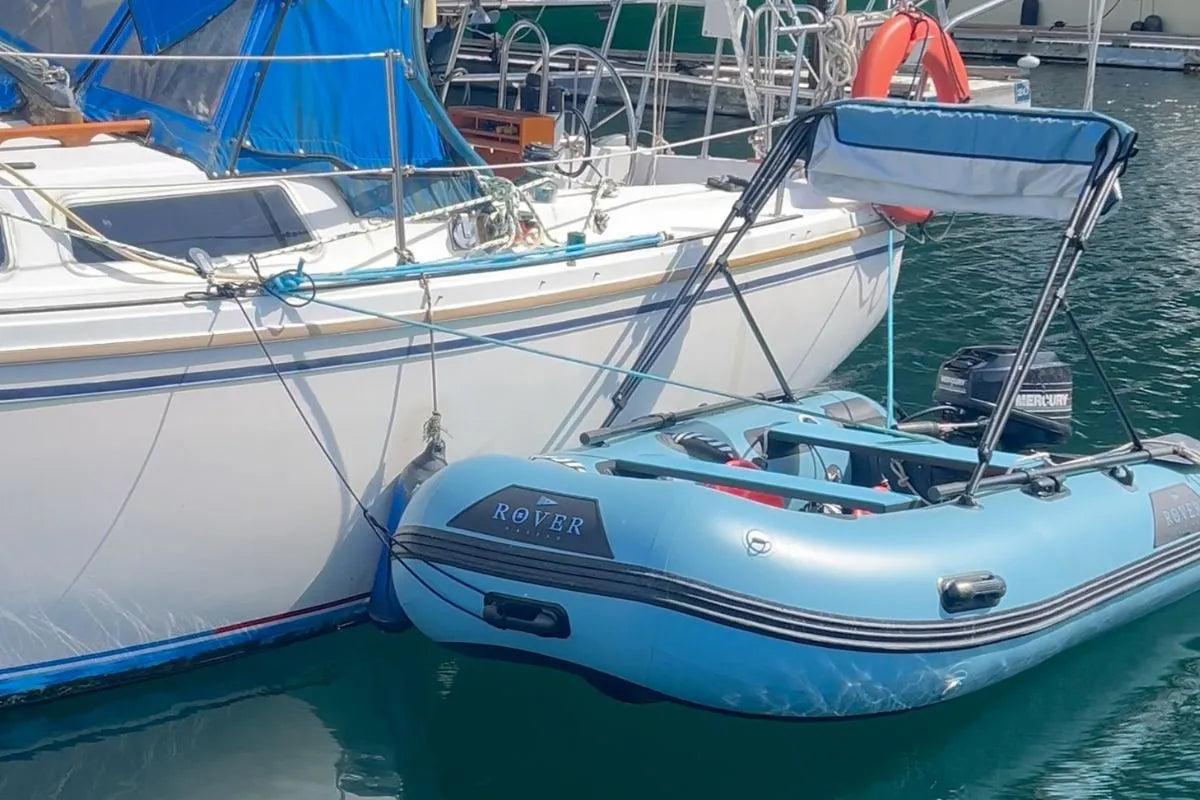
Sizing for the Rover Marine inflatable lineup
Matching the right outboard to the right boat is the most important spec decision. Under-powered means the boat feels sluggish, especially with two adults, gear, wind, or chop. Over-powered means wasted battery, harder handling, and unnecessary stress on the transom. Here's the practical pairing.
8 ft Battle Boat or Battle Cat: 0.5kW to 1.1kW class
The 8 ft inflatable is the compact end of the Rover Marine lineup. It is mostly used as a tender, short-run cottage boat, or solo / two-person lake boat. The right electric outboard is usually:
- ePropulsion Spirit 1.0 Evo, 1kW, 3HP-equivalent class, integrated 1,276Wh battery
- Torqeedo Travel S, 1100W, 3HP-equivalent class
- Torqeedo Travel XS S, 2HP-equivalent class for lighter tender-style use
- ePropulsion eLite, 500W compact option for very short, light-load use
For most buyers, the Spirit 1.0 Evo or Travel S is the safer pick because it gives enough push for two adults without making the setup oversized. The eLite is better treated as an ultra-compact option, not the default choice for a loaded inflatable boat.

10 ft Battle Boat or 10 ft Battle Cat: 1.0kW to 2.0kW class
The 10 ft size is the sweet spot for cottage use. It can carry more people and gear than the 8 ft, but it is still manageable to store and launch. The right pairing depends on how much load you expect.
- ePropulsion Spirit 1.0 Evo for lighter cottage cruising, short trips, and quieter low-speed use
- Torqeedo Travel XP, 1600W and 5HP-equivalent, for more thrust in wind or chop
- ePropulsion Spirit 2, 2kW with a 1539Wh integrated battery, for buyers who want more push and longer practical runtime from the Spirit platform
If the 10 ft boat will mostly carry one or two adults on calm water, 1kW can work. If it will carry kids, coolers, fishing gear, or run in afternoon wind, the 1.6kW to 2kW class is a better fit.
12 ft Battle Boat or 12 ft Battle Cat: 2.0kW and up
The 12 ft size is the biggest inflatable in the Rover Marine lineup and is the one most likely to carry a family, fishing gear, or heavier cottage load. This is where motor choice matters most.
- ePropulsion Spirit 2 is the current practical CBC-listed option for buyers who want a portable 2kW setup with a larger integrated battery.
- Torqeedo Travel XP is the higher-thrust portable Torqeedo option in the current lineup and is a strong choice for buyers who want a premium integrated system.
- For heavier 12 ft use, longer trips, or bigger loads, ask about Navy / Cruise-class systems before buying. Those setups move into larger batteries, separate battery planning, and more detailed rigging decisions.
The important point: do not buy the motor in isolation. Match the motor to the boat size, the expected load, your charging access, and the rating on the boat. Always confirm the current product page, printed specification, and compliance plate before mounting any motor.
Range: the honest math
Electric outboard range is the spec that gets oversimplified everywhere. Manufacturers publish best-case range numbers, usually single passenger, calm water, and low cruising speed. Real-world range depends on five variables:
- Battery capacity: the bigger the battery, the longer the range. This is the only spec that scales cleanly.
- Cruising speed: range drops sharply at higher speeds. Doubling speed can cut range dramatically.
- Load: passengers and gear matter. Heavier boats need more power for the same speed.
- Conditions: wind, chop, and current can cut range quickly.
- Hull efficiency: inflatable boats have more drag than rigid hulls, especially at higher speeds.
Realistic range expectations for a Battle Boat or Battle Cat with two adults aboard:
- 1.0kW motor with stock battery, cruising at 2-3 knots: roughly 1.5-2.5 hours
- 1.0kW motor with stock battery, cruising at 4-5 knots: roughly 0.5-1 hour
- 1.6kW to 2.0kW motor with stock or integrated battery, cruising at moderate speed: usually a practical cottage-session range, not an all-day expedition range
- Higher-power setups at higher speeds: expect range to fall quickly unless you add battery capacity
- Second battery carried on board: doubles the practical operating window for compatible systems
For most cottage use, plan around 2 hours of real on-water time per charge cycle, then plan to charge overnight. Range anxiety on an inflatable boat is mostly a planning problem, not an equipment problem.
Charging: the cottage reality
Electric outboard batteries charge from standard household power. The realistic charge times depend on the battery, charger, and system:
- 1.0kW class batteries usually work well with overnight charging from standard Canadian household power.
- 2.0kW class batteries, like larger Spirit systems, need more planning but are still realistic for overnight cottage charging.
- Fast chargers can shorten the charge window, but they add cost and should be matched to the exact battery.
Most cottage owners charge overnight, roughly 8pm to morning. For day-trippers without overnight access, the practical workaround is to carry a second battery where the system supports it.
For boats stored at marinas without 120V access, or for remote put-ins, the same logic applies as for any electric vehicle: plan around your charging access, or bring a generator. For most Canadian cottage scenarios, shore power exists and overnight charging is the right answer.

The decision matrix: gas or electric
For a Battle Boat or Battle Cat, the gas-vs-electric decision usually comes down to four questions.
Do you have shore power at the cottage?
Yes means electric is on the table. No means gas may still be the easier answer unless you are carrying spare batteries or charging from another reliable source.
What's your typical session length?
Under 3 hours means electric works for most cottage use. Four or more hours regularly means you should consider gas, a second battery, or a bigger system.
Do you mind handling fuel?
If you hate fuel cans, fuel smell, spills, winterization, and small-engine maintenance, electric becomes much more attractive.
Do you value quiet operation?
If yes, electric wins clearly. If quiet does not matter and upfront cost is the main driver, gas is still a practical option.
The honest split among Canadian cottage families using inflatable boats: plenty still run gas, especially if they already own the motor. But the electric share is growing every year, especially among new buyers who do not have legacy gas-engine investment.
What about used or budget options?
Both Torqeedo and ePropulsion hold value reasonably well, and used markets exist. The cautions:
- Battery health is the single most important variable in a used electric outboard. A motor with an older battery has noticeably less range than one with a fresh battery. Replacement batteries can be expensive, sometimes expensive enough to change the whole buying decision.
- Older Torqeedo Travel models are still functional but may not match the current Travel lineup. Older Travel 1003 / 1103 models can still work, but current CBC-listed Torqeedo options focus on Travel XS S, Travel S, and Travel XP.
- Older ePropulsion models should be checked carefully. The current Spirit lineup is much more mature than the earliest platforms.
- Budget electric brands beyond Torqeedo and ePropulsion exist, but parts support and warranty service in Canada can be spotty. We do not build recommendations around brands we cannot confidently support.
For a buyer who wants electric but is at the budget edge, the right call is usually a current 1kW class ePropulsion or Torqeedo setup paired with an 8 ft or 10 ft Battle Boat, depending on load. If you are trying to keep the package simple and serviceable, do not chase the cheapest motor online. Buy something with parts support, warranty support, and a real person you can call.
Service, parts, and warranty
Both Torqeedo and ePropulsion are supported in Canada through dealer networks. Service work for either brand depends on the issue, the part, the motor model, and the service centre, but replacement props, lower-unit parts, chargers, batteries, and battery service are all routine parts of the category.
The electric outboard collection is here: https://www.canadianboardco.com/collections/electric-outboard-motors.
Warranty coverage varies by brand and model, so check the exact product page before buying. For warranty work, we coordinate directly with the manufacturer and either ship parts or coordinate service. Call 1-800-399-5260 to start a warranty case or confirm the coverage on a specific motor.
The honest recommendation
For most Canadian cottage owners buying their first inflatable boat with an electric outboard, the recommendation is:
Best value setup
Battle Boat 8 ft or 10 ft plus ePropulsion Spirit 1.0 Evo. This is the clean, practical, low-maintenance cottage setup for short runs, quiet water, and buyers who want an electric alternative to a small gas motor.
Best premium portable setup
Battle Boat 10 ft or 12 ft plus Torqeedo Travel XP. This is the premium portable option for buyers who want more thrust, a polished Torqeedo platform, and better confidence in wind or heavier load.
Best fishing and stability setup
Battle Cat 10 ft or 12 ft plus ePropulsion Spirit 2 or Torqeedo Travel XP, depending on load and budget. The catamaran stability with quiet electric power is the refined fishing and family platform in the lineup.
For boaters who already have a gas outboard and are evaluating switching: it's worth a real conversation. Call our line. The trade-off depends heavily on how you actually use the boat, and we'd rather talk you out of an unnecessary swap than into one that won't pay back.
Browse the full electric outboard collection at https://www.canadianboardco.com/collections/electric-outboard-motors. Boats live at https://www.canadianboardco.com/collections/boats.
Shipping, warranty, and support
Free shipping Canada-wide on orders over $100.
Eligible boards are backed by the 60-Day Rider's Guarantee. Warranty coverage varies by product type and electric motor model, so check the exact motor page before buying. General warranty information is available here: https://www.canadianboardco.com/pages/3-year-warranty.
If you are not sure which motor fits your inflatable boat, call 1-800-399-5260. The people who answer are paddlers and boaters, not a call centre.
Frequently asked questions
Can I use a regular electric trolling motor on a Battle Boat?
Trolling motors work for low-speed maneuvering but aren't designed for sustained cruising. For real on-water use, shuttles, family runs, or getting back to the dock against wind, a proper electric outboard like Torqeedo or ePropulsion is the right call. Trolling motors as a primary propulsion choice work only for very small boats and very short distances.
How long does it take to charge an electric outboard battery?
Charge time depends on the battery size and charger. A 1kW class battery can often be handled with overnight cottage charging. Larger 2kW class systems need more time unless paired with a faster charger. Plan to charge overnight from standard household power, and consider a second battery if your cottage use involves multiple long trips in a day.
Is a Pleasure Craft Operator Card needed for electric outboards?
Yes. In Canada, if you operate a recreational boat with a motor, including an electric motor or electric trolling motor, you need proof of competency. The most common proof is a Pleasure Craft Operator Card. This is separate from Pleasure Craft Licensing. A Pleasure Craft Licence is required when the motor or motors total at least 10 HP, or 7.5 kW, and the craft is principally operated and maintained in Canadian waters. Check Transport Canada here: https://tc.canada.ca/en/marine-transportation/preparing-operate-your-vessel/pleasure-craft-operator-card-pcoc.
Are Torqeedo and ePropulsion outboards saltwater-rated?
Yes, both brands make motors suitable for saltwater use, but care matters. Rinse with fresh water after every saltwater outing, inspect for corrosion, and do not leave the motor sitting partially submerged in saltwater.
What's the difference between Torqeedo Travel and Cruise lines?
Travel models are portable electric outboards built for tenders, dinghies, and smaller boats. In the current Canadian Board Co. lineup, Travel XS S, Travel S, and Travel XP cover the compact to higher-thrust portable range. Cruise-class systems are higher-power, separate-battery systems for bigger loads, longer trips, and more involved rigging. For 8 ft to 10 ft inflatables, Travel or Spirit-class motors are usually the first place to look. For 12 ft inflatables with heavier loads, talk to us before choosing.
Is electric really cheaper to operate than gas?
Per hour, yes. Charging an electric battery costs far less than filling a gas can, and maintenance is dramatically lower. The catch is upfront cost. Electric motors and batteries often cost more at purchase, so the payback period depends on how many hours you run each season. Cottage owners who run often and have shore power usually feel the benefit fastest.
Can I take an electric outboard off the boat for charging?
Yes, depending on the model. Many Torqeedo and ePropulsion portable systems are designed around removable batteries or portable motor assemblies. That lets you bring the battery or motor up to the cottage for charging while leaving the boat at the dock. Check the exact motor configuration before buying, because battery setup varies by model.
What if the battery dies mid-trip?
Most inflatable boats are still paddle-able with emergency oars, but you should not plan your trip around that. Watch the motor display, keep range margin, avoid full-throttle running far from the dock, and carry a second battery if you are doing longer trips. Electric range warnings are useful, but they do not replace planning.

Leave a comment
All comments are moderated before being published.
This site is protected by hCaptcha and the hCaptcha Privacy Policy and Terms of Service apply.