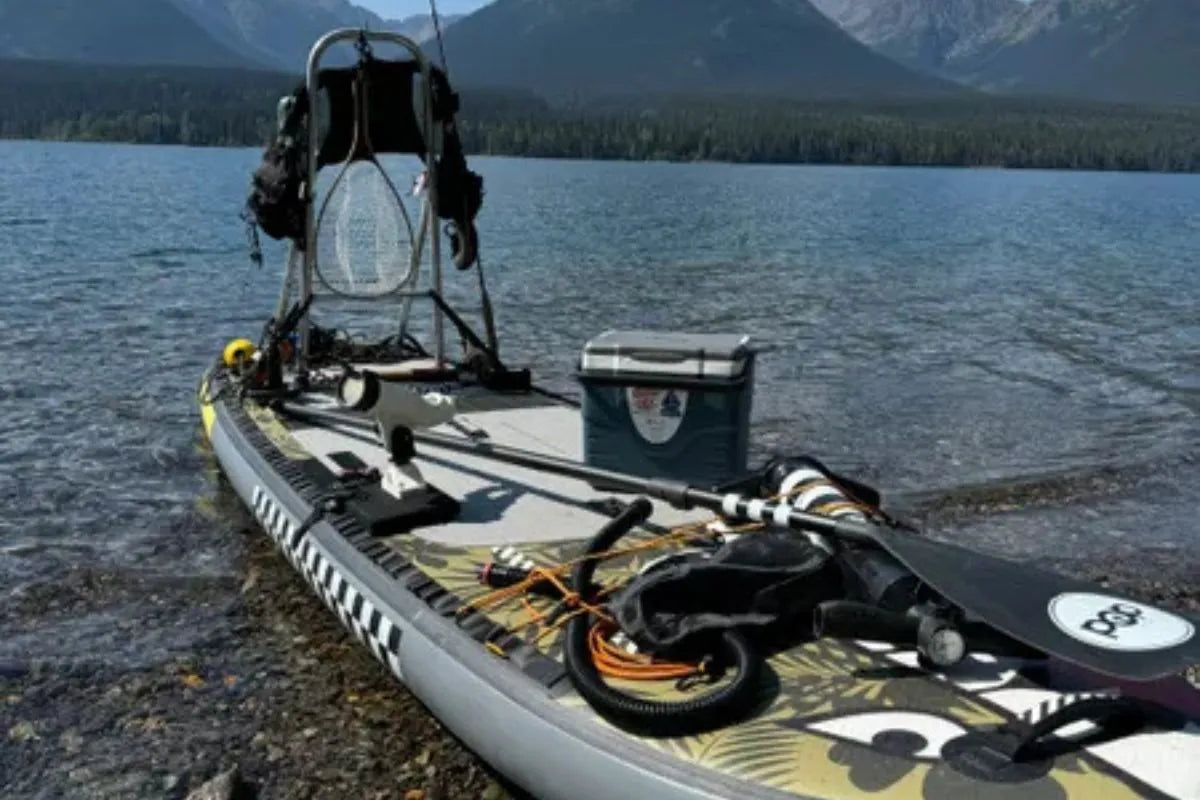
Fishing from a paddleboard is one of the most practical ways to reach quiet Canadian water without a trailer, launch ramp, or big storage setup. A stable inflatable SUP can get you into shallow weed beds, backcountry lakes, narrow river mouths, and calm coves where a larger powered boat may not make sense.
Canadian Board Company is a 100 percent Canadian owned and operated business based in Kelowna, BC. During fishing season, the Ionic Adventure Hook Em Edition is one of the boards customers ask us about most on our 1-800-399-5260 line. This guide breaks down where SUP fishing works, what safety and licence rules to check, and which board makes the most sense for the job.
Why paddleboards are an underrated Canadian fishing platform
A traditional fishing boat has three common problems for many Canadian anglers: access, noise, and setup. A trailer, launch ramp, and parking spot can rule out some of the best water. Many Crown land lakes, smaller park access points, cottage-country river put-ins, and rocky shorelines are easier to reach with an inflatable board than with a full boat setup.
A paddleboard also moves quietly. Instead of motoring into a cove, you can drift in, adjust your position, and cast without the same engine noise or wake. From a standing position, you can often see weed lines, rock piles, drop-offs, and shallow structure more clearly than you can from a low seated position.
The trade-off is stability. Casting from a paddleboard takes more balance than fishing from a boat, especially with wind, chop, boat wake, or cold water in the mix. The right board makes it realistic. The wrong board can make it frustrating fast.
The right inflatable paddleboard for fishing
For fishing, width and deck space matter. A narrow touring or performance board is not the right fit for most anglers. You want a stable platform, practical tie-down points, room for gear, and a way to manage rods safely.
Ionic Adventure Hook Em Edition
The Hook Em Edition is the purpose-built fishing option in the Ionic lineup. It has two rear flush-mount rod holders, a Scotty mount for a rod holder, camera, or fish finder bracket, and extra attachment points for fishing-day gear.
For most Canadian anglers buying their first fishing-focused paddleboard, this is the cleaner choice because the rod holders are already built into the package.
Ionic Adventure Ark
The Ionic Adventure Ark is the broader adventure board. It is built for gear-hauling, bigger paddlers, touring, family use, and fishing setups where you want a versatile board for more than one purpose.
The Ark works well for fishing when paired with the right rod holder setup, and it still makes sense for non-fishing weekends.
Best pick for fishing first: choose the Hook Em Edition if fishing is the main goal. Choose the Adventure Ark if you want one board that can fish, tour, carry gear, and handle family use.
Canadian fishing licence rules to check before you launch
Fishing licence rules are set by province or territory, and the exact fees can change by season, residency, age, species, and waterbody. Before you fish, check the official licence portal for the province or territory where you are launching.
2026 reference points by region
- Ontario: Most anglers need an Outdoors Card plus a recreational fishing licence. Ontario lists separate Sport and Conservation licence options, with different catch and possession limits.
- Quebec: Quebec separates licences by category, age, residency, and species. Zone-specific rules are important, especially if you are fishing a new lake or river.
- British Columbia: Freshwater fishing licences are handled through the provincial system, while tidal water fishing is handled federally through Fisheries and Oceans Canada. Conservation surcharges can apply to certain species.
- Alberta: Recreational anglers generally need an active WiN before buying a sportfishing licence, with exemptions for some age and residency categories.
- Saskatchewan and Manitoba: Check the current provincial licence portal and local waterbody rules before heading out, especially for catch-and-release waters and special management areas.
- Atlantic Canada: Rules vary by province and by freshwater versus tidal water. Salmon, striped bass, and other species may have separate rules, seasons, or release requirements.
- Yukon, Northwest Territories, and Nunavut: Territorial rules are different, so check the official territorial government portal before fishing.
The safest way to write this down is simple: buy your licence from the official provincial or territorial source, read the local zone rules, and check species-specific limits before keeping fish. Licence fees and limits should never be treated as permanent because they can change from year to year.
Federal safety rules for paddleboards in Canada
When a stand-up paddleboard is being used as a navigation craft in Canada, it falls under federal small-vessel safety rules. Transport Canada makes an important distinction for stand-up paddleboards: if every person on board is wearing a properly sized PFD or lifejacket, the board must carry a sound-signalling device, and a watertight flashlight is required if operating after sunset, before sunrise, or in restricted visibility.
If the PFD or lifejacket is not being worn, paddlers should carry the required safety equipment on board, including a properly sized PFD or lifejacket, a sound-signalling device such as a whistle, and the required floating throw rope or buoyant heaving line. For fishing alone, in cold water, or far from shore, wearing the PFD is the practical choice.
Transport Canada supports leash use, but a leash does not replace a lifejacket or PFD. For cold Canadian water, wind, and solo fishing days, a leash, waterproof phone pouch, and basic float plan are smart additions.
Canadian Board Company carries water safety gear for paddlers, including PFD and safety accessories.
Best Canadian SUP fishing water by region
The best SUP fishing water is usually calm, reachable without a trailer, and shallow enough that you can read structure from the board. Always check open seasons, slot limits, conservation closures, park rules, and local access rules before fishing.
- Ontario shield lakes: Algonquin, the Kawarthas, Muskoka backcountry, and smaller shield lakes can be excellent for smallmouth bass, lake trout, and walleye in season.
- Quebec Laurentians and Eastern Townships: Lakes around regions such as the Laurentians, Memphremagog, and Brome can offer bass, pike, and walleye opportunities depending on zone rules.
- BC Interior: The Okanagan, Shuswap, and Thompson regions have lakes suited to rainbow trout, kokanee, and bass fishing, with many smaller access points that work well for inflatables.
- Alberta foothills and stocked lakes: Many stocked lakes and reservoirs have shore access where an inflatable board is easier than a trailer setup.
- Atlantic rivers and quiet lower-water sections: Paddleboards can work well in calm sections, but Atlantic salmon and other species often carry strict seasonal, licence, and catch-and-release rules.
How to set up your paddleboard for a fishing day
A good fishing setup stays simple. The goal is to keep the deck clean, the board balanced, and essential gear clipped in so nothing important disappears if you bump a rod, shift your feet, or take a swim.
- Inflate the board properly. Pump to the recommended PSI range for the model and confirm the board feels rigid before loading gear.
- Wear your PFD and attach your whistle. This keeps safety simple and avoids digging through a bag if conditions change.
- Attach your leash. A coiled leash helps keep the board close if you fall. It is especially important in wind, current, or cold water.
- Keep rods organized. On the Hook Em Edition, use the built-in rod holders for one rod ready to cast and one rod stowed or ready for trolling.
- Pack a small dry bag. A 5 to 10 litre dry bag is enough for lures, leaders, pliers, a snack, keys, and a phone pouch.
- Use anchors carefully. Only anchor where it is legal, safe, and appropriate for the water conditions. Moving water, wind, boat traffic, and current can make anchoring risky on a paddleboard.
- Clip in accessories. Use D-rings and board hardware to keep light gear attached. Browse board hardware and replacement parts if you need fins, screws, or rigging accessories.
- Tell someone your plan. Share where you are launching, where you expect to fish, and when you expect to be back.
The bottom line
SUP fishing in Canada works because it keeps the day simple. You can pack the board into a vehicle, launch from shore, move quietly, and fish water that is awkward or impossible for a trailer boat. With a fishing-ready board like the Hook Em Edition, a valid licence, and the right safety gear, a paddleboard becomes a practical fishing platform for lakes, rivers, cottages, and backcountry access points.
The Hook Em Edition and Adventure Ark both include our standard 60-Day Rider's Guarantee on boards and a 3-year manufacturer warranty against defects on inflatable paddleboards. Orders over $100 ship free Canada-wide, with some exclusions. Call 1-800-399-5260 if you want help choosing between the two.
Build your fishing-ready paddleboard setup
Start with the board, then add the safety gear and simple rigging pieces that make your day easier on the water.
SUP fishing in Canada FAQ
Do I need a fishing licence to fish from a paddleboard in Canada?
In most cases, yes. Fishing from a paddleboard follows the same sport fishing rules as fishing from shore, a canoe, kayak, or boat. The exact licence, fees, exemptions, and catch limits depend on the province or territory, your residency, your age, the species, and the waterbody.
Is fishing from an inflatable paddleboard stable enough?
Yes, when you use the right board and pick the right conditions. A wide inflatable paddleboard, such as a 36-inch adventure or fishing board, gives much better standing stability than a narrow touring or performance board. Calm water is still the best place to start.
What rod holder setup works on the Hook Em Edition?
The Hook Em Edition includes two rear flush-mount rod holders and a Scotty mount. Most anglers keep one rod ready to cast and one rod secured in a holder.
Can I add a fish finder to a paddleboard?
Yes. Small portable fish finders can be used with compatible mounts and a compact battery setup. Keep the install removable and avoid anything that permanently changes or compromises the inflatable board.
What safety gear is required on a paddleboard in Canada?
For stand-up paddleboards, Transport Canada rules depend on how the PFD is used. Wearing a properly sized PFD or lifejacket simplifies the setup, with a sound-signalling device required and a watertight flashlight needed for low-light or restricted-visibility conditions. If the PFD is carried instead of worn, additional required equipment applies, including a floating throw rope or buoyant heaving line.
Where can I fish without a boat ramp?
Many Crown land lakes, small shield lakes, cottage-country lakes, park access points, and calm river sections have shore launches that work for an inflatable paddleboard. Always check local access rules, park rules, open seasons, and species limits before fishing.
What is the maximum rider weight for the Ionic Adventure Ark?
The Ionic Adventure Ark product page lists an 80 to 425 lb max rider weight range. Gear weight should still be kept balanced and practical for paddling conditions.
Do I need a separate licence for the paddleboard itself?
A human-powered paddleboard does not need a Transport Canada pleasure craft licence. Pleasure craft licensing applies to recreational craft with one or more engines totalling at least 10 horsepower, or 7.5 kW, when principally operated and maintained in Canadian waters.

Leave a comment
All comments are moderated before being published.
This site is protected by hCaptcha and the hCaptcha Privacy Policy and Terms of Service apply.