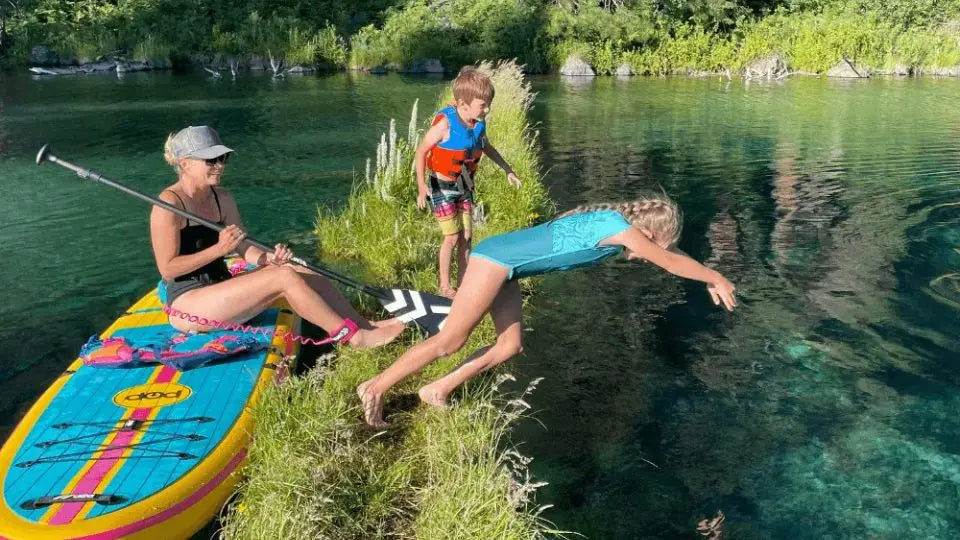
Children can ride on a parent's paddleboard when they are wearing a properly fitted Canadian-approved PFD and the parent is choosing calm, shallow water. Most kids can start standing and balancing on a stable inflatable SUP around ages 6 to 8 with adult help, and many can paddle solo in a protected cove around ages 10 to 12, depending on swim ability, confidence, and supervision.
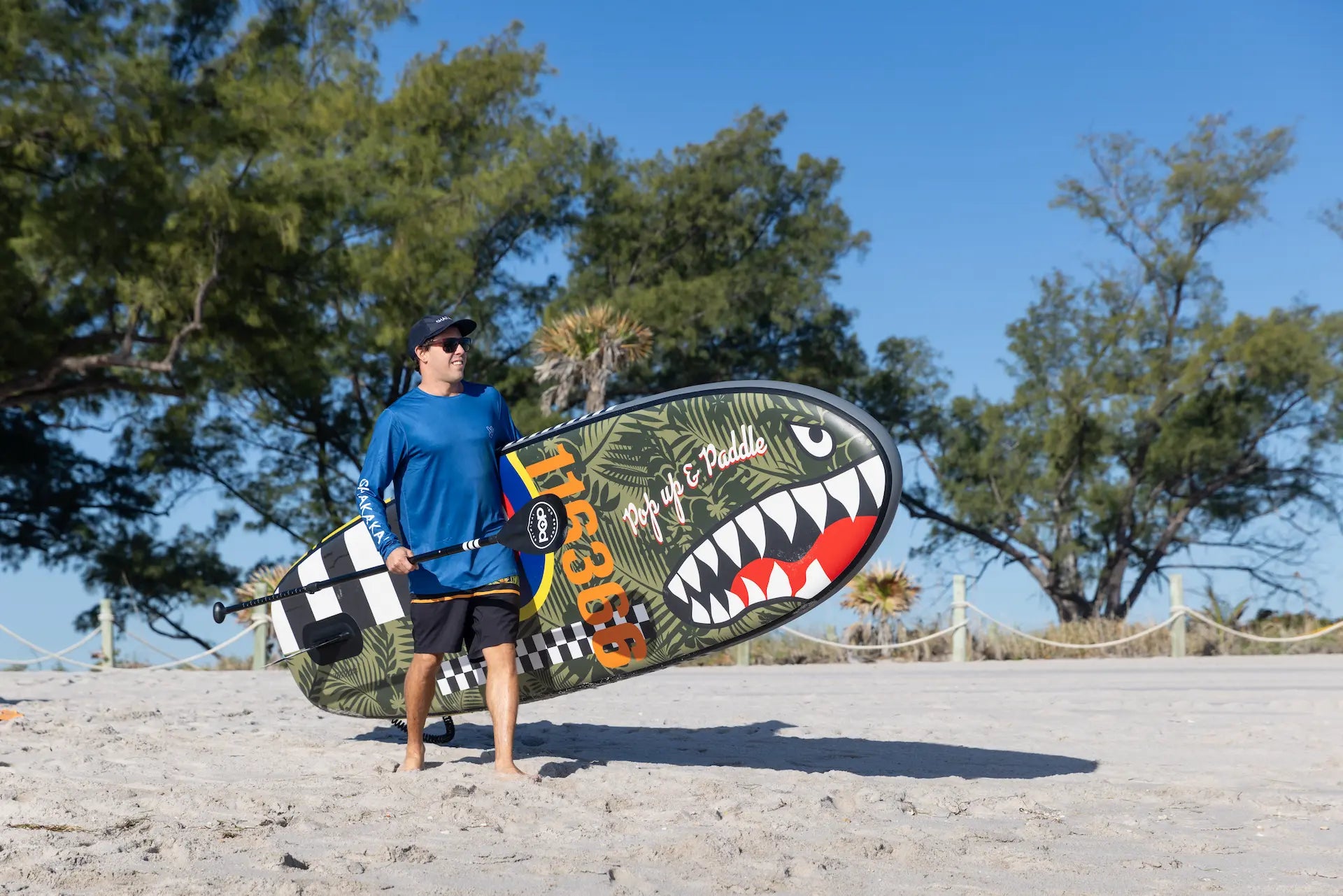
The board matters. For family use, look for a wide inflatable paddleboard, ideally 34 to 36 inches wide, with rigid drop-stitch construction and enough capacity for a parent, child, paddle, dry bag, and water bottle. The 11'6 El Capitan Bomber and Ionic Adventure Ark are both built for that kind of shared Canadian lake use.
Paddleboarding with kids is one of the best ways to introduce children to the water without the friction of a boat. A stable inflatable SUP is the closest thing to a portable swim platform that a Canadian family can buy. On a calm lake, the same board can go from a parent solo paddle to a parent-with-toddler ride to two kids learning beside Dad or Mom over a few summers.
We are a Canadian owned and operated team based in Kelowna, BC, and the family paddleboard question is one of the most common ones on the 1-800-399-5260 line in June. Schools are letting out, the cottage water is finally warming up, and parents want to know what gear actually works.
The PFD rules for kids on a paddleboard
The most important paddleboard rule for any Canadian family is the PFD. Transport Canada states that a lifejacket or PFD is required by law on board for each person on a watercraft, including human-powered craft. For stand-up paddleboards used for a trip or circuit, Transport Canada classifies the board as a human-powered vessel and requires a Canadian-approved lifejacket or PFD on board and available for immediate use.
Our family recommendation is simpler than the legal minimum: kids wear the PFD on the water, every session, regardless of swim ability or how shallow the launch point is.
Children's PFDs are sized by weight, not age. Before you buy, weigh the child and match the device to the label.
| Child size | Typical PFD category | What to check |
|---|---|---|
| Under 30 lb | Infant or small child PFD rated for that weight range | Head support, secure straps, snug fit, and no riding up around the face |
| 30 to 60 lb | Child PFD | Crotch strap, proper buckles, and a fit that stays below the chin and ears |
| 60 to 90 lb | Youth PFD | Full buckle closure, shoulder fit, and enough room to paddle comfortably |
| Over 90 lb | Adult extra-small or small, depending on the child | No loose gaps, no slipping upward, and full range of motion |
A PFD that is too big does not work properly. Transport Canada says children's flotation devices should fit snugly, should not ride up over the child's chin or ears, and should leave less than 7.6 cm, or 3 inches, between the child's shoulders and the device. A fast cottage check is to tighten the straps, lift the PFD at the shoulders, and watch what happens. If it slides up past the ears or chin, it is too big.
Browse our water safety lineup for kids' PFDs and family safety gear. If you are unsure which size to order, call 1-800-399-5260 with your child's weight and we will help recommend the right fit.
When kids can ride, balance, and paddle solo
Every kid is different, but the rough milestones for paddleboarding usually follow a predictable pattern. Treat these as a parent-friendly guide, not a race.
Ages 1 to 3: riding only
A toddler can sit on the front of a parent's paddleboard while the parent paddles. The board should be wide and stable, the child should wear a properly fitted PFD, and the session should stay short, usually 15 to 30 minutes.
Ages 4 to 6: sitting and standing with help
A preschooler can sit or kneel on the parent's board and try standing in calm water with a parent's hand for support. This is the age where kids learn what balance feels like on the water.
Ages 7 to 9: standing on the parent's board
A child this age can often stand on the front of a stable inflatable paddleboard while the parent paddles from the back. Falls are normal. A fitted PFD, warm water, and a calm parent turn most falls into part of the fun.
Ages 10 to 12: solo paddling in calm water
With a swim test passed and an adult nearby, many kids this age can paddle their own board in a protected cove. The right setup depends on the child's size, confidence, and how well they respond after falling in.
By the teen years, most kids with paddling experience can handle a stable inflatable SUP on calm-water Canadian lakes, with the same basic habits adults should follow: PFD, whistle, leash, weather check, and someone on shore who knows the plan.
The right board for a Canadian family
The family board has one job: make everyone feel steady enough that the first few paddles are fun. Narrow performance boards are not the right choice for parent-plus-child use. You want width, deck space, and a capacity number that leaves room for real life.
11'6 El Capitan Bomber
The El Capitan is the standard family-friendly recommendation for most Canadian cottages. It is wide enough for shared use and stable enough for newer paddlers who care more about confidence than speed.
- Dimensions: 11'6" x 36" x 6"
- Max rider weight: 420 lb
- Construction: AIR RIDE woven drop-stitch and PVC
- Optimal inflation: 12 to 15 PSI
- Current listed price: Sale $899 CAD, regular $1,199 CAD
Ionic Adventure Ark
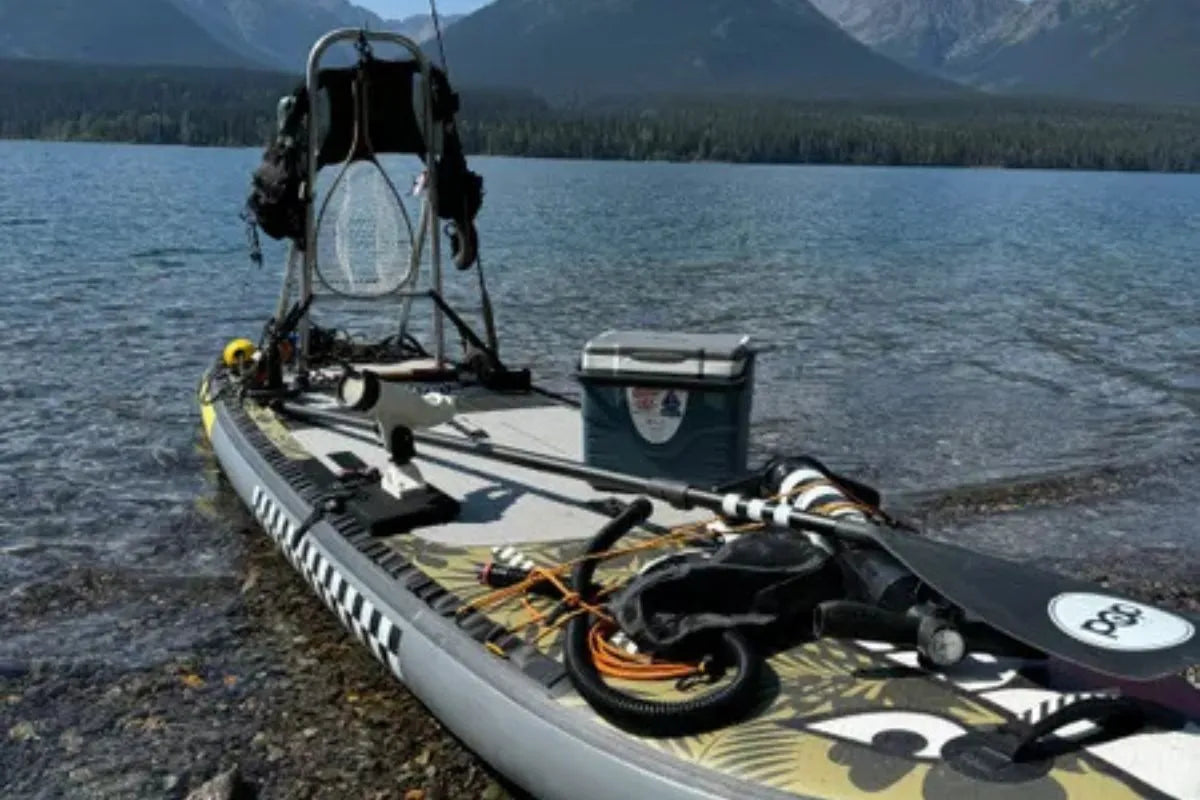
The Adventure Ark is the upgrade when you want extra gear attachment points. The bungees and D-rings are useful for snacks, a dry bag, a kid's water bottle, or an accessory setup for longer cottage days.
- Dimensions: 11'6" x 36" x 6"
- Max rider weight: 80 to 425 lb
- Extras: 2 trapper bungees, 4 extra D-rings, Scotty mount
- Package: Board, wheeled bag, paddle, leash, pump, fin, repair kit
- Current listed price: Sale $1,199 CAD, regular $1,599 CAD
For families that paddle together regularly, two boards is often the better long-term setup. One wide family board, like the El Capitan or Adventure Ark, plus one more agile board for the parent who paddles solo gives everyone more flexibility. The 11' Yacht Hopper can fill that solo/touring role for the right paddler.
The cottage swim platform that makes paddling with kids easier
The single biggest unlock for paddling with younger kids is having a stable platform to launch from, rest on, and return to. An inflatable dock deployed off the shoreline becomes that home base.
14' POPUP AquaDock
The 14' POPUP AquaDock is 14 feet long, 7 feet wide, and 8 inches thick, giving families 98 square feet of stable platform space. The product page lists capacity at up to 6 adults and 2,000 lb, making it a practical hub for kids learning to paddle.
- Best use: Swim platform, rest stop, dock extender, and paddleboard launch point
- Current listed price: Sale $1,399 CAD, regular $1,599 CAD
- Good pairing: AquaDock and Chair Bundle for a more comfortable supervising setup
Kids who get tired can paddle back to the dock. Kids who fall in can climb onto the dock instead of trying to climb back onto the board. Parents who want to rest can pull alongside and hand off snacks, towels, or encouragement without ending the whole session.
Safety habits that matter
Good family paddleboarding is not about making the water feel scary. It is about setting simple rules early so everyone knows what to do.
- PFD on, always. Not sitting on the dock as a backup. On the child, zipped and buckled.
- Run a 30-second float plan. Tell the kids where they can go, where they cannot go, and what to do if they get tired.
- Use the lap test. Before a child paddles solo, have them swim a short lap in their PFD with a parent watching.
- Respect hot weather. Sunscreen, hats, water bottles, snacks, and shade breaks matter more than most families expect in June and July.
- No swimming under a paddleboard. Make it a clear rule from day one.
- Use the buddy system. No kid paddles alone, even if they are a strong swimmer.
- Watch wind first, distance second. A short paddle into wind can feel much harder for a child on the way back.
Common questions parents ask
How young can a child be on the board?
With a properly fitted infant or child PFD, a toddler can ride on the front of a parent's stable inflatable SUP in calm, shallow water. Many families start with very short sessions around ages 1 to 3, then build from there as the child gets more comfortable.
What about cold water in June?
Early summer water can still be cold in many parts of Canada, especially in Northern Ontario, Quebec, Atlantic Canada, and BC interior lakes. Check local conditions before going, shorten sessions when the water is cold, and consider wetsuits for kids when the water is not comfortable for swimming.
Do kids need their own board?
Eventually, yes. By ages 10 to 12, many kids who paddle regularly want their own board. A wide board like the El Capitan or Adventure Ark can stretch the timeline because it works for parent solo use, parent-plus-child use, and kid solo use on calm water.
The bottom line
Paddleboarding with kids in Canada works when the board is stable enough, the PFD is fitted correctly, and the parent keeps the rules simple. A wide drop-stitch inflatable like the 11'6 El Capitan Bomber or Ionic Adventure Ark, paired with a stable inflatable dock for a home base, is the setup that grows with a family.
Boards are covered by our 60-Day Rider's Guarantee and our 3-year manufacturer warranty on inflatable paddleboards. We also offer free shipping Canada-wide on orders over $100.
Need help choosing the right family setup?
Browse family-friendly paddleboards, kids' PFDs, and inflatable docks, or call us with your child's age, weight, swim ability, and cottage setup. We will help point you toward the gear that actually makes sense.
FAQ: Paddleboarding with kids in Canada
What age can my child ride on my paddleboard?
With a properly fitted PFD, a child can ride on the front of a parent's stable inflatable SUP in calm, shallow water. Many families start around ages 1 to 3 with very short sessions and close supervision.
What PFD does my child need?
Children's PFDs are sized by weight, not age. Common ranges are under 30 lb, 30 to 60 lb, 60 to 90 lb, and over 90 lb. The PFD should fit snugly and should not ride up over the child's chin or ears.
When can my child paddle solo?
Many kids can paddle a stable board solo on calm protected water around ages 10 to 12, with adult supervision nearby. The real deciding factors are swimming ability, comfort in a PFD, confidence after falling in, and whether the child listens to safety boundaries.
What is the safest paddleboard for a family with young kids?
A wide, stable drop-stitch inflatable SUP is the best fit for most families. The 11'6 El Capitan Bomber is 36 inches wide with a 420 lb maximum rider weight, while the Ionic Adventure Ark adds more gear attachment options.
Can my kid swim under the paddleboard?
No. Kids should not swim under an inflatable paddleboard. Make this a clear rule from the first session.
How long can a kid paddle at a time?
For toddlers, 15 to 30 minutes is often plenty. Ages 4 to 6 may handle 30 to 45 minutes. Older kids can often manage 60 to 90 minutes with breaks, but heat, wind, hunger, and cold water can shorten the real window.
Do I need an inflatable dock to paddleboard with kids?
No, but it changes the experience. A 14' POPUP AquaDock gives kids a stable home base they can paddle to, climb onto, and rest at, which makes family paddle sessions easier to manage.
How do I check that a child's PFD fits properly?
Tighten all straps, including the crotch strap if the PFD has one, then lift at the shoulders. If the PFD slides up past the child's ears or chin, it is too big. If it stays in place and the child can move comfortably, the fit is much better.

Leave a comment
All comments are moderated before being published.
This site is protected by hCaptcha and the hCaptcha Privacy Policy and Terms of Service apply.