
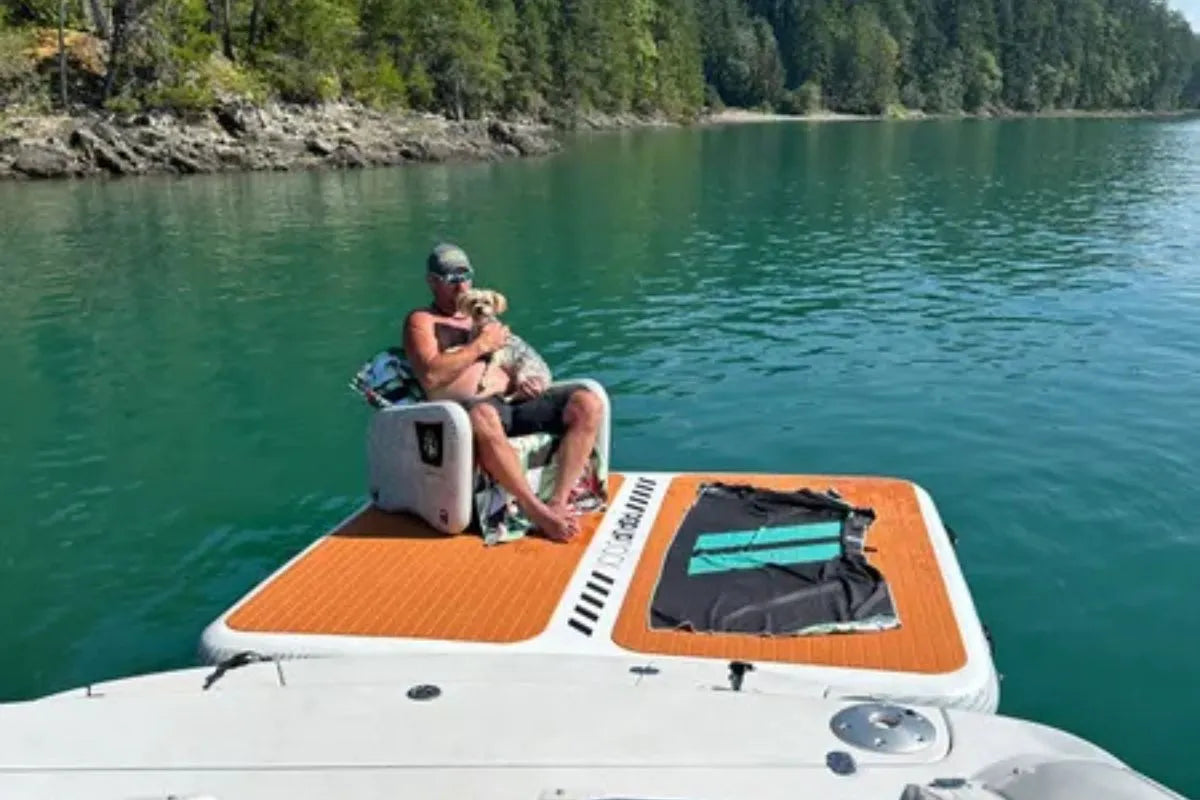
The honest answer: a traditional floating dock is best for permanent waterfront and boat mooring. An inflatable dock is best when you want a swim platform, lounge space, cottage setup, rental-friendly dock, or portable floating platform you can deploy, remove, and store for the Canadian off-season.
When people compare an inflatable dock vs a floating dock, they are usually comparing two very different things.
A traditional floating dock is a semi-permanent waterfront structure. It usually stays in place through the season, needs hardware, often requires more installation effort, and is designed for developed waterfront.
An inflatable dock is a portable floating platform. It inflates when you need it, anchors for swimming and lounging, packs away for storage, and can travel between cottages, lakes, rentals, and boats.
Canadian Board Co. is a Canadian owned and operated shop based in Kelowna, BC. Inflatable docks are one of the categories we are best known for, so we will make the inflatable case clearly, but we will also be honest about where a traditional floating dock still makes sense.

An inflatable dock gives you swim, lounge, and launch space without building a permanent waterfront structure.
Inflatable dock vs floating dock: the quick comparison
Inflatable dock
Inflate, position, and anchor. Setup is usually simple enough for cottage owners, renters, and families to manage without a dock crew.
Traditional floating dock
Often requires assembly, hardware, floats, anchoring, seasonal haul-out, and more planning. Larger systems may require professional help.
Inflatable dock
Deflates, rolls, packs into a carry bag, and can move between lakes, rental cottages, boats, and storage spaces.
Traditional floating dock
Effectively fixed once installed. It can be moved, but it is not something most people casually transport between locations.
Inflatable dock
Deflate, dry, pack, and store indoors away from ice. This is a major advantage in Canadian climates.
Traditional floating dock
May need to be removed, disconnected, winched, stored in sections, or protected from ice movement depending on the lake.
Inflatable dock
Best for swimming, lounging, extra platform space, paddleboard launching, cottage renters, boats, kids, and seasonal use.
Traditional floating dock
Best for permanent waterfront access, boat mooring, long-term shoreline infrastructure, and developed cottage properties.
Simple rule: if you need permanent boat mooring, look at a traditional dock. If you want portable swim and lounge space, an inflatable dock is usually the better fit.
Where an inflatable dock wins
1. You want a dock without building a dock
A traditional dock is infrastructure. It usually means planning, hardware, installation, storage, and ongoing upkeep. An inflatable dock is a product you can set up when you need it and pack away when you are done.
That makes inflatable docks useful for families who want more lake space but do not want to build or expand a permanent dock.
2. You rent cottages or move between lakes
If you rent cottages, visit friends, use public lakes, or travel between waterfronts, a traditional floating dock does not solve your problem. It stays where it is installed.
An inflatable dock can travel with you. It can be used at a rental cottage if the host allows it, off the side of a boat, beside a fixed dock, or near shore as a temporary swim platform.
3. You want it gone for winter
Canadian winter is one of the biggest reasons inflatable docks make sense. Ice movement can be hard on anything left in the water. A portable inflatable dock comes out before winter, stores indoors, and waits for next season.
4. You want a swim and lounge platform
Most inflatable dock buyers are not trying to replace a full marina-style dock. They want more usable lake space.
An inflatable dock works well for:
- Swimming
- Kids playing near shore
- Sun lounging
- Paddleboard launch and rest stops
- Floating chairs
- Boat-side hangouts
- Extra space beside a fixed dock
5. You want lower commitment
A built dock is a serious waterfront decision. An inflatable dock is easier to try, easier to move, easier to store, and easier to replace or upgrade later.
Check local rules before anchoring
Rules can vary by province, municipality, park, conservation authority, lake association, rental host, and shoreline type. Inflatable docks are portable, but you should still check local rules before anchoring anything in the water.
Where a traditional floating dock still makes sense
Traditional floating docks still have a real place. If you own developed waterfront and want long-term access, boat mooring, and a fixed shoreline setup, a traditional floating dock can be the right choice.
A traditional floating dock may be better if:
- You own the shoreline
- You want a permanent dock system
- You need regular boat mooring
- You want a walkway from shore to deeper water
- You need a structure that stays in the same place all season
- You are prepared for installation, maintenance, and seasonal storage
For permanent waterfront infrastructure, build the dock properly and follow local regulations. For floating recreation space, an inflatable dock is often the more practical choice.
AquaDock vs YachtDock: which inflatable dock fits your use?
At Canadian Board Co., the two main 14-foot inflatable dock choices are the POPUP AquaDock and the POPUP YachtDock. They are both portable floating platforms, but they are not built for the exact same use.
14' POPUP AquaDock
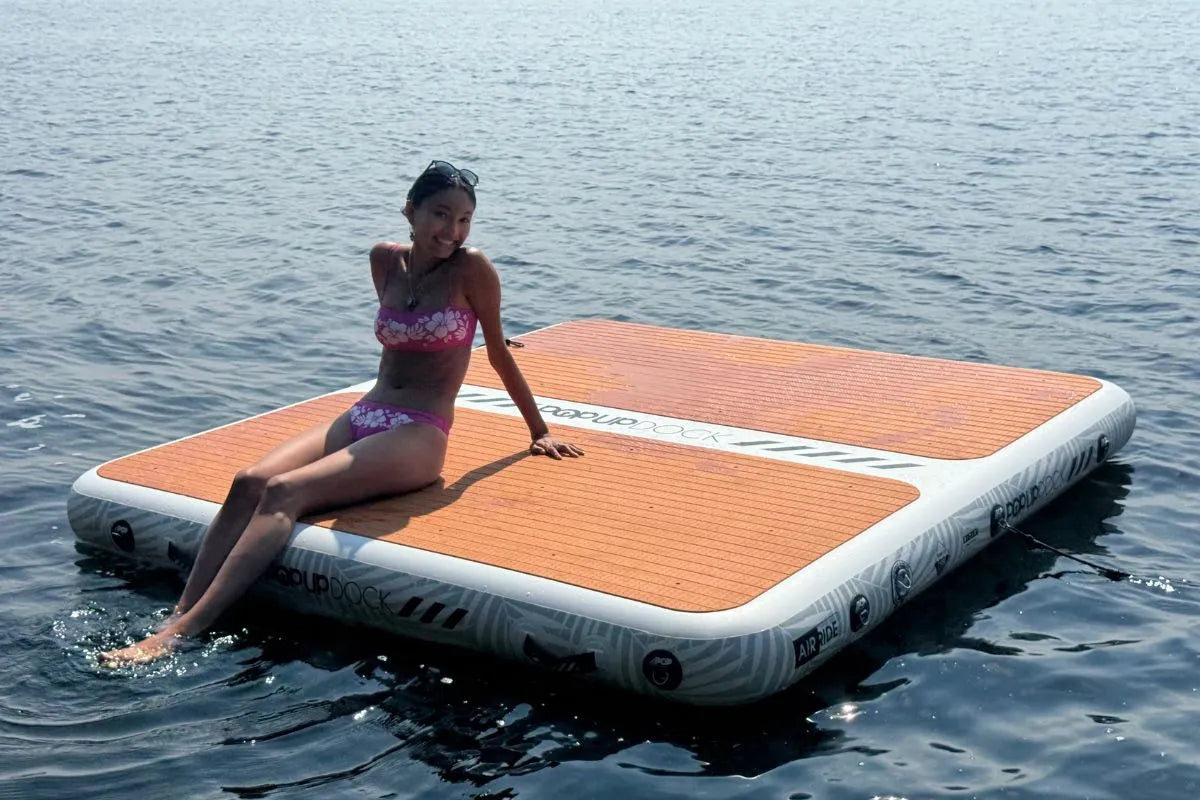
Best for family swimming, kids, cooling off, and cottage lounging. The centre wet zone makes it feel more like a floating swim platform.
- Great family cottage dock
- Centre wet zone
- Good for kids and swimmers
- Useful paddleboard launch area
- Strong all-around inflatable dock
14' POPUP YachtDock
Best for a solid full platform, chairs, coolers, dry bags, boat-side use, and a drier lounge setup.
- Solid full platform
- More dry usable surface
- Great for chairs and gear
- Better for boat-side use
- Higher listed capacity
Choose AquaDock if you want kids, swimming, cooling off, and a wet-zone family platform. Choose YachtDock if you want a solid full deck for chairs, coolers, bags, and boat-side lounging.

Inflatable docks are built for recreation first: swimming, lounging, paddleboarding, and boat-side lake time.
Inflatable dock cost vs floating dock cost
A traditional floating dock is usually a larger project. The final cost can include dock sections, floats, hardware, anchoring, labour, delivery, permits, seasonal removal, storage, and maintenance.
An inflatable dock is usually a simpler purchase. You buy the dock, inflate it, anchor it properly, use it, and store it when the season ends.
That does not mean an inflatable dock replaces every traditional dock. It means the cost comparison depends on what you are trying to do.
- If you need permanent boat mooring: a traditional floating dock may justify the larger project cost.
- If you want swim and lounge space: an inflatable dock is usually the easier and lower-commitment option.
- If you rent or travel: an inflatable dock is the only option that moves with you.
- If you want winter storage simplicity: inflatable wins clearly.
Permits and shoreline rules
Permit rules are not the same across Canada. They can depend on the province, municipality, conservation authority, park, body of water, rental property, lake association, and whether the dock is permanent, seasonal, temporary, or portable.
Because an inflatable dock is not a fixed built structure, it is often simpler than installing a traditional dock. But simpler does not mean “no rules anywhere.”
Before anchoring any dock, check:
- Provincial shoreline rules
- Municipal bylaws
- Conservation authority rules
- Park or campground rules
- Rental host rules
- Lake association guidance
- Navigation and boat traffic considerations
Rental cottage note
If you plan to bring an inflatable dock to a rental cottage, ask the host before booking. Most issues are not about the dock itself, but where it can be anchored, how it affects shoreline access, and whether the rental property has specific water-use rules.
Setup, anchoring, and storage
An inflatable dock is easy to use, but it still needs to be set up correctly. The dock should be inflated to the recommended PSI, positioned safely, anchored properly, and checked during changing weather.
Basic setup checklist:
- Inflate on a clean surface near the water
- Use the recommended PSI for the dock model
- Inspect valves, D-rings, handles, and seams
- Anchor based on lake depth, wind exposure, and shoreline layout
- Keep it away from boat traffic lanes
- Pull it in or secure it if storms or strong wind are forecast
- Dry it before long-term storage
For anchor hardware, visit: https://www.canadianboardco.com/collections/hardware.
For the full anchoring guide, visit: https://www.canadianboardco.com/blogs/water-sports-guide/anchoring-inflatable-dock-canadian-lake-wind-depth.
Who should choose an inflatable dock?
An inflatable dock is the better choice if you want more waterfront space without building a permanent structure.
Choose an inflatable dock if:
- You want a swim and lounge platform
- You want something portable
- You rent cottages or travel between lakes
- You want to store the dock indoors for winter
- You want extra space beside an existing dock
- You want a boat-side floating platform
- You want a paddleboard launch and rest area
- You do not want a permanent installation project
Who should choose a traditional floating dock?
A traditional floating dock is the better choice when the goal is permanent or semi-permanent waterfront infrastructure.
Choose a traditional floating dock if:
- You own the shoreline
- You need regular boat mooring
- You want a fixed walkway from shore
- You are building a long-term dock system
- You have storage or removal plans for winter
- You are ready to handle installation, approvals, and maintenance
The bottom line
Inflatable docks and traditional floating docks are not the same product. They solve different problems.
A traditional floating dock is the right choice for permanent waterfront access, boat mooring, and long-term shoreline infrastructure. An inflatable dock is the right choice for portable swim space, floating lounge setups, cottage weekends, rental properties, paddleboard launching, and winter-friendly storage.
For most Canadian families who want more fun on the water without building a dock, the inflatable option is the better fit.
Shop the 14' POPUP AquaDock here: https://www.canadianboardco.com/products/popup-aquadock-14-x-7-x-6.
Shop the 14' POPUP YachtDock here: https://www.canadianboardco.com/products/popup-yatchdock-14-x-7-x-8.
Browse inflatable docks here: https://www.canadianboardco.com/collections/inflatable-docks.
Browse hardware here: https://www.canadianboardco.com/collections/hardware.
Read the dock anchoring guide here: https://www.canadianboardco.com/blogs/water-sports-guide/anchoring-inflatable-dock-canadian-lake-wind-depth.
Read the AquaDock vs YachtDock comparison here: https://www.canadianboardco.com/blogs/water-sports-guide/aquadock-vs-yachtdock-vs-popup-dock-comparison-2026.
Warranty details are here: https://www.canadianboardco.com/pages/3-year-warranty.
Call 1-800-399-5260 if you want help choosing the right inflatable dock for your cottage, rental property, boat, shoreline, or lake setup.
FAQ
Is an inflatable dock the same as a floating dock?
No. An inflatable dock is a portable floating platform that can be inflated, anchored, removed, and stored. A traditional floating dock is usually a semi-permanent waterfront structure built on floats or pontoons.
Is an inflatable dock stable enough for swimming and lounging?
Yes, a quality inflatable dock inflated to the recommended PSI is stable for swimming, lounging, paddleboard launching, and general cottage use. It is not meant to replace every permanent boat-mooring dock.
Do I need a permit for an inflatable dock in Canada?
Rules vary by location. Because inflatable docks are portable and not fixed structures, they are often simpler than built docks, but you should still check local, provincial, municipal, conservation, park, rental, and lake association rules before anchoring.
Can I leave an inflatable dock in the water all summer?
Many owners use inflatable docks throughout the warm season, but the dock should still be checked, cleaned, secured, and removed before winter or severe conditions. Always follow the care guidance for your specific model.
Which is better, AquaDock or YachtDock?
Choose AquaDock if you want a family swim platform with a centre wet zone. Choose YachtDock if you want a solid full platform with more dry usable space for chairs, coolers, bags, and boat-side lounging.
Can I use an inflatable dock at a rental cottage?
Ask the host before booking or before bringing the dock. The main questions are where it can be anchored, whether it affects shoreline use, and whether the property or lake has specific rules.
Is an inflatable dock cheaper than a traditional floating dock?
An inflatable dock is usually lower commitment and simpler to buy, deploy, and store. Traditional floating dock costs can include structure, hardware, labour, anchoring, seasonal removal, and maintenance.
Can an inflatable dock be used beside a boat?
Yes, many inflatable docks are used as boat-side floating platforms. The YachtDock is usually the better choice for boat-side use because it has a solid full platform and more dry usable surface.

Leave a comment
All comments are moderated before being published.
This site is protected by hCaptcha and the hCaptcha Privacy Policy and Terms of Service apply.