
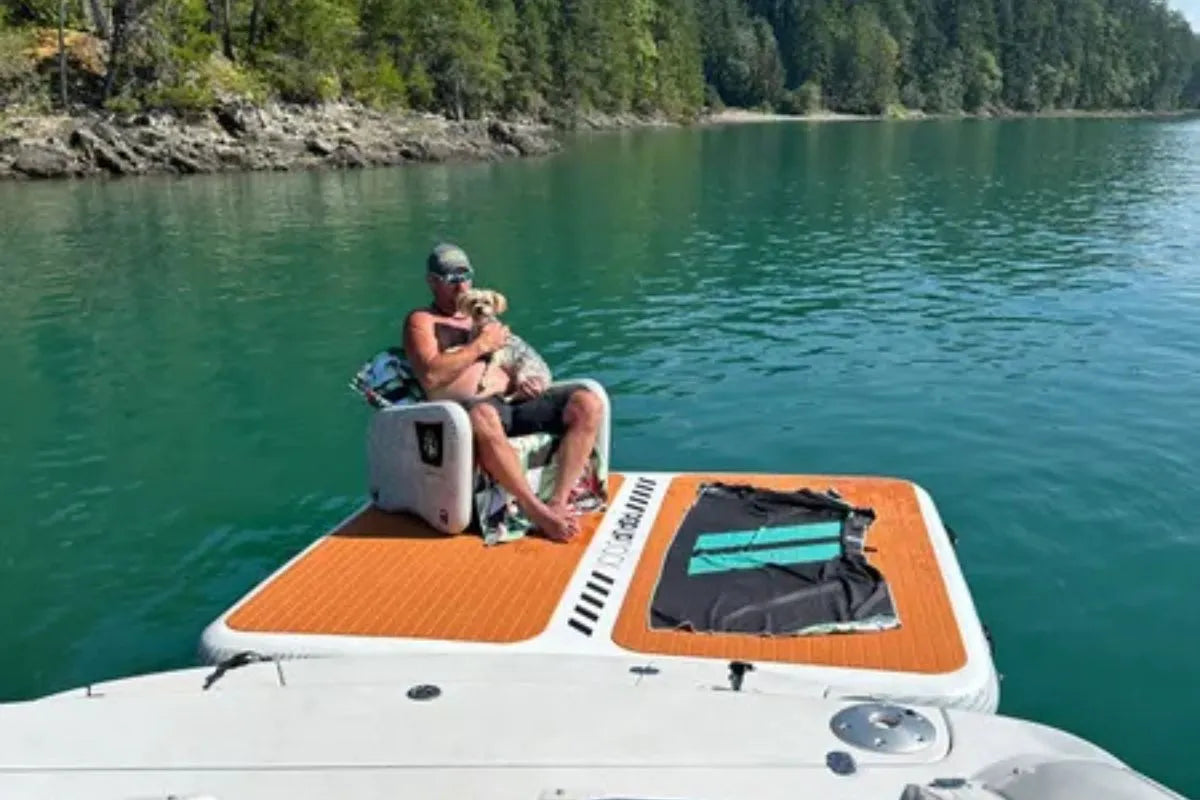
There is no single removal date for Canada. Take an inflatable dock out before local freezing conditions, serious fall weather, falling access or an extended absence makes safe removal and drying difficult.
Ask ten people at the marina and you will get ten answers. Thanksgiving. First frost. When the leaves turn. When my neighbour does it. Labour Day, because that is when my dad did it.
None of those are the answer. The answer is a physical condition, not a date, and knowing the difference can extend the useful waterfront season when local conditions remain suitable.
Our winterization guide covers how to shut a dock down. This one is about when.
The one thing that actually sets the deadline
Not cold. Not frost. Not the calendar. Ice, in two forms.
Freezing moisture around a valve, fitting or damaged area can expand and cause damage. Remove, drain and dry the dock before local freezing conditions.
Ice on the lake. Sheet ice against an inflated dock is abrasive, and the edges of forming and breaking ice are sharper than people expect. A dock left in through the first skim of ice is a dock with a compromised top layer.
These are practical reasons to remove the dock before freeze-up.
The three signs it is time

Overnight lows are forecast at or below freezing at the shoreline.
Watch overnight lows at the shoreline, not only daytime highs in the nearest town. Use Environment and Climate Change Canada forecasts and local observations, then leave enough time for a dry removal day.
Skim ice appears anywhere on the bay in the morning.
Sheltered corners, shallow inlets, the north side of a point. Skim ice shows up in these places well before the main body of the lake does anything. If you are seeing it, you are past the window.
You are not coming back.
This is the one that catches people. A dock left in because you might get up one more weekend, on a property you then do not visit, is a dock nobody is watching when the first hard freeze arrives.
How regional conditions change the decision
Use these as planning factors, not fixed dates. Coastal areas may be limited by wind and storms before freezing. Interior and Prairie locations can move from mild days to sub-zero nights quickly. Large, deep lakes may retain heat longer than nearby shallow bays. Northern and high-elevation properties usually have a shorter removal window.
Weather may lead
Wind, storms and the ability to monitor the property may set the deadline before ice.
Watch overnight lows
Cold nights can arrive while daytime conditions still look inviting.
Local freeze-up can be early
Sheltered bays and shallow edges can change before the main body of water.
Check the shoreline forecast, local observations and your return schedule. If you cannot come back promptly after a weather change, use the last reliable dry weekend rather than the last theoretical day.
What about storms, which nobody plans for
Wind is the underrated October risk.
Fall brings stronger and less predictable frontal systems than midsummer, and an inflatable platform is buoyant, light and has a lot of surface area. A dock that has been sitting happily on two anchors since June can be somewhere else entirely after one October blow.
So there is a second deadline running alongside the freeze deadline: the point at which you stop being present to check on things. If you are two hours away and you will not be back for three weeks, that is a reason to pull it even if the water will not freeze until December.
If you are leaving it in through the fall, add anchor points rather than trusting the summer setup. The 14 foot models carry ten side D-rings for exactly this reason. Set anchors at an angle rather than straight down, and leave slack for wave action.
The case for leaving it in longer than you do

some people pull earlier than local conditions require, and they lose real use doing it.
October waterfront can be quieter than peak summer, depending on the lake and weather. A dock may still provide useful space for sitting, launching or supervision while local conditions remain suitable.
An inflatable dock also has an advantage a crib or a floating hard dock does not: you can pull it in an hour, by yourself, without a tractor or a neighbour or a boat. That flexibility is the whole point. Use it. Leave it in until the forecast tells you not to, then take it out that weekend.
Our inflatable docks are all designed to come out this way, and if you are weighing whether the format is right for your waterfront, are inflatable docks worth it works through it honestly.
A note for people with a hard dock too
If you have a permanent or floating hard dock as well, the two have different deadlines and different failure modes. Hard docks worry about ice heave, which happens over the whole winter as ice expands and shifts. Inflatables worry about a single freeze event getting inside them.
That means the inflatable usually comes out first, and it comes out on a weather forecast rather than on a schedule.
What to do the day you decide
Do not just haul it up the bank and deal with it later. Cold, wet gear should not be rolled and forgotten.
The sequence is: clean while it is still inflated and floating, pull it out, inspect every seam and D-ring, dry both sides completely, drain the valves, roll loose from the far end, store in a sealed bin somewhere temperature-stable. The full detail is in the winterization guide.
Give yourself a weekend with decent weather rather than doing it in sleet on the last possible day. That is really the argument for watching the forecast rather than waiting for the first freeze: it lets you pick your day.
Frequently Asked Questions
When should I take my inflatable dock out of the water?
When overnight lows at the shoreline are consistently forecast at or below freezing, when skim ice appears anywhere on your bay, or when you will no longer be around to check on it. There is no fixed calendar date.
Can you leave an inflatable dock in the water over winter?
No. Ice forming against it abrades and can puncture the material, and water freezing inside a valve or seam expands and causes damage. It must be out before there is any risk of ice.
When do lakes freeze in Canada?
It varies enormously by region, depth and size. Prairie and northern lakes can begin freezing in October, inland Ontario and Quebec lakes in late October into November, and large or coastal water bodies much later or not at all. Depth and surface area matter more than latitude.
Is first frost the deadline for pulling a dock?
Not quite. A single light frost with above-freezing water is not usually a problem. The trigger is consistent overnight freezing at the shoreline, which is when water inside valves and fittings can freeze.
How long does it take to remove an inflatable dock?
Removal time depends on platform size, access, anchoring and available help. Drying is often the slower part, so choose a day with enough time to finish the job.
Is first frost a universal removal deadline?
No. Use local shoreline conditions, forecast, access and your ability to return, while leaving enough time to clean and dry the dock.
Related Canadian Board Co. guides and gear
Choose the platform that fits the real setup
Compare current dock dimensions, capacities and deck formats, or call 1-800-399-5260 for help.
Compare inflatable docks


Leave a comment
All comments are moderated before being published.
This site is protected by hCaptcha and the hCaptcha Privacy Policy and Terms of Service apply.