
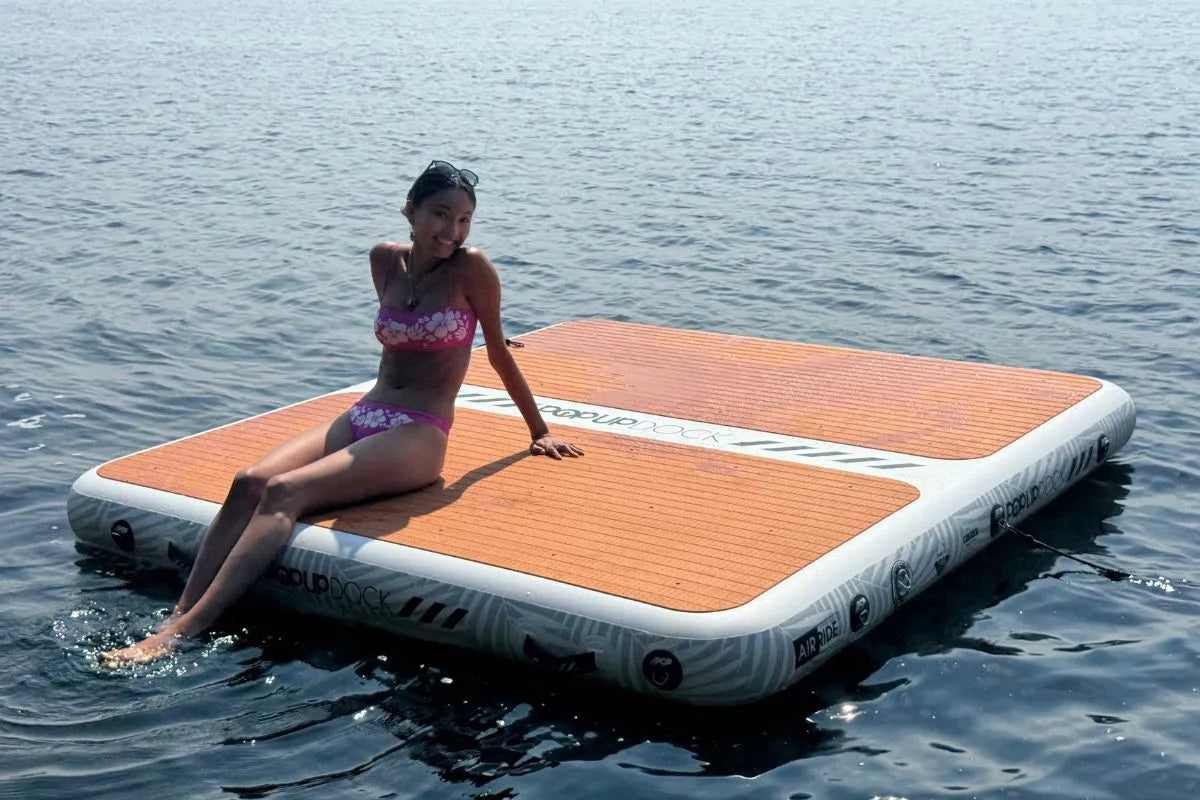
An inflatable dock is only as useful as its anchor setup. Use multiple D-rings, match the anchor style to the lake bottom, leave enough line for small waves, and pull the platform in before strong wind or storms. Get that right and your dock feels steady instead of drifting around the bay.
A floating dock can look perfect on the water, but if the anchoring is wrong, it quickly becomes something you babysit instead of enjoy. A light breeze, a few swimmers, boat wake, or a group of kids climbing on and off can slowly move the platform if it is not secured properly.
The good news is that anchoring an inflatable dock is not complicated. You just need to understand your lake bottom, use the built-in D-rings correctly, and give the dock enough line and anchor weight for the conditions.
Canadian Board Co. is a Canadian owned and operated shop based in Kelowna, BC. This guide explains how to anchor an inflatable dock on sandy, muddy, rocky, and weedy bottoms, plus how to keep it safer in wind, wake, and changing lake conditions.

Start with the built-in D-rings, then match your anchor setup to wind, depth, bottom type, and how the dock will be used.
Start with the D-rings
The built-in D-rings are the foundation of your anchor setup. They give you strong attachment points for anchor lines, tie-off lines, accessories, and positioning.
The most common mistake is using only one anchor point. A dock held from a single point can swing in a wide arc, rotate with the wind, and drift around more than expected. A dock held from two or more points is much easier to control.
Simple anchoring rule: one anchor point controls location poorly. Two or more anchor points help control swing, rotation, and drift.
For most calm lake setups, start with two anchor lines from separate D-rings. Place them so wind and wake push the platform into the anchors instead of pulling it away from them.
Match your anchor to the lake bottom
The bottom type matters more than most people think. An anchor that works well in sand may slide on rock. A setup that holds in mud may need more weight in weeds. Before you choose anchor weight or line length, think about what is under the dock.
Usually the easiest hold
Sand is one of the easier lake bottoms for anchoring. A mushroom-style anchor or weighted anchor can settle into the bottom and hold well in calm conditions.
- Good grip in many conditions
- Works well in protected bays
- Still needs enough line and weight
Good grip once it settles
Mud can hold an anchor well because the anchor can bury and create suction. Give it time to settle before loading the dock heavily.
- Good for mushroom-style anchors
- Let the anchor set before trusting it
- Check after swimmers or boat wake
Use more weight and caution
Rock is harder because many anchors slide instead of digging in. You may need heavier weights, multiple points, or a backup tie-off to shore where allowed.
- Less natural grip
- More likely to slide
- Avoid sharp rock contact with the dock
Get below the weeds if possible
Weeds can reduce grip because the anchor may sit on vegetation instead of firmer bottom. Use enough weight to settle through the weeds and test the hold before use.
- Can hide poor anchor contact
- Needs a test pull
- Recheck during the day
How many anchors does an inflatable dock need?
For most inflatable dock setups, use at least two anchor points from separate D-rings. That gives you much better control than a single anchor.
Two anchors are usually enough for calm, protected lake use. Three or four anchor points may make sense when the platform is larger, the water is deeper, the shoreline is exposed to wind, or the dock needs to stay more precisely positioned.
Two-point anchoring
Good for calm lake days, protected bays, and light family use when wind and boat wake are limited.
Three-point anchoring
Helpful when the dock is swinging too much or you want better control near shore, a boat, or a swim area.
Four-point anchoring
Useful when you want the platform to stay more square and stable, especially in locations with shifting breeze or boat wake.
Shore tie-off
Where allowed and safe, a shore line can help limit movement, especially on rocky bottoms where anchors may not dig in well.
Do not overload one D-ring
Spread the load across multiple anchor points. Using one anchor, one line, and one D-ring puts more stress on the hardware and allows more swing.
Anchor weight: how much is enough?
Anchor weight depends on the dock size, wind, bottom type, water depth, current, and how many people are using the platform. A protected bay on a calm lake needs less than an exposed shoreline that catches afternoon wind.
Rather than relying on one oversized anchor, it is usually better to split the load across multiple anchor points. That helps control the platform from more than one direction and reduces swing.
Use more anchor weight when:
- The bottom is rocky or weedy
- The dock is exposed to wind
- The lake gets afternoon chop
- There is regular boat wake
- The dock is farther from shore
- The platform is loaded with people, chairs, dogs, or coolers
Practical test: after anchoring, load the dock gradually and watch whether it holds position. If it slides, swings too far, or pulls hard on one line, adjust before letting everyone use it.
Set your anchor line length for the conditions
Anchor line, often called rode, should not be perfectly vertical unless you are using a specialized mooring setup. A little angle and slack lets the dock ride small waves without yanking the anchor loose.
Too little line can make the dock pull sharply on the anchor every time a wave or swimmer moves it. Too much line lets the dock wander around a larger area.
The goal is controlled movement. The dock should be able to move slightly with the water without drifting into shore, boat traffic, rocks, or another dock.
Hard pulls on the anchor
If the line is too short, small waves can yank the anchor or D-ring instead of letting the dock move naturally.
Too much wandering
If the line is too long, the dock may drift too far from its intended position and swing into areas you do not want it.
Small movement, controlled position
The dock rides small waves, stays clear of hazards, and does not put constant strain on one anchor point.
Adjust after the first use
The first busy afternoon usually tells you if your line length, anchor weight, or anchor position needs to change.
A simple anchoring routine
Once you understand the bottom and conditions, the process becomes repeatable.
Inflate the dock properly
Inflate to the recommended PSI for your model before anchoring. An under-inflated dock feels soft and is harder to position.
Float it into position
Place the dock in calm water, away from boat traffic, sharp rocks, and places where wind could push it into hazards.
Set the first anchor
Lower the first anchor from a D-ring facing the open water or main wind direction so the dock is held against the expected pull.
Add the second anchor
Use another D-ring to reduce swing and rotation. Adjust line length until the dock sits where you want it.
Test before full use
Have one or two adults step on, shift weight, and watch the anchor lines. If the platform moves too much, adjust the setup.
Recheck after use
After swimming, boat wake, kids jumping, or wind changes, recheck anchors, D-rings, and line tension.

A dock close to shore can be easier to monitor, but it still needs proper anchor points and enough clearance from rocks and traffic.
What real customers notice
Anchoring affects how a dock feels in real life. A properly inflated and well-positioned platform feels steady, useful, and easy to trust. That is why CBC reviews often mention stability, kids, family use, and the dock becoming the centre of the lake day.
“Rock solid.”
That is the feeling you want after setup: a platform that holds position and feels stable enough for real use.
“Grandkids were constantly playing on it.”
Kids will test every dock setup quickly. Good anchoring helps keep the platform in the right place while the whole family uses it.
“These docks are the best!”
Customers often use their dock as the centre of summer with chairs, swimmers, paddleboards, dogs, and boat days.
Read more Canadian Board Co. customer reviews here: https://www.canadianboardco.com/pages/reviews.
Storm and wind smarts
The best feature of an inflatable dock is that you can remove it. No anchor setup beats pulling the platform in before serious weather.
Bring the dock in or secure it differently when:
- Strong wind is forecast
- A thunderstorm is expected
- Boat wake is getting heavy
- The dock is rubbing on rocks, concrete, or metal
- The anchor lines are under constant strain
- The platform is no longer staying where you placed it
Use removability as a safety feature
An inflatable dock is not a permanent dock. If weather is coming, pull it in, move it to shelter, or deflate and store it. Removing the dock from bad conditions is often the smartest anchor plan.
Which dock are you anchoring?
The same anchoring principles apply to AquaDock and YachtDock, but the best choice depends on how the platform will be used.
14' POPUP AquaDock
Best for calm lakes, kids, swimming, cooling off, paddleboard launching, and cottage lounging. Anchor it where swimmers can use it safely and boat traffic is not a concern.
- Centre wet zone
- Best family swim platform
- Great for paddleboard launches
- Commonly listed around 2,000 lb capacity
14' POPUP YachtDock
Best for boat-side lounging, chairs, coolers, dry bags, gear, and heavier setups. Anchor carefully if it is being used near a boat or other structure.
- Solid full deck
- More dry usable surface
- Better for chairs and gear
- Commonly listed around 3,000 lb capacity
Anchoring mistakes to avoid
Using one anchor point
A single anchor lets the dock swing and puts more load on one D-ring. Use two or more anchor points for better control.
Ignoring the bottom type
Sand, mud, rock, and weeds all hold differently. Choose your anchor setup based on what is under the water.
Leaving too much slack
Some scope is good, but too much lets the dock drift into hazards or swing farther than expected.
Leaving it out in storms
Inflatable docks are removable. Pull the dock in before serious wind, storms, or rough water.
The bottom line
Proper anchoring is the difference between an inflatable dock you trust and one you constantly chase around the lake.
Use multiple D-rings. Match the anchor to the bottom. Use enough weight for your wind, depth, and platform size. Leave enough line for small movement without letting the dock wander. Check the setup after the first busy afternoon. Pull the dock in when weather demands it.
Choose the AquaDock if you want a family swim platform for calm lake use, kids, paddleboards, and cottage lounging.
Choose the YachtDock if you want a solid full platform for chairs, coolers, dry bags, boat-side lounging, and heavier setups.
Shop the 14' POPUP AquaDock here: https://www.canadianboardco.com/products/popup-aquadock-14-x-7-x-6.
Shop the 14' POPUP YachtDock here: https://www.canadianboardco.com/products/popup-yatchdock-14-x-7-x-8.
Browse dock hardware here: https://www.canadianboardco.com/collections/hardware.
Browse inflatable docks here: https://www.canadianboardco.com/collections/inflatable-docks.
Read where inflatable docks work best here: https://www.canadianboardco.com/blogs/water-sports-guide/where-to-use-an-inflatable-dock.
Read the traveling with an inflatable dock guide here: https://www.canadianboardco.com/blogs/water-sports-guide/traveling-with-an-inflatable-dock.
Read the AquaDock vs YachtDock comparison here: https://www.canadianboardco.com/blogs/water-sports-guide/aquadock-vs-yachtdock-comparison.
Call 1-800-399-5260 if you want help choosing the right inflatable dock and anchor setup for your lake bottom, shoreline, boat, cottage, or water depth.
FAQ
How do you anchor an inflatable dock?
Use two or more anchor lines from separate D-rings, match the anchor to the lake bottom, use enough line for small wave movement, and test the dock before full use.
How many anchors does an inflatable dock need?
Most inflatable docks should use at least two anchor points. More anchor points may help if the dock is larger, farther from shore, exposed to wind, or moving too much.
What is the best anchor for a sandy lake bottom?
Sand usually holds well with a mushroom-style anchor or weighted anchor because the anchor can settle into the bottom. Always test the hold before loading the dock.
What is the best anchor for a muddy lake bottom?
Mud can hold a mushroom-style anchor well because it can bury and create suction. Give the anchor time to settle before trusting it fully.
How do you anchor a dock on a rocky bottom?
Rocky bottoms are harder because anchors may slide instead of digging in. Use more weight, multiple anchor points, and a safe shore tie-off where allowed.
How do you keep a floating dock from drifting?
Use multiple anchor points, enough anchor weight, proper line length, and a setup that accounts for wind, wake, current, and bottom type.
Should I leave an inflatable dock anchored during a storm?
No. If strong wind or storms are expected, pull the dock in, move it to shelter, or deflate and store it. Removability is one of the biggest advantages of an inflatable dock.
Can I tie an inflatable dock to shore?
In some setups, a shore tie-off can help control movement, especially near shore or on rocky bottoms. Make sure it is allowed, safe, visible, and not creating a trip hazard or blocking access.

Leave a comment
All comments are moderated before being published.
This site is protected by hCaptcha and the hCaptcha Privacy Policy and Terms of Service apply.