
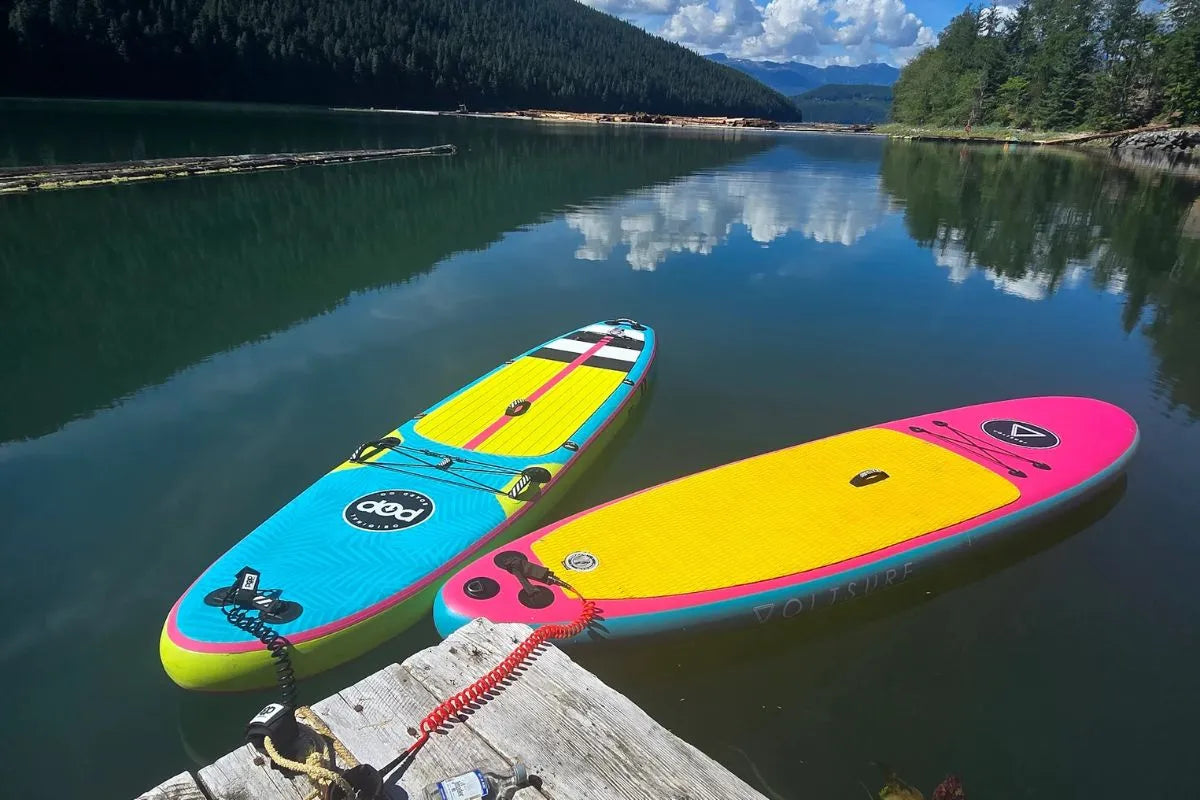
There's a specific moment, usually on the first warm Saturday of the year, when a Canadian paddler pulls their inflatable paddleboard or dock out of winter storage, pumps it up, and watches it slowly go soft over the next half hour. It happens to almost everyone at some point. The fix is almost always five minutes of work, but only if you know which five minutes.
We're a Canadian-owned, family-run team based in Kelowna, BC, and the 1-800-399-5260 line gets a wave of pressure-loss calls every May. Most are valve issues. Most are fixable on opening weekend with a spare core. This guide walks the diagnostic in the order we walk it on the phone.
First: is it actually leaking?
The most common false alarm in spring is cold-temperature pressure drop. PVC, the air inside, and the seams all contract as temperatures drop. A 14-foot inflatable dock fully inflated to 7 PSI in 25°C afternoon air will read 5-5.5 PSI by the next morning at 5°C. That's not a leak. That's gas-law physics. The same happens to paddleboards.
Before assuming a leak, eliminate temperature drop:
- Re-inflate to spec in stable temperature conditions, mid-day, indoors, or a warm garage works.
- Mark the gauge reading.
- Wait 24 hours in the same temperature window.
- If pressure dropped more than 1 PSI in stable temperatures, it's a real leak.
- If pressure dropped 1-2 PSI overnight outdoors and bounced back when daytime warmed up, it's normal cold-temperature drop. Don't repair what isn't broken.
The soap test (do this first, every time)
Before opening a valve or buying a patch kit, run the soap test. This is the diagnostic everyone skips and everyone shouldn't.
Mix one teaspoon of dish soap in a litre of water. Pour into a spray bottle. Inflate the dock or board to full pressure.
Spray the soap solution generously on:
- The valve and the area around it
- Every seam, especially seams at corners and ends
- Every D-ring base
- The bottom-edge fold lines, these are the most common puncture sites on docks that have been dragged across rocks
Bubbles mean a leak. The bigger the bubble formation, the bigger the leak. Mark the spot with a permanent marker so you can find it after deflating.
Most paddlers find the leak in 90 seconds with the soap test. Some find more than one. Diagnose all of them before doing any repairs.

The 80% case: valve leaks
Eight times out of ten, the leak is at the valve. Halkey-Roberts-style valves are used on most CBC paddleboards and docks, and most quality inflatable gear globally, and they have a known set of failure modes:
Hardened gasket
The rubber seal at the base of the valve dries out over winter, especially in cold dry storage. The fix is to replace the valve core, which has a fresh gasket built in.
Debris in the valve
Sand, dust, or organic matter trapped in the valve threads prevents a clean seal. Open the valve, blow it out, wipe with a damp cloth, lubricate threads with silicone spray, never petroleum-based because petroleum degrades PVC, and reseat.
Loose valve core
The core can vibrate loose during transport. Halkey-Roberts valves include a tool slot for tightening; the tool is included in any spare core kit.
Cracked valve cap
Cracked valve caps or stripped threads on the cap are less common, more annoying. New caps are widely available.
The fix sequence:
- Use the valve tool, or the included key in a spare core kit, to unscrew the valve core.
- Inspect the gasket. If it's stiff, dry, or cracked, replace the core entirely.
- Wipe valve threads clean. Apply a thin coat of silicone spray.
- Reseat or replace the core. Tighten firmly but don't over-torque, snug, not gorilla-tight.
- Re-inflate and re-soap-test the valve.
Spare valve core kits ship from us for $4-$8. Call 1-800-399-5260 or order through https://www.canadianboardco.com/collections/hardware. Always keep one at the cottage. The 30 seconds you save in May is worth it.
The 15% case: seam-area pinholes
The next most common leak source is a pinhole in or near a seam. Pinholes happen from:
- Dragging the dock across gravel or rocks, most common
- Storing with a sharp object pressed against the surface
- UV degradation over multiple seasons, the surface gets brittle
- Rodent damage in storage, not common, but happens. Mice chew valves and corner reinforcements.
Once you've located the pinhole with the soap test, the repair is a PVC patch kit fix:
- Deflate the gear completely.
- Clean the area around the pinhole with isopropyl alcohol. Let it dry. Never use petroleum-based solvents.
- Roughen the surface lightly with fine sandpaper to improve adhesion.
- Cut a patch from the included material, circular shape, at least 5 cm larger than the damage in every direction. Round corners to prevent peel.
- Apply PVC adhesive to both the dock surface and the patch. Wait for it to become tacky. Manufacturer instructions vary, typically 5-10 minutes.
- Press the patch on, working from centre outward. Use a roller or the back of a spoon to eliminate air bubbles.
- Cure for at least 24 hours at room temperature before re-inflating.
- Re-test with soap after curing.
For pinholes in or right at a seam, the repair is more delicate. If the leak is on a seam line itself, not just near it, call us before patching. Seam separation is different from a pinhole and may need professional repair to maintain warranty coverage.
The 5% case: drop-stitch internal damage
Drop-stitch is the construction inside every quality inflatable dock and paddleboard, thousands of internal threads that connect the top and bottom surfaces, creating the rigid platform when inflated. When drop-stitch fails internally, the visible symptom is a "bulge", a section of the dock or board that's higher than the surrounding surface, or feels softer underfoot.
Drop-stitch failure isn't a DIY repair. The threads are sealed inside the air chamber. If you've identified a bulge, soft spot, or area where the surface feels uneven:
- Don't continue using the gear. Internal failure can progress under load.
- Document the issue with photos.
- Call 1-800-399-5260 or open a warranty case at https://www.canadianboardco.com/pages/3-year-warranty.
Drop-stitch failure within the 3-year warranty period and not caused by user error is covered for inflatable paddleboards and inflatable docks. Most cases we see are at the second or third season mark, on gear that's been stored well. It's a manufacturing fatigue issue, not a use issue.
What pumps and pressure gauges actually matter
Half of pressure-loss complaints turn out to be pump or gauge issues, not gear issues. Cheap or worn pumps under-read pressure; cheap gauges over-read it. If you're chasing a "leak" that's actually a measurement error, you'll never find it.
The recommendations:
- Use a separate pressure gauge to verify pump readings. Pumps' built-in gauges drift over time and aren't accurate enough for diagnostic work.
- Replace pump O-rings every 2-3 seasons. Worn O-rings cause the pump to under-deliver pressure even though the gauge reads correctly.
- For docks that need 5-7 PSI and boards that need 15 PSI, a single rechargeable electric pump with adjustable cut-off pressure is the cleanest option. https://www.canadianboardco.com/collections/pumps has the curated lineup.
- Calibrate by comparing two gauges. If the pump and a separate gauge disagree by more than 0.5 PSI, replace one.
When to stop troubleshooting and call
Some issues are fixable on the dock with a 30-second swap. Some need a phone conversation. The signals that you should call us instead of continuing the diagnostic:
- Multiple leaks across the same surface, indicates UV degradation or systemic issue
- A leak that doesn't soap-test, the leak is in a place you can't see and usually means an internal issue
- Bulges, soft spots, or visible drop-stitch failure
- Seam separation longer than 5 cm
- Valve damage where the threads are stripped or the housing is cracked
- A pressure-loss test that shows more than 1 PSI loss in stable-temperature conditions and you can't find the leak
Our team at 1-800-399-5260 can usually diagnose the issue and ship the part, or escalate to warranty, in a single call. Most issues are recoverable. The mistake is throwing gear away or attempting major repairs without the right parts.
The opening-weekend troubleshooting kit
Every cottage with inflatable gear should keep this kit at the cottage permanently:
PVC patch kit
The kit that came with your gear, plus a backup.
Isopropyl alcohol
For surface prep before patching.
Fine-grit sandpaper
For light surface roughening before adhesive.
Separate pressure gauge
To verify pump readings during diagnostics.
Silicone spray
Use silicone spray only. Do not use petroleum-based products.
Soap solution spray bottle
Mix it on opening day and refresh annually.
Support number
Keep 1-800-399-5260 written somewhere accessible.
The kit fits in a small toolbox. It costs less than $50 to assemble. It has saved cottage weekends every May for as long as we've been selling inflatable gear in Canada. Build it once, use it for ten years.
For replacement gear when the troubleshooting tells you it's time, the lineup lives at https://www.canadianboardco.com/collections/inflatable-docks for docks, https://www.canadianboardco.com/collections/inflatable-paddleboards-canadas-best-isup for boards, and https://www.canadianboardco.com/collections/boats for inflatable boats.
Warranty and shipping note
Free shipping Canada-wide over $100.
Inflatable paddleboards and inflatable docks are covered by the 3-year warranty. Electric pumps and electronic items are listed with 1-year warranty coverage. Rover Marine Battle Boat and Battle Cat seams and manufacturer defects are listed with 5-year warranty coverage. Eligible boards are backed by the 60-Day Rider's Guarantee.
Frequently asked questions
My paddleboard lost 2 PSI overnight outside. Is it leaking?
Probably not. PVC and air both contract in the cold, and a 1-2 PSI drop overnight in cool temperatures, especially if the board was inflated in warm afternoon air and sat through a cold night, is normal. Re-test in stable temperature conditions, warm garage, mid-day, before assuming a leak.
How do I find a leak I can hear but can't see?
The soap test. Mix dish soap and water, spray on every seam, valve, and D-ring while the gear is at full pressure. Bubbles show the leak. If soap-testing doesn't reveal anything, the leak may be internal and needs professional inspection. Call 1-800-399-5260.
Where do I get a spare valve core kit?
We ship them from https://www.canadianboardco.com/collections/hardware, or call 1-800-399-5260 for fastest dispatch. Most kits are $4-$8 and include the core, gasket, and the valve key tool. Always keep one at the cottage. Valve issues are the #1 cause of opening-weekend pressure loss.
Can I patch an inflatable paddleboard at home?
Yes, for small punctures under 5mm and surface abrasions. The standard PVC patch kit handles these. For larger damage, seam separation, or drop-stitch internal failure, call us. DIY patches on those issues can void warranty coverage.
What pressure should my CBC paddleboard be inflated to?
15 PSI for most boards in our lineup, always verify on the printed spec on your specific board. Don't exceed 15 PSI. Over-inflation stresses seams and increases puncture risk.
What pressure should my inflatable dock be inflated to?
5-7 PSI for the 8' POPUP Dock, 14' POPUP AquaDock, and 14' POPUP YachtDock. Don't exceed 7 PSI. Cold-temperature drop in spring may need a top-up to maintain the range during use.
My valve is hard to turn. What do I do?
Open and close it a few times to clear debris, then lubricate the threads with silicone spray, never petroleum-based because petroleum degrades PVC. If it's still stiff, the core gasket has hardened. Replace the core with a spare from https://www.canadianboardco.com/collections/hardware.
Is a slow leak covered by warranty?
Yes if it's a manufacturing defect, such as seam failure, drop-stitch internal issue, or valve housing crack, within the applicable warranty period. Pinholes from external damage, dragging across rocks, rodent chew, or sharp objects in storage, are not warranty cases, but they're usually inexpensive to repair. Call 1-800-399-5260 to triage which case you have.


Leave a comment
All comments are moderated before being published.
This site is protected by hCaptcha and the hCaptcha Privacy Policy and Terms of Service apply.