
Why Inflatable Docks Are Game-Changers for Canadian Fishing
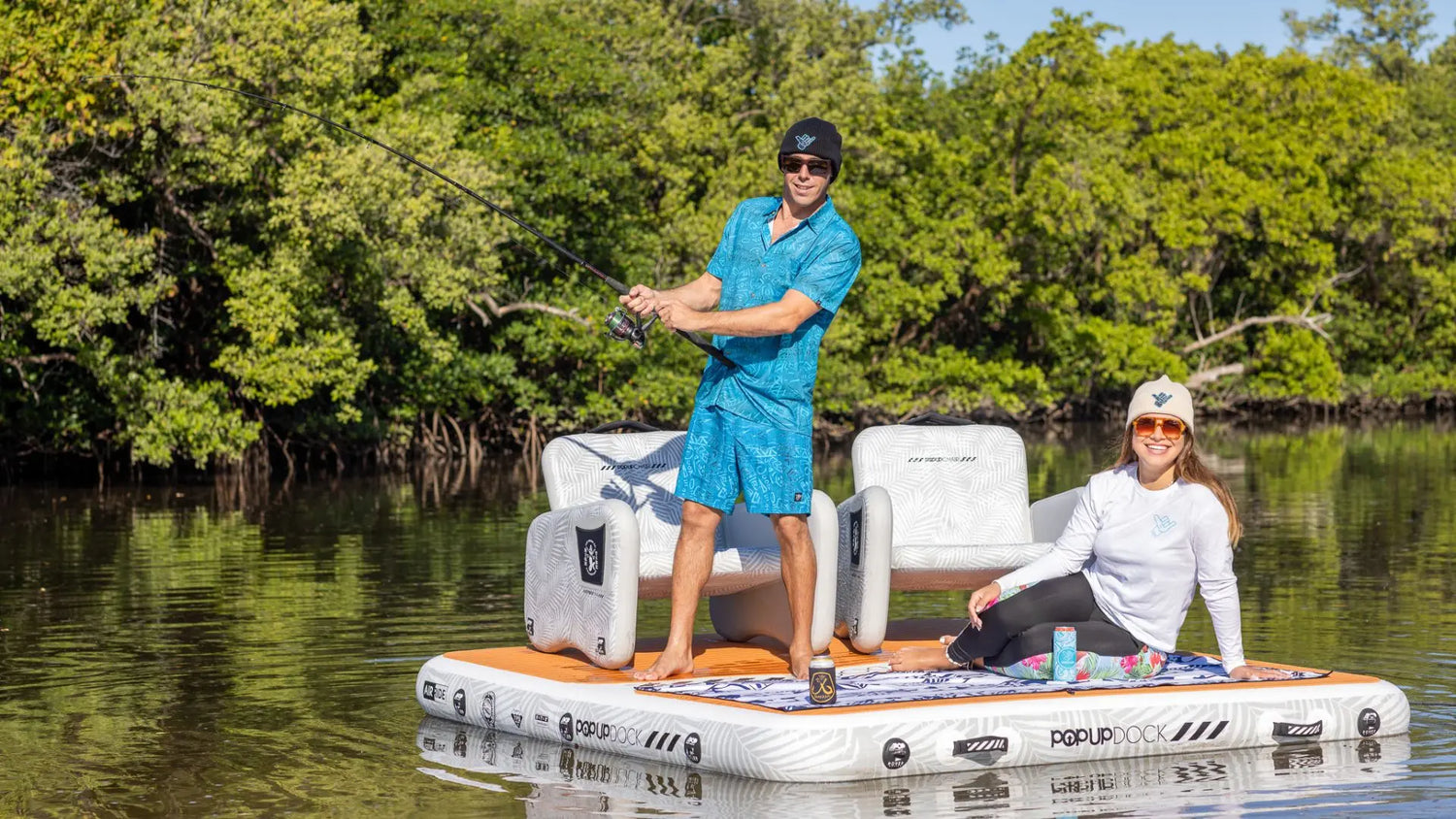
Inflatable fishing platforms are revolutionizing how Canadian anglers access prime fishing spots. The 14' POPUP AQUADOCK and similar platforms provide stable, portable fishing bases that traditional docks and boats can't match. With 98 square feet of stable platform space, proper anchoring, and the ability to deploy in shallow waters inaccessible to boats, inflatable docks open up entirely new fishing opportunities across Canadian lakes, rivers, and coastal waters.
Portability: Fish Anywhere, Anytime
Traditional fishing docks are permanent fixtures—you fish where they're installed. Boats require trailers, ramps, and significant setup. Inflatable fishing docks pack into a carry bag and deploy in minutes, giving you unprecedented fishing location flexibility.
Access Remote Fishing Spots
The best fishing often happens in locations boats can't reach—shallow bays, weed beds, rocky shorelines, and protected coves. Inflatable docks excel in these environments. Carry your deflated AQUADOCK to remote locations, inflate in 5-10 minutes, and anchor in your prime fishing zone. No boat ramp required, no trailer needed, no depth restrictions beyond 1.5 meters minimum for safe anchoring.
Multi-Location Fishing Sessions
Canadian fishing success often requires mobility—moving between spots as conditions and fish activity change. Deflate your dock in 10 minutes, relocate, and redeploy. This mobility is impossible with traditional docks and cumbersome with boats requiring trailering between locations.
Cottage and Camping Integration
Bring your inflatable fishing platform to different cottages, camping trips, or friend's properties. One dock serves multiple fishing locations throughout the season rather than being locked to a single permanent installation.
Stability: The Ultimate Fishing Platform
Stability separates great fishing platforms from frustrating ones. Inflatable docks inflated to 5-7 PSI create rock-solid platforms that outperform many boats for fishing applications.
Superior to Kayaks and Canoes
Kayaks and canoes tip when you stand, shift when you cast, and rock when you fight fish. The 14' POPUP AQUADOCK provides 98 square feet of stable platform—stand, cast, move around, and fight fish without the constant balance management required in narrow watercraft. According to Take Me Fishing, stable platforms significantly improve catch rates by allowing anglers to focus on fishing rather than balance.
Calmer Than Small Boats
Small fishing boats rock in waves and wake from passing vessels. Inflatable docks' low profile and wide footprint create exceptional stability even in choppy conditions. The 14' x 7' platform distributes your weight across a massive surface area, dramatically reducing rocking motion compared to narrow-beam boats.
Multi-Angler Stability
Fish with friends or family without the cramped quarters and instability of small boats. The AQUADOCK comfortably accommodates 4-6 anglers with room to move, cast in different directions, and manage multiple rods without interfering with each other. Weight capacity of 1,500+ lbs handles multiple adults plus gear, coolers, and tackle.
Shallow Water Access: Where the Fish Are
Many prime Canadian fishing zones exist in water too shallow for boats but too deep for wading. Inflatable docks thrive in this sweet spot.
Weed Bed Fishing
Bass, pike, and panfish love weed beds—and inflatable docks let you position directly over or adjacent to these productive zones. Deploy in 1.5-3 meters of water, anchor securely, and fish the edges where predators ambush prey. Traditional boats can't access these areas without fouling props, while shore fishing limits your reach.
Rocky Shoreline Access
Rocky shorelines hold smallmouth bass, walleye, and lake trout—but boats risk hull damage in these areas. Inflatable docks deploy safely in rocky zones, providing stable platforms for vertical jigging, drop-shotting, and casting to structure. The flexible PVC construction handles occasional rock contact that would damage rigid hulls.
River Fishing Platforms
Position your inflatable dock in river eddies, behind islands, or along current breaks where fish hold. Anchor securely using the four-point configuration recommended in our safety guidelines, and fish current seams inaccessible from shore.
Ease of Use: Fishing, Not Boat Management
Boats require constant management—motor maintenance, fuel, battery charging, winterization, and trailering. Inflatable fishing docks eliminate this complexity.
Simple Setup and Breakdown
Inflate your dock in 5-10 minutes using the included high-pressure pump. Deploy anchor system (15-20 minutes for four-anchor configuration). Start fishing. When done, deflate in 10 minutes and pack into carry bag. Total setup and breakdown time: 30-40 minutes including anchoring—far less than launching and retrieving a boat.
No Motor, No Fuel, No Maintenance
Eliminate outboard motor maintenance, fuel costs, and mechanical failures. Your fishing platform has no moving parts beyond valves. Maintenance consists of rinsing with fresh water and proper storage—detailed in our comprehensive maintenance guide.

One-Person Operation
The 8' POPUP DOCK is easily handled solo. Even the 14' models are manageable alone, though two people make setup easier. Compare this to boats requiring two people for launching, trailering, and docking.
Fishing-Specific Advantages
360-Degree Fishing Access
Unlike shore fishing with limited casting angles or boats where anglers interfere with each other, inflatable docks provide 360-degree access. Position anglers around the perimeter, each with clear casting lanes and independent fishing zones.
Gear Organization and Storage
The flat, stable platform accommodates tackle boxes, rod holders, coolers, and landing nets without the cramped storage of kayaks or small boats. Use bungee rigging to secure gear, preventing items from sliding or falling overboard. The non-slip deck surface keeps tackle boxes stable even when wet.
Live Well and Catch Management
Position live wells, fish baskets, or stringers directly from your dock. The stable platform makes catch photography easy—no balancing fish while trying to stabilize a rocking boat. According to the Department of Fisheries and Oceans Canada, proper catch handling improves survival rates for released fish—stable platforms facilitate this.
Sit-Down Fishing Option
Add the Kayak Paddle and Seat Set to convert your standing platform into a comfortable sit-down fishing station. This versatility lets you fish standing for casting and sight-fishing, then sit for extended jigging or bottom fishing sessions.
Species-Specific Applications
Bass Fishing Platforms
Smallmouth and largemouth bass fishing benefits enormously from inflatable dock mobility. Move between weed beds, rocky points, and drop-offs throughout the day as fish activity changes. The stable platform enables accurate casting to specific targets—laydowns, dock pilings, weed edges—that boat anglers often overshoot or undershoot due to rocking.
Pike and Muskie Platforms
Big pike and muskie require substantial platforms for fighting and landing. The 14' POPUP YACHTDOCK provides premium capacity for battling trophy fish. The stable platform prevents the dangerous situations that occur when large fish thrash alongside unstable kayaks or canoes.
Panfish and Perch Setups
Panfish and perch fishing often involves multiple rods and precise depth control. Inflatable docks let you spread out multiple rods, monitor each for bites, and maintain exact positioning over productive structure. The stability enables the subtle bite detection required for panfish success.
Walleye and Lake Trout Jigging
Vertical jigging for walleye and lake trout demands stable platforms for maintaining precise lure position and detecting subtle strikes. Inflatable docks anchored over structure provide ideal jigging platforms. The 98 square feet of the AQUADOCK accommodates multiple anglers jigging different depths and locations simultaneously.
Saltwater and Coastal Fishing
Coastal anglers targeting striped bass, mackerel, or bottom fish benefit from inflatable platforms deployed in protected bays and estuaries. The portability enables access to remote coastal locations inaccessible by vehicle, while stability handles moderate wave action. Always check marine forecasts and follow Environment Canada marine forecasts for coastal deployments.
Safety Considerations for Fishing Applications
PFD Requirements
Transport Canada requires personal flotation devices for all persons on water platforms. While fishing, wear inflatable belt PFDs that don't restrict casting motion. The Onyx M24 Inflatable Belt PFD provides unobtrusive protection that won't interfere with fishing activities.
Anchoring for Fishing
Proper anchoring is critical for fishing applications—drifting platforms make fishing impossible and create safety hazards. Use four-anchor configuration with 20-30 lb anchors and 5:1 scope ratio. This creates a stable platform that won't drift even when multiple anglers move around or fight fish. Detailed anchoring protocols are covered in our comprehensive safety guide.
Weather Monitoring
Canadian weather changes rapidly. Check Environment Canada forecasts before each fishing session. Evacuate your dock immediately if winds exceed 35 km/h or lightning is observed. The portability of inflatable docks makes rapid evacuation practical—deflate and move to shore in 15 minutes if conditions deteriorate.
Cold Water Precautions
Canadian waters remain cold even in summer. Water below 15°C creates hypothermia risk if you fall in. Wear PFDs at all times, establish buddy systems when fishing with others, and keep rescue equipment (throw rope, reaching pole) immediately accessible on the dock.
Seasonal Fishing Strategies
Spring Fishing (April-May)
Spring fishing targets spawning bass, pike, and walleye in shallow bays and tributaries. Inflatable docks excel in these environments—deploy in 1.5-2 meters of water near spawning areas, providing stable platforms for sight-fishing and accurate casting to beds and structure. Cold water temperatures demand wetsuits or drysuits if you fall in.
Summer Fishing (June-August)
Summer fishing moves to deeper structure, weed beds, and thermocline zones. Position your inflatable dock over drop-offs, weed edges, or rocky points. The stable platform enables vertical jigging and precise lure presentation. Peak season also means peak boat traffic—position away from navigation channels and mark your dock with visible flags or markers.
Fall Fishing (September-October)
Fall fishing offers exceptional opportunities as fish feed aggressively before winter. Inflatable docks provide stable platforms for casting to schooling baitfish and working transition zones. Cooling water temperatures require increased safety awareness—wear PFDs and monitor weather closely as conditions become less predictable.
Comparing Fishing Platform Options
Inflatable Dock vs. Kayak
Stability: Docks win decisively—stand, move, cast without balance concerns
Capacity: Docks accommodate multiple anglers and substantial gear
Fishing area: Docks provide 360-degree access; kayaks limit casting angles
Mobility: Kayaks paddle between spots; docks require deflation/relocation
Cost: Similar price points for quality options
Best for: Docks excel for stationary fishing; kayaks better for covering water
Inflatable Dock vs. Small Boat
Stability: Docks more stable in waves and wake
Setup: Docks faster to deploy; boats require launching and trailering
Maintenance: Docks minimal; boats require motor maintenance and winterization
Shallow access: Docks access areas boats can't reach
Mobility: Boats move under power; docks require manual relocation
Cost: Docks significantly less expensive
Best for: Docks for stationary fishing in specific zones; boats for covering large areas
Inflatable Dock vs. Shore Fishing
Access: Docks reach structure and depth inaccessible from shore
Casting angles: Docks provide 360-degree access vs. limited shore angles
Comfort: Docks offer stable platform vs. uneven shoreline terrain
Setup: Shore fishing requires no setup; docks need inflation and anchoring
Cost: Shore fishing free; docks require investment
Best for: Docks when prime structure is offshore; shore when fish are accessible
Accessories and Modifications for Fishing
Rod Holders
Add clamp-on or adhesive rod holders to your dock's perimeter. Position multiple rods for trolling, live bait fishing, or monitoring different depths simultaneously. Ensure holders are marine-grade and rated for the rod weights you'll use.
Anchor System Upgrades
Invest in quality anchors matched to your bottom type. Fluke anchors for sand/mud, mushroom anchors for silt, grapnel anchors for rock. Use marine-grade rope with 1,500 lb breaking strength and proper scope ratio (5:1 minimum).
Gear Organization
Add waterproof storage bags, tackle organizers, and bungee rigging to keep gear secure and organized. The flat platform accommodates substantial gear without the cramped quarters of boats or kayaks.
Shade and Weather Protection
For extended fishing sessions, add a portable canopy or umbrella mount. Sun protection becomes critical during summer fishing—UV exposure on water is intense. Ensure any shade structure doesn't create excessive wind resistance that stresses anchors.
Fish Finder Integration
Portable fish finders with transducers can be deployed from inflatable docks. Secure the display unit to prevent water damage, and position the transducer over the side for depth and fish location data. This technology dramatically improves fishing success by identifying productive structure and fish-holding zones.
Regulations and Licensing
Ensure compliance with Canadian fishing regulations:
- Valid fishing license for your province/territory (purchase through Fisheries and Oceans Canada)
- Species-specific regulations (size limits, possession limits, seasons)
- Water body-specific rules (some lakes have special regulations)
- Invasive species prevention (clean your dock between water bodies)
- Transport Canada safety equipment requirements (PFDs, sound signaling device)
Cost-Benefit Analysis: Fishing Platform Investment
Initial Investment
Quality inflatable fishing docks range from $899 for the 8' POPUP DOCK to $1,399 for the 14' POPUP AQUADOCK. Add $100-200 for quality anchor system and safety equipment.
Ongoing Costs
Minimal—no fuel, no motor maintenance, no insurance, no trailer fees. Annual costs limited to storage space and occasional replacement of anchor lines or minor repairs.
Comparison to Alternatives
- Fishing kayak: $800-2,000 (similar initial cost, less stability and capacity)
- Small fishing boat: $5,000-15,000+ (plus trailer, motor, maintenance, fuel, insurance)
- Guided fishing charters: $300-600 per day (inflatable dock pays for itself in 3-5 fishing days)
Value Proposition
For anglers who fish 10+ times per season, inflatable docks deliver exceptional value. The platform pays for itself in 1-2 seasons compared to charter costs, while providing fishing access and stability that kayaks can't match—all without the expense and complexity of boat ownership.
Real-World Fishing Success Stories
Ontario Bass Fishing
Anglers using inflatable docks to access weed bed edges in Muskoka lakes report significantly improved bass catches compared to shore fishing. The ability to position directly over structure and cast to specific targets increases hookup rates while the stable platform improves landing percentages for larger fish.
BC Coastal Fishing
British Columbia coastal anglers deploy inflatable platforms in protected bays for bottom fishing and jigging. The portability enables access to remote locations requiring hiking to reach, while stability handles moderate wave action from ocean swells.
Prairie Lake Walleye
Saskatchewan and Manitoba walleye anglers use inflatable docks for vertical jigging over rocky structure. The stable platform enables precise lure control and subtle bite detection that produces consistent catches even during tough conditions.
Frequently Asked Questions
Can I really fish effectively from an inflatable dock?
Absolutely. The 14' POPUP AQUADOCK provides 98 square feet of stable platform—more stable than most small boats and far superior to kayaks. Stand, cast, move around, and fight fish without balance concerns. Many anglers report better fishing success from inflatable docks than boats due to superior stability and positioning flexibility.
How do I anchor my fishing dock?
Use four-anchor configuration with 20-30 lb anchors matched to your bottom type (fluke for sand/mud, mushroom for silt, grapnel for rock). Deploy 5:1 scope ratio—for 3-meter depth, use 15 meters of anchor line. This creates a stable platform that won't drift even when multiple anglers move around. Detailed anchoring instructions are in our safety guide.
What's the minimum water depth for fishing?
1.5 meters (5 feet) minimum for safe anchoring and to prevent users from striking bottom if they fall in. Shallower deployment increases injury risk and limits safe movement on the dock.
Can I use my inflatable dock in rivers?
Yes, in calm sections with minimal current. Position in eddies, behind islands, or along current breaks. Use four-anchor configuration to prevent drift. Avoid fast-moving water or areas with significant current—these create dangerous conditions and excessive anchor loads.
How many anglers can fish from one dock?
The 14' AQUADOCK comfortably accommodates 4-6 anglers with room to cast in different directions. The 8' POPUP DOCK works well for 2-3 anglers. Weight capacity isn't the limiting factor—space for casting and moving is. Distribute anglers around the perimeter for maximum fishing efficiency.
Do I need a boat license for an inflatable dock?
No. Inflatable docks are not motorized vessels and don't require boat licensing. You do need a valid fishing license for your province/territory and must comply with Transport Canada safety equipment requirements (PFDs, sound signaling device).
Can I add a motor to my inflatable dock?
While technically possible, inflatable docks are designed as stationary platforms, not motorized vessels. For mobility, consider a paddleboard or kayak. For stationary fishing with occasional relocation, deflate and move the dock rather than adding motor complexity.
How do I prevent my dock from drifting while fighting a fish?
Proper four-anchor configuration with adequate anchor weight and scope prevents drift even when fighting large fish. The distributed anchor load handles dynamic forces from angler movement and fish fighting without allowing the platform to move.

Get Started: Choosing Your Fishing Platform
For solo or duo fishing in compact spaces, the 8' POPUP DOCK provides excellent value and portability. For family fishing, groups, or serious anglers wanting maximum space and capacity, the 14' POPUP AQUADOCK delivers premium performance. For boat owners wanting a yacht-grade swim platform that doubles as a fishing station, the 14' POPUP YACHTDOCK offers ultimate versatility.
Explore our complete inflatable docks collection and transform your Canadian fishing experience with portable, stable, easy-to-use platforms designed for serious anglers.

Leave a comment
All comments are moderated before being published.
This site is protected by hCaptcha and the hCaptcha Privacy Policy and Terms of Service apply.