
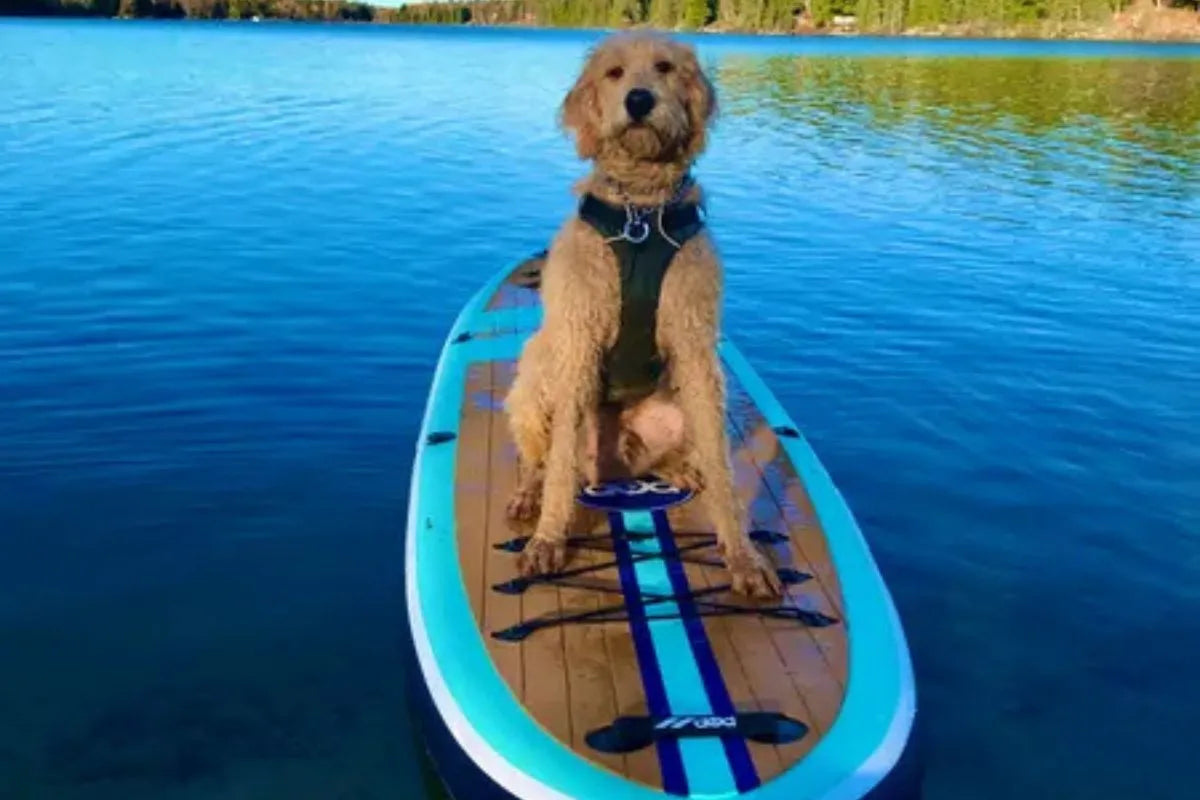
Most first-time paddleboarders can learn the basics in a weekend. Start on a wide, stable inflatable board, choose calm protected water, begin on your knees, stand once the board is moving, look at the horizon, and keep the first session short. With the right setup, most beginners are standing and paddling comfortably within the first hour.
Paddleboarding looks harder than it is. Most adults who have never been on a paddleboard before can stand up in their first session, paddle comfortably in calm water, and feel ready for a real cottage paddle after a weekend of practice.
Canadian Board Co. is a Canadian owned and operated team based in Kelowna, BC. Every June and July, the beginner paddleboard question comes up on our 1-800-399-5260 line: what board should I start with, and how do I learn without feeling embarrassed or unstable?
This guide walks through the practical beginner framework: the right starter board, the right launch spot, how to stand, how to paddle, what mistakes to avoid, and what to expect in your first weekend.
The most important decision: start on a stable board
The board you learn on determines whether paddleboarding feels natural or frustrating. A narrow performance board might be fast for experienced paddlers, but it is not the right place to start. Beginners need width, stability, and a board that feels solid underfoot.
The easiest beginner board is a wide drop-stitch inflatable SUP. Width matters because it gives the board side-to-side stability. Drop-stitch construction matters because it makes the inflated board feel firm instead of soft or mushy.
11'6 El Capitan Bomber
The standard beginner pick for most adults, families, cottage paddlers, and anyone who wants extra stability.
- 11'6" long
- 36" wide
- 420 lb capacity
- Drop-stitch inflatable construction
- Complete package setup
- Sale price listed in the draft: $899 CAD
Ionic Adventure Ark
A stronger upgrade choice for beginners who want a stable board with more attachment points and room to grow into touring, gear, or fishing setups.
- 11'6" long
- 36" wide
- 425 lb capacity
- Extra D-rings
- Scotty mount
- Sale price listed in the draft: $1,199 CAD
Beginner rule: start wider than you think you need. A 34" to 36" wide board gives new paddlers the confidence to stand, balance, turn, and recover after a wobble.
The right first launch spot
Where you launch matters almost as much as the board. Your first session should be about confidence, not fighting wind, wakes, rocks, or boat traffic.
Look for a beginner-friendly launch spot with:
- Calm protected water: choose a cove, sheltered bay, or the lee side of a point.
- Gentle shoreline: sand, grass, or a gradual entry is easier than sharp rocks.
- Enough water depth: around 3 to 6 feet near launch gives room for the fin and paddle.
- Minimal boat traffic: fewer wakes means fewer surprises.
- Someone nearby: a friend on shore or another paddler nearby makes the first session safer and more relaxed.
For cottage owners, the best place to learn is usually the calm side of the dock or a sheltered bay close to shore. For city paddlers, look for a quiet beach or paddle-friendly access point with calm morning conditions.
The first 15 minutes: kneel first
The biggest mistake beginners make is trying to stand immediately. Start on your knees first. This lets you feel how the board moves before adding the balance challenge of standing.
- Inflate the board properly. A soft board feels unstable. Follow the board's recommended PSI and make sure it feels firm before launching.
- Put your PFD on or have the required PFD immediately available. For beginners, wearing the PFD is the smart move every time.
- Attach the leash. The leash keeps the board with you if you fall. Do not leave it sitting on shore.
- Walk the board into knee-deep water. Set it parallel to shore and climb on from the side near the centre handle.
- Start on your knees. Keep your knees on either side of the centre handle and paddle slowly for a minute or two.
- Stand once the board is moving. A board moving slowly forward is easier to stand on than a board sitting still.
- Look at the horizon. Do not stare down at your feet. Your body balances better when your eyes are up.
Falling is normal
Falling in is part of learning. With a properly fitted PFD, a leash, calm water, and warm conditions, a fall is usually just a reset. Climb back on from the side near the center of the board, take a breath, and try again.
How to stand on a paddleboard
Once you have paddled from your knees for a minute or two, place the paddle across the board in front of you. Bring one foot forward, then the other, so your feet are roughly where your knees were. Stay low at first, then slowly rise to standing.
- Feet about shoulder-width apart
- Feet centered around the carry handle
- Knees slightly bent
- Back relaxed and upright
- Eyes forward, not down
- Paddle in the water when you need extra balance
The board will feel less wobbly once it is moving. Take a few easy strokes and let the board glide before trying to turn or speed up.
The basic paddle stroke
A good paddle stroke makes paddleboarding easier. A bad stroke makes it feel like arm day at the gym.
- Top hand: one hand holds the T-grip at the top of the paddle.
- Lower hand: the other hand sits partway down the shaft, around shoulder-width from the top hand.
- Blade angle: the blade should angle slightly forward as it enters the water.
- Power source: use your core and torso, not just your arms.
- Stroke path: reach forward, plant the blade, pull back to your feet, then lift out.
- Switch sides: change sides every few strokes to keep the board tracking straighter.
Beginner tip: if the board keeps turning, do not panic. Shorter, smoother strokes and switching sides more often will help you go straighter.
Your first 60 minutes on the water
Here is what the first hour usually looks like for a beginner:
- Minutes 0 to 10: launch, kneel, paddle slowly, stand up, wobble, maybe fall, then try again.
- Minutes 10 to 30: paddle a small loop in calm water and practice turning.
- Minutes 30 to 60: paddle to a nearby dock, point, buoy, or shoreline target and return.
After the first hour, most beginners understand how the board moves and feel confident enough to continue practicing in calm protected water. A second short session later that day or the next morning usually locks in the basics.
Common beginner mistakes
Most beginner problems come from the same few mistakes. Avoid these and the learning curve gets much easier.
- Starting on a narrow board: anything under 34" wide can feel too tippy for a true beginner.
- Under-inflating the board: a soft board flexes and feels unstable.
- Looking down: stare at the horizon, not the board.
- Standing while completely still: get the board moving slightly first.
- Paddling only with your arms: use your torso and core.
- Learning in wind: calm water makes the first day dramatically easier.
- Skipping the leash: the leash is part of the setup, not an accessory to ignore.
What to do after the first weekend
Once the basics click, most new paddlers want to go a little farther, bring someone else, or make setup easier.
Add a second board
If the family keeps sharing one board, a second board becomes the next obvious upgrade. The Yacht Hopper is a lighter solo-friendly option once someone has the basics.
Add an inflatable dock
The AquaDock gives beginners a place to rest, launch, climb back on, and regroup between paddling sessions.
Add an electric pump
Hand-pumping works, but an electric pump makes weekend paddling much easier and faster.
Add accessories
A dry bag, better paddle, water bottle holder, phone pouch, and small safety kit make every paddle easier.
Safety gear for your first paddle
Transport Canada classifies stand-up paddleboards as human-powered vessels when they are being used to take a trip or do a circuit. In that situation, you must have a Canadian-approved lifejacket or PFD on board and immediately available. Transport Canada also supports leash use, but a leash is not a replacement for a PFD.
For beginners, the safest practical setup is:
- A properly fitted Canadian-approved PFD or lifejacket
- A leash attached to the paddler
- A whistle or sound signaling device
- A phone in a waterproof pouch if paddling away from shore
- Water, sunscreen, and weather-appropriate clothing
Browse water safety gear here: https://www.canadianboardco.com/collections/water-safety.
The bottom line
Paddleboarding is easier than it looks when you start with the right board, the right launch spot, and the right expectations. Start wide, start calm, kneel first, stand once the board is moving, look at the horizon, and use your core when you paddle.
Most adults can stand and paddle in their first session. A weekend of two or three calm-water sessions is usually enough to feel comfortable paddling independently in easy conditions.
Browse beginner-friendly paddleboards here: https://www.canadianboardco.com/collections/inflatable-paddleboards-canadas-best-isup.
Shop the 11'6 El Capitan Bomber here: https://www.canadianboardco.com/products/116-el-capitan.
Browse PFDs and safety gear here: https://www.canadianboardco.com/collections/water-safety.
Browse inflatable docks here: https://www.canadianboardco.com/collections/inflatable-docks.
Browse electric pumps here: https://www.canadianboardco.com/collections/pumps.
Boards are backed by the 60-Day Rider's Guarantee: https://www.canadianboardco.com/pages/60-day-riders-guarantee.
Warranty details are here: https://www.canadianboardco.com/pages/3-year-warranty.
Call 1-800-399-5260 if you want help choosing the right starter setup for your height, weight, swim ability, lake, cottage, or paddling goals.
FAQ
How hard is it to learn paddleboarding?
It is easier than most people expect. On a wide, stable beginner board, most adults can stand and paddle in calm water during their first session.
What is the best paddleboard for a complete beginner?
A wide drop-stitch inflatable board is the best choice. The 11'6 El Capitan Bomber is a strong beginner pick because it is 36" wide, stable, and built for recreational paddling.
Do I need to know how to swim to paddleboard?
Yes. You should be comfortable in the water and able to recover calmly if you fall. A properly fitted PFD is still important even if you can swim.
How long does it take to learn paddleboarding?
Most adults can stand and paddle in the first hour. A weekend of two or three calm-water sessions is usually enough to feel comfortable in beginner conditions.
What pressure should I inflate a beginner paddleboard to?
Follow the PSI recommendation for your specific board. A properly inflated board should feel firm underfoot. Under-inflated boards feel soft, flexy, and less stable.
Do I need a PFD on a paddleboard in Canada?
Transport Canada requires a Canadian-approved PFD or lifejacket to be on board and immediately available when a paddleboard is being used as a human-powered vessel. Beginners should wear the PFD while paddling.
What if I fall in?
Falling is normal. Stay calm, keep hold of the board or use the leash to bring it back, climb on from the side near the center handle, and start again from your knees.
Can I learn paddleboarding alone?
You can learn in calm protected water with proper safety gear, but having someone nearby for your first session is a smart precaution.

Leave a comment
All comments are moderated before being published.
This site is protected by hCaptcha and the hCaptcha Privacy Policy and Terms of Service apply.