
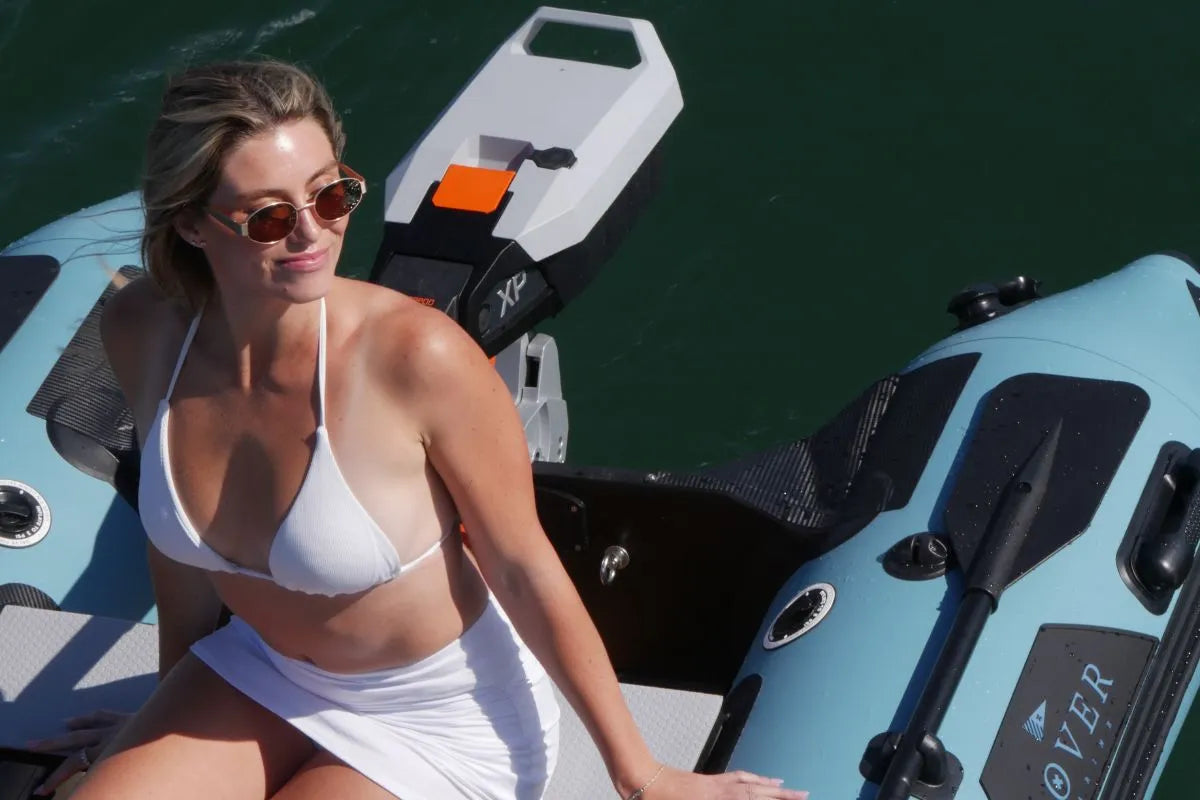
An electric outboard is the better cottage boat motor if you want quiet cruising, simple maintenance, clean lake use, and short-to-medium trips close to shore. Gas still makes sense for long runs, heavier loads, and bigger open water. For inflatable cottage boats like the Rover Marine Battle Boat and Battle Cat, the best choice depends on your boat size, lake rules, range needs, and how you actually use the boat.
Electric outboards have moved from novelty to serious cottage equipment. For many Canadian families, anglers, and lake homeowners, they now make more sense than gas for everyday use.
They are quiet, clean, easy to store, and simple to run. There is no fuel smell in the car, no gas can in the cottage shed, no oil changes, and no loud cold start at the dock.
That does not mean electric is right for every boat or every lake. If you run long distances, carry heavy loads, or cross big open water, gas may still be the better tool. This guide breaks down the honest choice for Canadian cottage boaters.
Canadian Board Co. is a Canadian owned and operated shop based in Kelowna, BC. We carry inflatable boats, electric outboards, and the gear that helps customers build clean, portable lake setups.

The right motor should match your boat size, lake rules, range needs, and how far you actually travel.
The short answer: electric or gas outboard?
Use the decision below as your starting point.
You want quiet cottage use
- You cruise close to the cottage
- You fish or troll quietly
- You want low maintenance
- You dislike fuel smell and gas cans
- Your lake restricts gas motors
- You use an inflatable boat for short-to-medium trips
You need range and power
- You run long distances
- You cross bigger open water
- You carry heavier loads often
- You need higher sustained speed
- You are comfortable with fuel and maintenance
- Your lake allows gas motors
Simple rule: electric is best for quiet cottage cruising, fishing, tenders, short trips, and gas-restricted lakes. Gas is best for longer runs, bigger water, heavier loads, and higher sustained speed.
Why electric outboards suit cottage life
Cottage boating is often different from big-water boating. Many families are not running 20 km across a large lake. They are heading to a swim spot, visiting a neighbour, fishing a calm bay, taking kids for a ride, or moving quietly around the shoreline.
That is where electric outboards make the most sense.
They are quiet
The first thing most people notice is the sound. An electric outboard does not roar like a gas motor. It hums quietly, which changes the feel of the whole boat ride.
That matters when you are leaving early to fish, cruising past cottages, talking with passengers, or trying to keep the lake calm and peaceful.
They are clean
There is no fuel to haul, no fumes in the car, no gas can sitting at the cottage, and no oily smell around the boat. For families who care about the lake, that is a major advantage.
They are low maintenance
Electric outboards have fewer maintenance tasks than gas motors. You do not have a carburetor, oil changes, spark plugs, stale fuel, or fuel system winterizing in the same way.
You still need to care for the battery, keep connections clean, rinse as needed, and follow the manufacturer’s storage guidance, but the ownership experience is much simpler.
They work well on many smaller lakes
Many cottage trips are short. If your typical run is from the dock to a fishing spot, across a bay, or around a sheltered lake, electric can cover the use case comfortably when matched properly.
Range depends on how you use it
Battery range depends on motor size, boat size, total load, wind, water conditions, speed, and battery capacity. Slow cruising and trolling use much less power than running at full throttle.
Where gas outboards still win
Gas is not going away for every use case. If your cottage boating is more demanding, gas may still be the practical choice.
Gas outboards still make sense when you need:
- Longer distance between refuels
- Higher top speed
- More sustained power
- Better performance with heavy loads
- Long runs on big open water
- Easy refuelling in remote areas where charging is limited
For a small cottage lake, electric may feel perfect. For a big windy lake where you regularly run far with passengers and gear, gas may still be the better tool.
Electric outboard vs gas outboard: practical comparison
Electric is quieter
Best for fishing, early mornings, cottage neighbours, calm cruising, and relaxed family rides.
Gas is louder
Better when noise is less important than speed, range, or power.
Electric is simpler
No fuel system, oil changes, or carburetor winterizing. Battery care still matters.
Gas takes more upkeep
Gas motors need fuel management, engine care, maintenance, and proper seasonal storage.
Electric depends on battery
Great for short-to-medium runs, trolling, tenders, and cottage cruising when sized properly.
Gas is better for long distance
Still the stronger choice when you need long range and quick refuelling.
Electric may be allowed where gas is restricted
Many lake rules are specific to gas engines, but always check the rules for the exact lake.
Gas rules vary
Some lakes restrict gas motors, horsepower, wake, speed, or motor use in certain areas.
Matching an electric outboard to a Rover Marine boat
The motor should match the boat, not the other way around. The boat size, rated power, total load, and expected distance all matter.
Rover Marine Battle Boat and Battle Cat models are available in multiple sizes. The live CBC boats collection lists the current size path as 8 ft, 10 ft, and 12 ft, with max power ratings that increase by size. Always confirm the live product page before choosing a motor.
Rover Marine Battle Boat
Best for customers who want a traditional inflatable boat feel with electric or gas motor compatibility, cottage cruising, fishing, tender use, and general lake exploring.
- Classic inflatable boat layout
- Good all-around cottage boat
- Electric or gas outboard ready
- Available in 8 ft, 10 ft, and 12 ft sizes
Rover Marine Battle Cat
Best for customers who want a stable catamaran-style inflatable boat for fishing, family cruising, cottage lake use, and a more planted feel on the water.
- Twin-pontoon catamaran layout
- Strong stability for fishing
- Electric or gas outboard ready
- Available in 8 ft, 10 ft, and 12 ft sizes
Check the live specs before buying a motor
Boat size, motor rating, package details, and compatible motor recommendations can change. Confirm the live product page or call 1-800-399-5260 before matching an electric outboard to a boat.
Which boat size makes sense for electric?
Electric outboards can work across different inflatable boat sizes, but the right setup depends on the total load and expected range.
Best for compact cottage use
Good for solo use, short runs, light gear, calm water, and customers who care most about portability.
Best all-around size
Good for two-person use, fishing, family cottage cruising, and customers who want more room without going too large.
Best for more load and space
Good for more people, more gear, longer days, and customers who want higher capacity from the inflatable boat platform.
Match range to real use
A quiet short cruise needs less battery than trolling all afternoon or running back and forth across a windy lake.
Electric outboards for fishing
Fishing is one of the strongest reasons to choose electric. A quiet motor helps you move without the noise and vibration of a gas outboard. It also makes trolling and positioning feel simpler on smaller lakes.
Electric is a strong fishing fit if you:
- Fish calm cottage lakes
- Troll at slower speeds
- Want quiet movement around bays and shorelines
- Do not need long, fast runs
- Prefer simple setup and low maintenance
For the most stable fishing platform, the Battle Cat is usually the better Rover Marine choice because of its catamaran-style layout. For a more classic small-boat feel, choose the Battle Boat.
Read the inflatable fishing boat guide here: https://www.canadianboardco.com/blogs/water-sports-guide/inflatable-fishing-boats-canada.
Canadian lake rules and electric motors
Lake rules vary. Some lakes restrict gas motors. Some restrict horsepower. Some have speed limits, no-wake rules, conservation restrictions, or local association guidelines. Electric motors may be allowed in places where gas motors are not, but you still need to check the specific lake before launching.
Also remember that adding a motor changes the rules for your boat. Even a small electric motor means you are operating a powered pleasure craft, and you need to follow the applicable Transport Canada requirements.
Before launching, check:
- Whether gas motors are allowed on your lake
- Whether electric motors are allowed
- Horsepower or kilowatt restrictions
- Speed and no-wake rules
- Proof of competency requirements
- Pleasure craft licence requirements based on motor power
- Required safety gear for your boat and use
Boating rule reminder: in Canada, operators of power-driven pleasure craft need proof of competency, with the Pleasure Craft Operator Card being the most common. Also check whether your motor power triggers pleasure craft licence requirements.
Browse water safety gear here: https://www.canadianboardco.com/collections/water-safety.
Browse boating accessories here: https://www.canadianboardco.com/collections/boating-accessories.
What electric outboard owners should plan for
Electric motors are simple, but they still need planning. The biggest thing is battery management.
Think through:
- Where you will charge the battery
- How far you travel on a normal trip
- How much weight the boat carries
- Whether you often run into wind
- Whether you need a backup paddle or oars
- How you will store the motor and battery between trips
For many cottage users, this is easy. Charge at the cottage, run short trips, return to the dock, and repeat. For remote lake use or longer fishing days, plan more carefully.
When a paddleboard is still the better choice
Not every cottage trip needs a motor. If you only want quiet movement close to shore, a POP Board Co paddleboard may be simpler, lighter, and easier to store than a boat and outboard setup.
11'6 El Capitan Bomber
Best for stability, family paddling, dogs, light fishing, and customers who want a simple cottage board without adding a motor.
- Wide stable platform
- Great first board
- Good for families and dogs
- No motor, battery, or fuel planning
11'0 Yacht Hopper
Best for calm-water cruising, solo paddling, cottage exploring, and customers who want a lighter recreational board.
- Easy solo cottage cruiser
- Lighter recreational feel
- Good for calm lakes
- Simple board-only setup
Boat or board? Choose an electric outboard setup when you want powered range, passengers, fishing gear, or tender use. Choose a POP Board Co paddleboard when you want the simplest quiet lake setup.
Best electric outboard buyer
An electric outboard is the right fit if you want a cleaner, quieter, lower-maintenance cottage boat setup and your trips are within the range of the motor and battery you choose.
You are probably a good electric outboard buyer if:
- You cruise close to the cottage
- You fish or troll quietly
- You want less maintenance than gas
- You want to avoid fuel storage
- You use a portable inflatable boat
- You have reliable charging access
- You paddle or boat on lakes with gas restrictions
Who should stay with gas?
Gas may still be better if your trips demand more sustained power, faster travel, or longer range than your electric setup can comfortably provide.
Gas may make more sense if:
- You run far across big lakes
- You carry heavy loads often
- You need higher speed
- You do not have reliable charging access
- Your lake allows gas motors
- You already know how to maintain and store a gas outboard
The bottom line
You do not need an electric outboard for every cottage boat. But for many Canadian lake setups, it is the cleaner, quieter, simpler choice.
Choose electric if you want quiet cruising, fishing, short-to-medium trips, simple maintenance, and clean cottage use. Choose gas if you need long distance, heavier loads, higher sustained speed, or big-water range.
For inflatable boat owners, match the motor to the boat size, total load, and how far you actually travel. The Rover Marine Battle Boat is the classic inflatable boat choice. The Rover Marine Battle Cat is the more stable catamaran-style option for fishing and family lake days.
Browse electric outboard motors here: https://www.canadianboardco.com/collections/electric-outboard-motors.
Browse inflatable boats here: https://www.canadianboardco.com/collections/boats.
Shop the Battle Boat here: https://www.canadianboardco.com/products/rover-marine-battle-boat-inflatable-boat.
Shop the Battle Cat here: https://www.canadianboardco.com/products/rover-marine-battle-cat-inflatable-catamaran.
Browse boating accessories here: https://www.canadianboardco.com/collections/boating-accessories.
Browse water safety gear here: https://www.canadianboardco.com/collections/water-safety.
Shop the El Capitan Bomber here: https://www.canadianboardco.com/products/116-el-capitan.
Shop the Yacht Hopper here: https://www.canadianboardco.com/products/110-yacht-hopper-teak-blue-mint-2024.
Read the inflatable fishing boat guide here: https://www.canadianboardco.com/blogs/water-sports-guide/inflatable-fishing-boats-canada.
Warranty details are here: https://www.canadianboardco.com/pages/3-year-warranty.
Call 1-800-399-5260 if you want help matching an electric outboard to your Battle Boat, Battle Cat, cottage lake, fishing style, range needs, or storage setup.
FAQ
Is an electric outboard powerful enough for a cottage boat?
For many cottage boats, yes. Electric outboards are well suited for quiet cruising, fishing, tenders, and short-to-medium lake trips when the motor and battery are matched properly to the boat and load.
Is electric better than gas for a cottage boat?
Electric is better for quiet operation, low maintenance, clean use, short trips, and gas-restricted lakes. Gas is better for longer runs, higher sustained speed, heavier loads, and big open water.
Can I use an electric outboard on a Rover Marine Battle Boat?
Yes. The Battle Boat is designed for electric or gas outboards based on the size rating. Check the live product page or call 1-800-399-5260 before choosing a motor.
Can I use an electric outboard on a Rover Marine Battle Cat?
Yes. The Battle Cat can be paired with electric or gas outboards based on the size rating. It is also a strong choice for anglers who want more stability from the catamaran-style layout.
Are electric outboards allowed where gas motors are banned?
Often, but not always. Some lakes restrict gas engines specifically, while others may restrict all motors, horsepower, speed, or powered craft. Always check the rules for the specific lake before launching.
Do I need a Pleasure Craft Operator Card for an electric outboard?
In Canada, operators of power-driven pleasure craft need proof of competency, with the Pleasure Craft Operator Card being the most common. This can apply even when the motor is electric.
How long does an electric outboard battery last?
Battery life depends on motor size, battery capacity, boat load, water conditions, wind, and speed. Slow cruising and trolling use much less power than full-throttle operation.
What is better for fishing, electric or gas?
Electric is usually better for quiet fishing, trolling, and smaller cottage lakes. Gas is better if you need longer range, higher speed, or more power on bigger water.

Leave a comment
All comments are moderated before being published.
This site is protected by hCaptcha and the hCaptcha Privacy Policy and Terms of Service apply.