
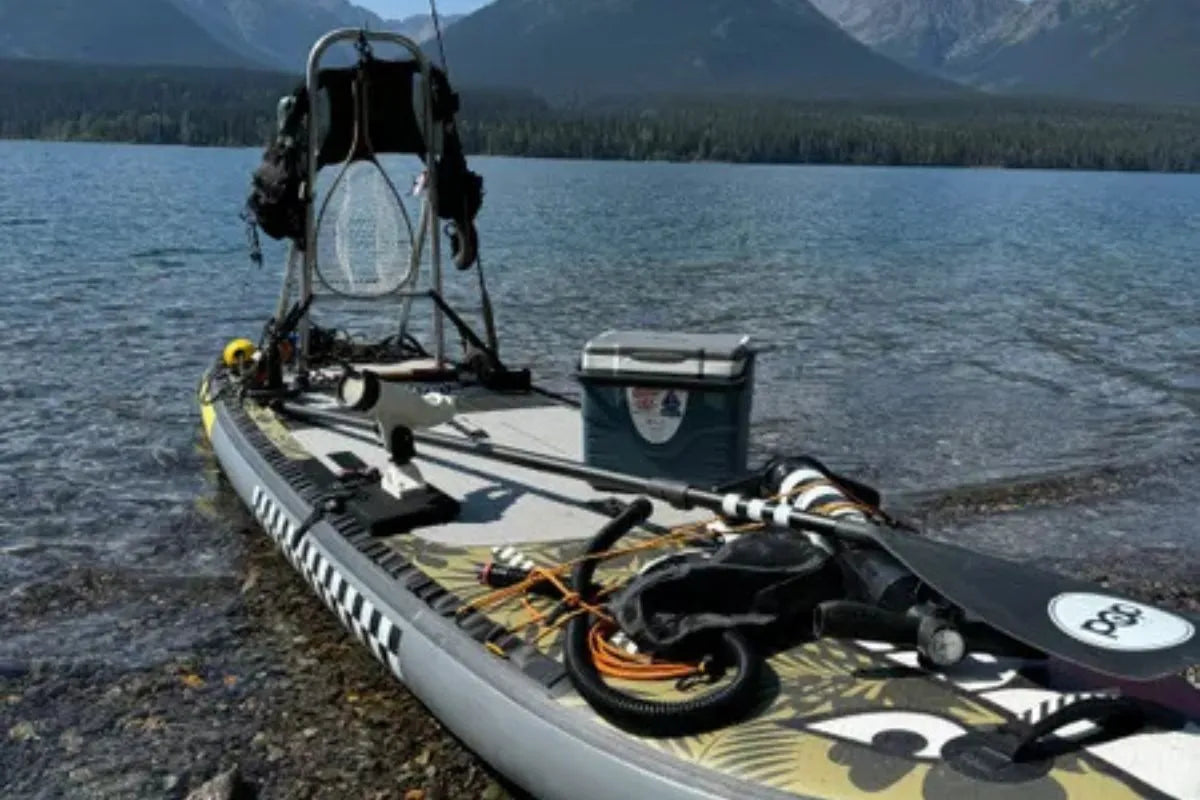
For most Canadian cottage and lake paddlers, a quality inflatable paddleboard is the better choice. Hard boards still make sense for dedicated racing, surf, and performance training, but inflatables win for storage, travel, rocky shorelines, family use, and the long Canadian off-season.
The inflatable versus hard paddleboard debate used to be simple. Hard boards were stiff and fast. Inflatable boards were soft, slow, and mostly treated like beginner toys.
That is no longer the case. Modern inflatable paddleboards use drop-stitch construction, high-pressure inflation, reinforced PVC, and complete travel-ready packages that make them practical for real cottage, lake, and family use.
Canadian Board Co. is a Canadian owned and operated shop based in Kelowna, BC. We sell inflatable paddleboards because they fit the way most Canadians actually paddle: seasonal use, cottage weekends, road trips, limited storage, rocky launches, family sharing, and a lot of carrying gear from the car to the lake.
Here is the honest comparison.

For most cottage paddlers, portability and stability matter more than top-end race speed.
Inflatable vs hard paddleboard, side by side
| Factor | Inflatable Paddleboard | Hard Paddleboard |
|---|---|---|
| Storage | Deflates, rolls into a carry bag, and stores in a closet, basement, condo, vehicle, or cottage storage room. | Needs full-length wall, garage, dock, shed, or rafter storage year-round. |
| Transport | Fits in most vehicles without a roof rack. | Usually needs roof racks, straps, and careful loading. |
| Durability | Handles bumps against docks, rocks, and gravel launches well when used properly. | Can ding, crack, or chip on impact. |
| Performance | Excellent for recreational paddling, touring, cottage use, families, and fishing. | Still has an edge for racing, surf, and high-performance paddling. |
| Beginner friendliness | Wide inflatable boards are forgiving, stable, and comfortable to fall on. | Can be stable if wide, but harder impacts and transport make them less forgiving. |
| Canadian off-season | Easy to deflate and store for winter. | Takes up full board length all year. |
| Best use | Cottages, families, dogs, travel, road trips, beginners, rocky lakes, and limited storage. | Racing, surf, performance training, and permanent waterfront storage. |
Where inflatable paddleboards clearly win
Storage through the Canadian winter
For most Canadians, paddling season is only part of the year. That means the board needs to live somewhere from fall through spring.
A hard board takes up full-length storage year-round. That may work if you have a large garage, boathouse, shed, or permanent waterfront property. It does not work as well for condos, apartments, townhomes, packed garages, or cottages already full of winter gear.
An inflatable paddleboard deflates, rolls into a carry bag, and stores away cleanly. For a lot of Canadian paddlers, that alone makes the decision.
Getting to different lakes
Many of the best paddling spots in Canada do not have perfect access. A small beach, rocky launch, gravel shoulder, cottage path, or walk-in lake is much easier with an inflatable in a carry bag than a hard board on a roof rack.
If you paddle different lakes, rent cottages, visit friends, road trip, or move between home and the cottage, inflatables are simply easier to live with.
Rocky cottage shorelines
Canadian lakes are not always soft sand. Muskoka, the Canadian Shield, the Okanagan, parts of Quebec, and many cottage regions have rocky entries, gravel launches, wooden docks, and uneven shorelines.
A quality inflatable handles those real-world touches better than many people expect. You should still avoid dragging any board over sharp rocks, but an inflatable is more forgiving around docks, shorelines, and family use.
Simple rule: if your board will be carried, packed, loaned to guests, stored over winter, used by kids, or launched from rocky cottage shorelines, inflatable is usually the practical choice.
Where hard boards still make sense
This is not a fake comparison. Hard boards still have a place.
A hard paddleboard can be the better choice if you are focused on:
- Competitive racing
- Dedicated ocean surf
- Performance training
- Maximum glide in perfect conditions
- Permanent waterfront storage where transport is not an issue
If you store the board beside the water all season, never travel with it, never need to fit it in a vehicle, and care most about performance, a hard board can make sense.
For most Canadian cottage and lake paddlers, those are not the real priorities. Most people want the board that is easy to store, easy to carry, stable enough for guests, and ready for lake weekends.
Are inflatable paddleboards rigid enough?
Yes, when they are properly built and properly inflated. The soft, bouncy inflatable boards people remember are usually cheap boards, under-inflated boards, or older construction.
Modern drop-stitch inflatable paddleboards are built with thousands of internal threads that hold the board’s shape as pressure increases. When inflated to the recommended PSI, a quality inflatable feels firm underfoot and performs well for recreational paddling.
Most Canadian Board Co. inflatable paddleboards ride best in the 12 to 15 PSI range. Correct pressure matters. A board that is under-inflated will feel soft, unstable, and slow, even if the size is right.
Do not judge an inflatable board under-inflated
If a board is only halfway inflated, it will feel flexy and unstable. Inflate to the recommended PSI before deciding how the board actually performs.
Which is better for beginners?
For most beginners, an inflatable paddleboard is the better choice. A wide inflatable board is stable, forgiving, easier to transport, and easier to store after the first season.
Beginners rarely benefit from the small performance edge of a hard board. They benefit from stability, confidence, and not needing a complicated transport setup before every paddle.
A beginner-friendly inflatable should be:
- At least 34" wide for most adults
- Wide enough to feel stable in calm water
- Built with drop-stitch construction
- Inflated to the recommended PSI
- Sold as a complete kit with paddle, leash, fin, pump, and bag
Which is better for families, dogs, and cottage guests?
Inflatables are usually better for families because they are easier to share and more forgiving when people are learning.
At a cottage, the board is rarely used by only one person. Dad uses it in the morning, kids climb on it after lunch, guests try it for the first time, the dog walks across the deck pad, and someone eventually bumps it into the dock.
That is exactly where a stable inflatable shines.
- For kids: softer deck, stable platform, easier learning curve.
- For dogs: a wide inflatable gives more room and stability.
- For guests: easier to stand on and less intimidating.
- For cottage storage: rolls away when the weekend is over.
Best inflatable paddleboards for Canadian cottages
11'6 El Capitan Bomber
Best for beginners, families, larger riders, dogs, kids, and anyone who wants maximum stability.
- 11'6" length
- 36" width
- 420 lb capacity
- Stable all-around platform
- Great cottage board
11'0 Yacht Hopper
Best for recreational paddlers who want a lighter, more responsive board for calm-water cruising.
- 11'0" length
- 32" width
- More agile feel
- Good solo board
- Easy cottage cruiser
Ionic Adventure Ark
Best for paddlers who want stability plus attachment points for gear, fishing accessories, cameras, or longer lake days.
- 11'6" length
- 36" width
- 425 lb capacity
- Extra D-rings
- Scotty mount
Cost of ownership: what people forget
The purchase price is only part of the comparison. Hard boards can add extra ownership costs that people do not always think about before buying.
| Ownership Cost | Inflatable Paddleboard | Hard Paddleboard |
|---|---|---|
| Vehicle setup | Usually fits inside the vehicle. | Often needs roof racks and tie-down straps. |
| Storage setup | Stores in bag, closet, basement, or cottage storage room. | May need wall racks, ceiling racks, or boathouse space. |
| Accessory package | Many inflatable packages include paddle, pump, fin, leash, bag, and repair kit. | Some hard boards are sold board-only or require more add-ons. |
| Travel flexibility | Easy to bring on road trips and cottage rentals. | Harder to travel with unless vehicle setup is ready. |
| Damage risk | More forgiving around bumps and drops. | Dings and cracks can require more involved repair. |
Which is easier to maintain?
Both board types need care. The maintenance is just different.
For an inflatable paddleboard:
- Rinse after use, especially after dirty or sandy water.
- Let the board dry before packing for storage.
- Store out of direct sun when not in use.
- Do not leave it over-pressurized in extreme heat.
- Check the valve, fin box, leash, and deck pad regularly.
For a hard paddleboard:
- Check for dings, cracks, or soft spots after impacts.
- Repair damage before water gets into the core.
- Use a board bag during transport.
- Store carefully so it does not fall or get crushed.
- Protect it from long-term UV exposure.
For seasonal cottage use: inflatables are easier for most families because they pack away cleanly after the weekend and do not require dedicated full-length storage all winter.
Which board is better for travel and cottage rentals?
Inflatable wins clearly here. If you rent cottages, visit friends, road trip between lakes, or want one board that can go anywhere, a hard board becomes a transport problem quickly.
An inflatable board lets you keep the water setup flexible. You can bring it to an Airbnb cottage, a public lake, a family cabin, a weekend road trip, or a smaller launch point where roof-rack unloading would be a hassle.
For renters and road trippers, pair the board with an electric pump, PFD, dry bag, and basic accessories.
Browse pumps here: https://www.canadianboardco.com/collections/pumps.
Browse paddleboard accessories here: https://www.canadianboardco.com/collections/paddle-board-accessories.
When should you choose a hard paddleboard?
Choose a hard paddleboard if you already know you need its specific performance advantages.
- You race or train for speed.
- You surf regularly and want sharper carving.
- You have permanent waterfront storage.
- You do not need to travel with the board.
- You are an experienced paddler who prioritizes performance over convenience.
If that does not sound like your use case, an inflatable is likely the better fit.
When should you choose an inflatable paddleboard?
Choose an inflatable paddleboard if you want the board that fits real Canadian life.
- You paddle at a cottage.
- You have limited storage.
- You drive to different lakes.
- You want to bring the board on trips.
- You are buying for a family.
- You want one board guests can use.
- You paddle around rocky shorelines.
- You want a complete package in one purchase.

The biggest advantage of an inflatable is simple: it goes where you go.
The bottom line
Hard boards still have a role for racing, surf, and performance paddlers. But for most Canadian cottage and lake paddlers, a quality inflatable paddleboard is the better choice.
It stores easier, travels easier, handles rocky shorelines better, works for families, and makes more sense for the Canadian off-season.
If you want maximum stability, choose the 11'6 El Capitan Bomber. If you want a lighter recreational board, choose the 11'0 Yacht Hopper. If you want gear attachment points for longer days, touring, or adventure paddling, choose the Ionic Adventure Ark.
Browse inflatable paddleboards here: https://www.canadianboardco.com/collections/inflatable-paddleboards-canadas-best-isup.
Browse water safety gear here: https://www.canadianboardco.com/collections/water-safety.
Browse electric pumps here: https://www.canadianboardco.com/collections/pumps.
Browse paddleboard accessories here: https://www.canadianboardco.com/collections/paddle-board-accessories.
Read the paddleboard sizing guide here: https://www.canadianboardco.com/blogs/water-sports-guide/what-size-paddleboard-do-i-need-canada.
Boards are backed by the 60-Day Rider's Guarantee: https://www.canadianboardco.com/pages/60-day-riders-guarantee.
Warranty details are here: https://www.canadianboardco.com/pages/3-year-warranty.
Call 1-800-399-5260 if you want help choosing between inflatable and hard-board style performance for your lake, cottage, family, storage space, or paddling style.
FAQ
Are inflatable paddleboards as good as hard boards?
For most recreational paddling, yes. A quality inflatable paddleboard is stable, rigid when properly inflated, easy to transport, and much easier to store. Hard boards still have an edge for racing and dedicated surf.
Are inflatable paddleboards good for beginners?
Yes. Wide inflatable paddleboards are excellent for beginners because they are stable, forgiving, easier to carry, and easier to store than hard boards.
Do inflatable paddleboards pop easily?
No, quality inflatable paddleboards are built for real use. You should still avoid dragging them over sharp rocks or leaving them in extreme heat, but they are much tougher than many first-time buyers expect.
Are hard paddleboards faster than inflatable paddleboards?
Hard boards can be faster, especially for racing and performance paddling. For most cottage paddlers, the speed difference is less important than storage, transport, and stability.
Which is better for a Canadian cottage?
An inflatable paddleboard is usually better for a cottage because it stores easily, handles rocky launches better, travels well, and can be shared by different family members and guests.
Can I leave an inflatable paddleboard inflated all summer?
You can leave it inflated during the season if it is stored out of harsh direct sun and checked regularly, but for long-term storage it is better to clean, dry, deflate, and pack it properly.
Which paddleboard is better for dogs?
A wide inflatable paddleboard is usually better for dogs because it gives more stability and a softer deck. Choose a board with enough capacity for you and the dog together.
Which paddleboard lasts longer?
Both can last for years with proper care. Hard boards need protection from dings and cracks. Inflatable boards need proper inflation, cleaning, drying, and storage away from extreme heat and UV.


Leave a comment
All comments are moderated before being published.
This site is protected by hCaptcha and the hCaptcha Privacy Policy and Terms of Service apply.