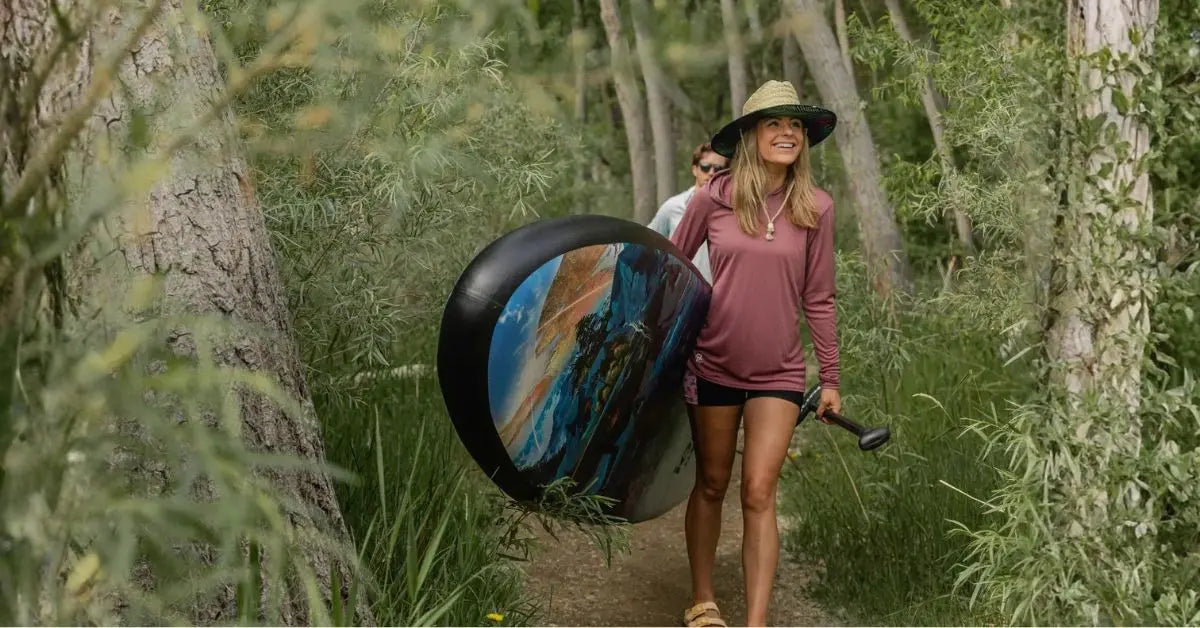
The best inflatable paddle board for Canadian adventurers depends on how you actually paddle. Beginners and families usually need stability first. Solo lake paddlers often want an easy all-around cruiser. Dog owners need a steadier platform. Gear-heavy paddlers and anglers need more room, tie-downs, and control.
Inflatable paddle board reviews are most useful when they connect the board to real Canadian use. A board that works well on a calm Ontario cottage lake may not be the same board you would choose for fishing, dog paddling, coastal chop, shallow rivers, or a compact road trip setup.
That is why this guide focuses less on generic ranking and more on fit. We will look at the boards that make the most sense for beginners, families, dogs, solo cruising, touring-style paddling, and gear-heavy days on the water.
Canadian Board Co. is a Canadian owned and operated shop based in Kelowna, BC. This updated guide reviews inflatable paddle board options for Canadian adventurers and links you to the right board, accessories, safety gear, and related buying guides.

Canadian paddlers need boards that match real conditions: calm lakes, rocky shorelines, cold water, cottage storage, and changing weather.
How to read inflatable paddle board reviews
Before choosing a board, look beyond the name and the colour. The best review questions are practical.
Will it feel steady?
Beginners, larger riders, kids, dogs, and cottage guests usually benefit from a wider, more forgiving platform.
What will you do most?
A board for solo cruising is different from a board for dog paddling, fishing, cottage guests, or gear-heavy touring.
Where will it live?
Inflatable boards make sense for apartments, cabins, RVs, cottage storage, and road trips because they deflate and pack down.
Where will you paddle?
Calm lakes, slow rivers, coastal bays, and rocky launches all change what features matter most.
Do you carry gear?
Dry bags, dogs, coolers, fishing gear, deck rigging, and kayak seats all affect board choice.
Can you get help?
Buying from a Canadian retailer gives you easier product guidance, support, and warranty direction than guessing from a generic listing.
Simple rule: do not buy the board with the longest feature list. Buy the board that fits your rider size, confidence level, water type, storage space, and most common paddling day.
Best stable inflatable paddle board for beginners and families
For beginners, the first priority is stability. A board that feels steady will get used more often because new paddlers can relax instead of fighting the board the entire time.
For families, stability matters even more. Cottage boards often get used by different people in the same weekend: adults, kids, guests, and sometimes dogs. That means the board needs to be forgiving, not overly narrow or twitchy.
11'6 El Capitan Bomber
The El Capitan is the board to start with when stability matters most. It is the stronger fit for beginners, families, larger riders, kids, dogs, and cottage guests.
- Best CBC pick for stability
- Good for beginners and family use
- Better choice for dogs and kids
- Strong cottage guest board
- Good platform for calm lake learning
10'6 Royal Hawaiian Palm
The Royal Hawaiian is a fun all-around option for casual paddlers who want a shorter board feel for calm water, easy cruising, and relaxed lake days.
- Compact 10'6 size
- Good for casual paddling
- Fun all-around feel
- Best for lighter recreational use
- Good complete package option

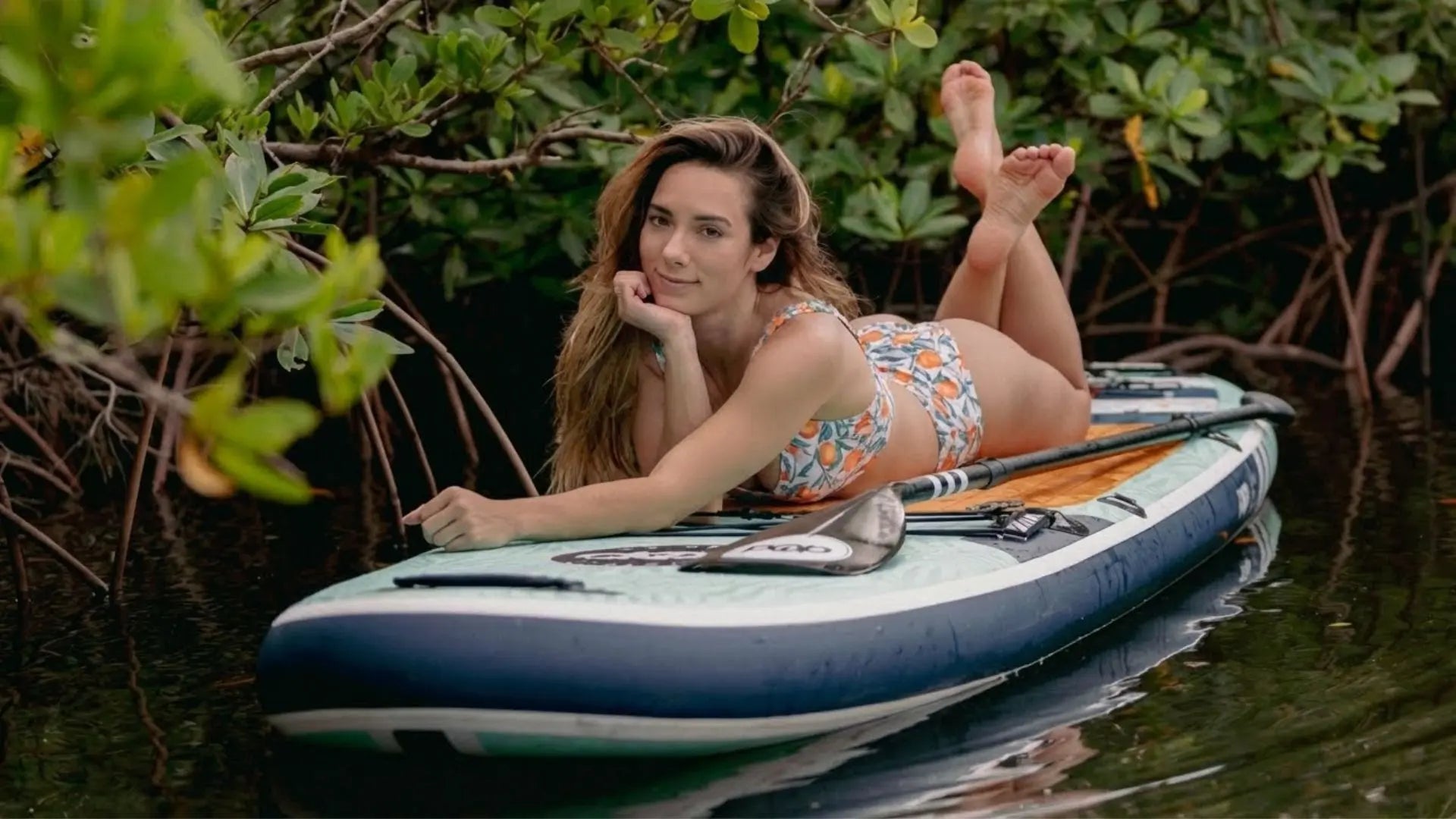
A stable inflatable board is easier for beginners, families, and relaxed lake paddlers to trust.
Best inflatable paddle board for solo lake cruising
If you are not carrying a dog, child, cooler, or heavy fishing setup, you may not need the widest board in the lineup. Many solo paddlers want a board that feels smooth, responsive, and easy to take from lake to lake.
That is where the Yacht Hopper fits well. It is a strong choice for solo cottage cruising, weekend paddles, travel, and calm lake use.
11'0 Yacht Hopper Teak Blue Mint
The Yacht Hopper is a great fit for solo paddlers who want an easy all-around inflatable board for calm lakes, cottages, travel, and recreational cruising.
- Best for solo recreational paddling
- Good cottage and road trip board
- Responsive all-around feel
- Pairs well with an adjustable paddle
11'0 Yacht Hopper Turq Pink Yellow
This Yacht Hopper option gives paddlers the same solo-cruiser category with a brighter POP Board Co. look for lake days, cottages, and travel.
- Great for calm lake paddling
- Good for travel and seasonal storage
- Fun visual style
- Good all-around board for confident beginners

The Yacht Hopper is a strong fit for solo paddlers who want an easy, packable lake board.
Best inflatable paddle board for dogs and kids
Dog paddling and kid-friendly paddling change the review criteria. You are no longer just asking whether the board is fast. You are asking whether it feels steady when someone shifts weight unexpectedly.
For dogs and kids, choose the board that gives you more confidence. A little more stability is usually worth more than a little more speed.
Best CBC pick for dogs and kids: start with the 11'6 El Capitan if the board will be shared with pets, kids, cottage guests, or less confident paddlers.
For dog paddling, add a properly fitted dog life vest, start on calm water, and keep the first few sessions short. For kids, stay close to shore, use active adult supervision, and make PFDs part of the routine.

For dogs and kids, a stable board and proper flotation matter more than top speed.
Read the dog paddleboarding guide here: https://www.canadianboardco.com/blogs/water-sports-guide/paddleboarding-with-your-dog-canada.
Shop dog life vests here: https://www.canadianboardco.com/products/dog-life-vests.
Best board for gear-heavy paddling and fishing
Fishing and gear-heavy paddling need more than a nice-looking board. You need room for dry bags, tackle, a cooler, straps, and accessories without making the board feel awkward.
If your main goal is fishing, long day trips, or carrying more gear, look at a utility-focused board rather than forcing a casual board to do everything.
11'6 Adventure Ark
The Adventure Ark is the better choice for paddlers who care about gear, fishing setups, utility use, and longer days where storage and tie-down points matter.
- Best for gear-heavy paddling
- Good for SUP fishing setups
- Adventure and utility focused
- Good when deck organization matters
11'6 Hook Em Edition
The Hook Em Edition is the board to consider when the blog topic is truly fishing-focused. It is not the first choice for every paddler, but it makes sense for anglers.
- Best for dedicated SUP fishing
- Useful for tackle and fishing accessories
- Fishing-first positioning
- Not necessary for casual lake paddling

Fishing and gear-heavy paddling need stability, storage, tie-downs, and the right accessory setup.
What makes a good inflatable board for Canadian conditions?
Canadian water is not one single environment. A paddler in the Okanagan may care about lake wind and summer storage. A cottage family in Ontario may care about rocky launches and kids. A coastal paddler in BC may care about saltwater rinsing, chop, and transport.
Look for these practical features when comparing inflatable paddle board reviews:
Width and volume
More stability helps beginners, families, dogs, and larger riders. Do not chase speed if confidence is the real goal.
Drop-stitch build
A good drop-stitch inflatable board inflates into a firm platform while still packing down for storage and transport.
Traction pad
A good deck pad helps with footing, kneeling, sitting, dog paws, and casual family use.
Fins and tie-downs
Fin setup affects tracking and shallow-water use. Bungees and D-rings help with dry bags, gear, and day trips.
Packability
A board that stores easily is more realistic for condos, cabins, RVs, garages, and winter storage.
Canadian service
Local support matters when you have product questions, need accessories, or want help matching a board to real water conditions.
What customers notice in real use
Real reviews are useful because they focus on the things specs do not always explain well: stability, setup, portability, support, and whether the board actually gets used.
“Quality, real sturdy.”
That is the kind of feedback new paddlers want to see when choosing a board for real Canadian lake use.
“Easy to inflate, deflate, and pack away.”
Inflatable boards win when they are easy to get from storage to the water and back again.
“They help out right away.”
Support matters when you are choosing between board sizes, paddles, fins, pumps, and safety gear.
Read more Canadian Board Co. customer reviews here: https://www.canadianboardco.com/pages/reviews.
Safety gear for Canadian paddleboarders
Even the most stable inflatable paddle board is still a board on open water. Safety gear matters, especially in Canada where water can stay cold even when the air feels warm.
Transport Canada includes paddleboards under human-powered craft guidance when they are used as a vessel for a trip or circuit. In those cases, required safety equipment applies, and a Canadian-approved lifejacket or PFD should be on board and immediately available. Wearing it is the better habit, especially for beginners, kids, cold water, wind, or paddling away from shore.
Do not let stability replace safety
A stable board helps confidence, but it does not replace a properly fitted Canadian-approved PFD or lifejacket, a sound device, weather awareness, and paddling within your ability.
Shop water safety gear here: https://www.canadianboardco.com/collections/water-safety.

A properly fitted PFD or lifejacket is one of the most important pieces of paddleboard gear for Canadian water.
Beginner checklist before buying
If you are buying your first inflatable paddle board, start with fit and confidence before worrying about every advanced feature.
Pick your main use
Family board, solo cruiser, dog board, fishing setup, cottage guest board, or travel board. Choose based on your real use.
Prioritize stability
New paddlers usually enjoy the water faster when the board feels forgiving and steady.
Check included gear
Look at the pump, paddle, fin, leash, bag, and repair kit so you know what is included and what still needs to be added.
Add safety gear
Choose a properly fitted PFD or lifejacket and build the rest of the kit around where you paddle.
Accessories that make the board better
The right accessories help your board fit your paddling style. Start with safety and paddling basics, then add comfort and storage upgrades.
Upgrade the feel
A better paddle can reduce fatigue and make longer sessions more enjoyable.
Make setup easier
A reliable pump helps you hit proper pressure and get on the water faster.
Carry more
Deck rigging, cup holders, and dry bags help organize day-trip gear.
Paddle with pets
A dog life vest and a stable board make dog paddling safer and easier.
Read the paddleboard accessories guide here: https://www.canadianboardco.com/blogs/water-sports-guide/best-paddleboard-accessories-canada-2026-complete-guide-to-paddles-safety-gear-storage.
Care and storage for Canadian seasons
Inflatable paddle boards are easy to own because they pack down, but they still need a simple care routine.
- Rinse after saltwater, muddy, sandy, or weedy use.
- Dry the board fully before long-term storage.
- Remove the fin before winter storage.
- Store the board in a cool, dry, shaded place.
- Avoid sharp tools, damp concrete, pests, and long direct sun exposure.
- Check PSI, valve, fin box, and seams before each season.
Storage tip: the board that is easy to store is usually the board that gets used more. Clean it, dry it, pack it properly, and keep the pump and fin with the bag.
Which inflatable paddle board should you choose?
Use this simple match-up to narrow the choice.
11'6 El Capitan Bomber
Best for beginners, families, kids, dogs, larger riders, and cottage sharing.
11'0 Yacht Hopper
Best for solo paddlers, calm lake days, travel, and casual cottage cruising.
10'6 Royal Hawaiian Palm
Best for casual paddlers who want a shorter all-around board with a fun lake-day feel.
11'6 Adventure Ark
Best for anglers, utility use, gear-heavy paddling, and organized day trips.
The bottom line
The best inflatable paddle board review is not the one that crowns one board for everyone. It is the one that helps you match the board to your water, rider size, confidence level, storage space, and real use.
Choose the 11'6 El Capitan if stability, beginners, kids, dogs, and cottage sharing matter most.
Choose the 11'0 Yacht Hopper if you want a responsive solo cruiser for calm Canadian lakes and road trips.
Choose the 10'6 Royal Hawaiian Palm if you want a compact all-around board for relaxed recreational paddling.
Choose the 11'6 Adventure Ark or Hook Em Edition if fishing, gear, and utility are the real focus.
Browse inflatable paddleboards here: https://www.canadianboardco.com/collections/inflatable-paddleboards-canadas-best-isup.
Shop paddleboard accessories here: https://www.canadianboardco.com/collections/paddle-board-accessories.
Shop paddles here: https://www.canadianboardco.com/collections/paddles.
Shop water safety gear here: https://www.canadianboardco.com/collections/water-safety.
Read the paddleboard size guide here: https://www.canadianboardco.com/blogs/water-sports-guide/what-size-paddleboard-do-i-need-canada.
Read the inflatable vs hard paddleboard guide here: https://www.canadianboardco.com/blogs/water-sports-guide/inflatable-vs-hard-paddleboard-canada.
Read the dog paddleboarding guide here: https://www.canadianboardco.com/blogs/water-sports-guide/paddleboarding-with-your-dog-canada.
Warranty details are here: https://www.canadianboardco.com/pages/3-year-warranty.
Call 1-800-399-5260 if you want help choosing the right inflatable paddle board for your lake, cottage, family, dog, road trip, or fishing setup.
FAQ
What is the best inflatable paddle board for beginners in Canada?
The El Capitan is the better CBC choice for beginners because it prioritizes stability, confidence, and a forgiving feel on calm lake water.
What inflatable paddle board is best for families?
For families, kids, cottage guests, and shared use, start with the El Capitan. Stability and confidence matter more than top speed for most family lake days.
What inflatable paddle board is best for solo cruising?
The Yacht Hopper is a strong choice for solo lake cruising, weekend paddling, calm water, travel, and recreational use.
What inflatable paddle board is best for dogs?
The El Capitan is usually the better fit for dogs because it gives paddlers a more stable platform. Use a properly fitted dog life vest and start on calm water.
What inflatable paddle board is best for fishing?
For fishing, look at utility-focused options like the Adventure Ark or Hook Em Edition because gear storage, stability, and accessory layout matter more than casual cruising feel.
Are inflatable paddle boards good for Canadian lakes?
Yes. Inflatable paddle boards are a practical choice for Canadian lakes because they are portable, stable, easy to store, and forgiving around cottage shorelines and rocky launches.
Do I need safety gear on an inflatable paddle board in Canada?
Yes. When a paddleboard is used as a human-powered craft for a trip or circuit, Transport Canada safety equipment requirements apply. A properly fitted Canadian-approved lifejacket or PFD is the safest starting point.
How should I store an inflatable paddle board in Canada?
Rinse when needed, dry the board fully, remove the fin, and store it in a cool, dry, shaded place away from sharp objects, pests, and long periods of direct sun.

Leave a comment
All comments are moderated before being published.
This site is protected by hCaptcha and the hCaptcha Privacy Policy and Terms of Service apply.